EasyManua.ls Logo

Philips AC 914 - Page 6

Philips AC 914
42 pages
Print Icon
To Next Page IconTo Next Page
To Previous Page IconTo Previous Page
Loading...
INTRODUCTION
WHY
MCC?
The
high
quality
reception
of
FM
especially
in
stereo
is
the
main
reason
for
FM’s
popularity.
For
the
motorist
however,
the
limited
range
of
most
FM
transmitter
(+
50
kms)
is
a
cause
of
irritation
when
travelling
through
different
transmitter
zones.
In
such
cases
the
motorist
is
forced
to
retune,
to
maintain
reception
of
his
FM
programme,
as
each
transmitter
in
the
network
broadcasts
the
same
FM
station
on
a
different
frequency.
At
high
speed
or
in
traffic
this
retuning
process
could
be
dangerous
as
well
as
frustrating.
Further
more
you
cannot
know
the
frequency
of
the
best
alternative
everywhere
in
the
country.
Tall
buildings,
hills,
etc.
can
also
cause
fading
of
the
signal
with
an
accompanying
loss
in
reception
quality.
The
MCC
system
overcomes
these
problems.
It
is
possible
to
store
up
to
ten
different
frequencies
in
the
computer’s
memory
for
each
of
the
six
FM
programmes
you
may
wish
to
receive.
When
one
of
the
’P’
buttons
is
pressed
the
computer
scans
the
programmed
frequencies
and
locks
onto
the
strongest
signal.
While
you
are
listening
to
the
programme
in
question
the
computer
frequently
checks
on
the
other
programmed
frequencies
and
changes
over
at
the
moment
a
better
alternative
becomes
available.
These
actions
are
carried
out
at
such
a
high
speed
that
they
become
completely
inaudible
in
nearly
all
circumstances.
How
to
programme
MCC
A
series
of
maps
has
been
separately
packed
in
a
bandrol.
For
programming
each
frequency
follow
the
short
programming
instructions
for
MCC
in
the
map
or
consult
chapter
'Programming
the
MCC
system’
in
this
booklet.
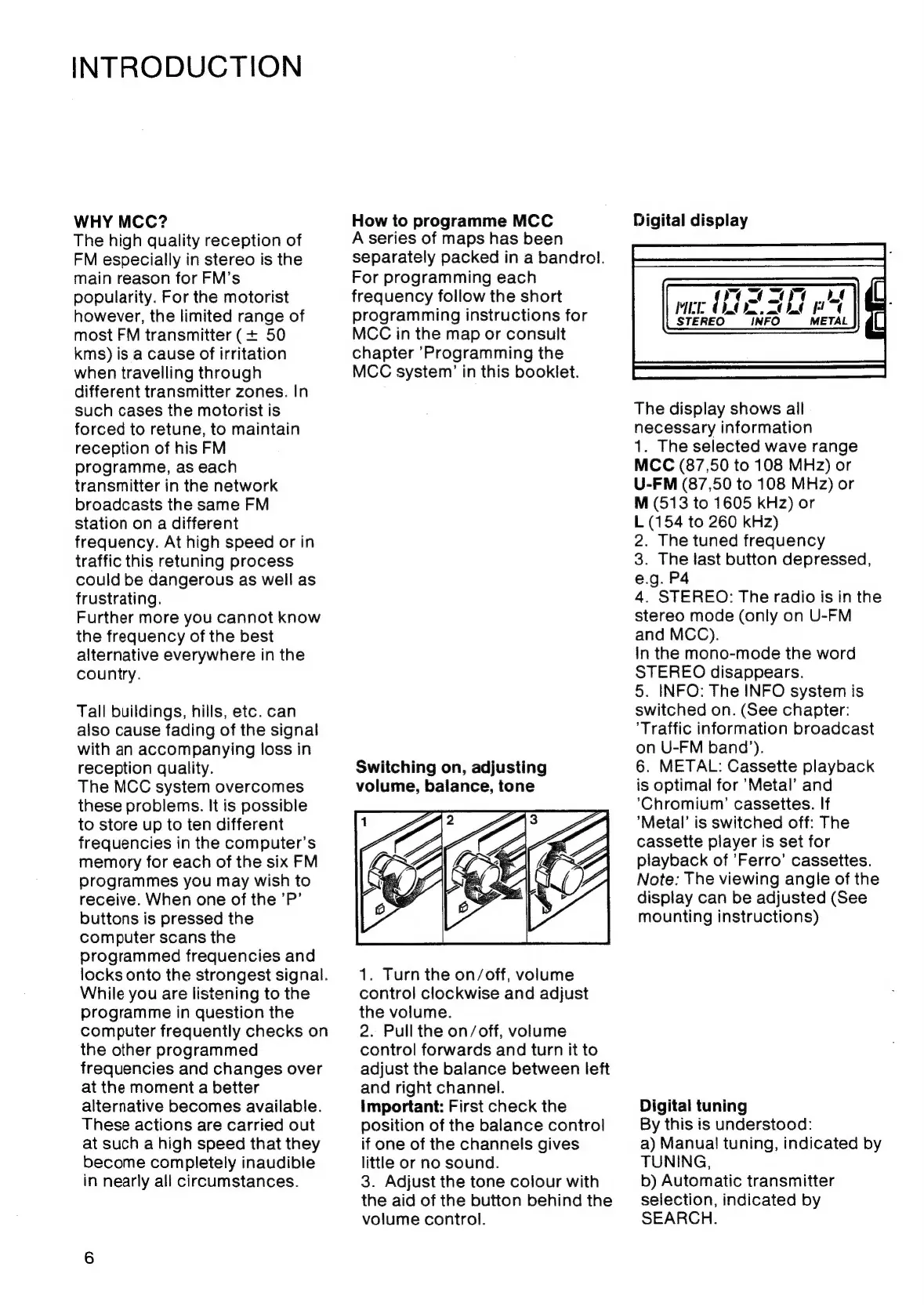
Switching
on,
adjusting
volume,
balance,
tone
1.
Turn
the
on/off,
volume
control
clockwise
and
adjust
the
volume.
2.
Pull
the
on/off,
volume
control
forwards
and
turn
it
to
adjust
the
balance
between
left
and
right
channel.
important:
First
check
the
position
of
the
balance
control
if
one
of
the
channels
gives
little
or
no
sound.
3.
Adjust
the
tone
colour
with
the
aid
of
the
button
behind
the
volume
control.
Digital
display
TI)
pace
GLO
Sd
pe
(
STEREO
INFO
METAL
The
display
shows
ail
necessary
information
1.
The
selected
wave
range
MCC
(87,50
to
108
MHz)
or
U-FM
(87,50
to
108
MHz)
or
M
(513
to
1605 kHz)
or
L
(154
to
260
kHz)
2.
The
tuned
frequency
3.
The
last
button
depressed,
e.g.
P4
4.
STEREO:
The
radio
is
in
the
stereo
mode
(only
on
U-FM
and
MCC).
in
the
mono-mode
the
word
STEREO
disappears.
5.
INFO:
The
INFO
system
is
switched
on.
(See
chapter:
‘Traffic
information
broadcast
on
U-FM
band’).
6.
METAL:
Cassette
playback
is
optimal
for
Metal’
and
‘Chromium’
cassettes.
If
‘Metal’
is
switched
off:
The
cassette
player
is
set
for
playback
of
’Ferro’
cassettes.
Note:
The
viewing
angle
of
the
display
can
be
adjusted
(See
mounting
instructions)
Digital
tuning
By
this
is
understood:
a)
Manual
tuning,
indicated
by
TUNING,
b)
Automatic
transmitter
selection,
indicated
by
SEARCH.

Related product manuals