Need help?
Do you have a question about the Philips FR-984 and is the answer not in the manual?
Instructions for positioning the subwoofer for optimal bass reproduction.
Guide on connecting the subwoofer to the receiver and power.
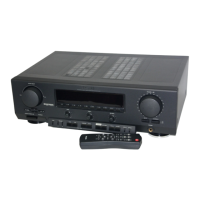
Lists the components included with the receiver.
Instructions for placing the receiver and ensuring proper ventilation.
Information on packaging materials and recycling.
Acknowledgment of Dolby Laboratories and DTS trademarks.
Explains the meaning of various status indicator lights on the receiver.
Visual representation of speaker placement for surround sound.
Explains menu symbols and navigation directions.
Method for finding remote control codes by scanning.
Instructions to reset the remote control to factory defaults.
Explains analogue audio connections and Dolby Digital Laserdisc.
Explains digital audio connections and DTS Digital Surround.
Describes CINEMA LINK system bus for integrated control.
Illustrates video connection options for various devices.
Instructions for mains connection, power handling and safety.
Guide to connecting speakers using screw and click-fit connectors.
How to use a TV as a center speaker via CINEMA LINK.
Instructions for connecting AM and FM antennas.
How connecting headphones affects speaker output.
General guidelines and best practices for speaker placement.
Adjusting speaker volume levels and performing speaker tests.
Setting speaker size and distance for optimal surround sound.
Explains the meaning of various status indicator lights on the receiver.
Visual representation of speaker placement for surround sound.
Explains menu symbols and navigation directions.
Overview of the receiver's menu system and navigation.
Settings for subwoofer, center, and rear speakers presence.
Setting speaker sizes (small/large) for optimal sound reproduction.
Setting speaker distance for surround sound delay time.
Assigning audio inputs to different source selections.
Setup options for radio stations, including auto and manual programming.
Using the TV menu to set up the system via CINEMA LINK.
How to switch CINEMA LINK connection on or off.
Steps to activate CINEMA LINK for system control.
Changing the default audio input for a source selection.
Using 6 CHANNEL/DVD INPUT for multichannel audio sources.
Steps to play audio or video sources.
Adjusting bass, treble, and subwoofer volume.
How to record from connected sources to external devices.
Recording digital audio signals from the receiver's digital output.
Explanation of surround sound and compatible formats like Dolby Digital.
How to switch surround sound modes and virtual surround modes.
Details various surround sound modes like HALL, SURROUND, STEREO.
Explains virtual surround sound and its modes (3D, MULTI, NATURAL).
How to search for and tune to radio stations.
Automatic and manual methods for storing radio stations.
Adjusting tuner sensitivity for better reception.
Selecting and tuning to preset radio stations.
Changing the sequence of stored radio stations.
Assigning names to stored radio stations.
Removing names assigned to radio stations.
Information about Radio Data System and switching RDS information.
Setting up tuner to interrupt playback for news and traffic announcements.
Technical specifications for the receiver's general, tuner, and amplifier sections.
Technical specifications for various input connectors.
Technical specifications for various output connectors.

 To Next Page
 General