EasyManua.ls Logo

Philips PM 6670 - Ratio and Count Measurement Principles; Time Interval Measurement Techniques

Philips PM 6670
21 pages
Print Icon
To Next Page IconTo Next Page
To Previous Page IconTo Previous Page
Loading...
15
The
number
of
cycles
(N)
is:
effective
measuring
time
N
=
period
duration
rounded
to
the
nearest
higher
multiple
of
10
for
frequency
measurements
or
higher
integer
for
period
measurements.
When
the
measuring
time
has
elapsed,
the
micro
computer
calculates
the
measuring
result
with
a
10-digit
resolution.
However,
the
number
of
digits
displayed,
is
limited
only
to
the
significant
digits,
depending
on
the
measuring
resolution.
This
measuring
resolution
is
defined
by
the
input
frequency
and
the
measuring
time.
The
number
of
digits
is
selected
in
such
a
way
that
the
measuring
resolution
is
equal
to
0.2...2
units
of
the
least-significant
digit
(LSD),
where:
LSD
=
2.5
X
Frequency
Measuring
timex
10^Hz
rounded
to
the
nearest
decade.
2.5
X
Period
Measuring
time
x
10'Hz
Ratio
Measurements
The
counter
measures
the
frequency
ratio
between
signals
connected
to
input
A
and
input
B.
The
frequency
range
is
0...10MHz.
To
obtain
full
input
frequency
range
on
PM
6671
...72,
a
ratio
measurement
can
be
done
in
the
FREQ
A
or
C
mode.
Connect
the
signal
with
the
highest
frequency
to
input
A
(0.1H2...120MHz)
and
the
other
signal
to
input
D
set
to
EXT
STD
IN.
The
frequency
range
at
input
D
is
50kHz...
10MHz.
However,
this
arrange
ment
does
not
give
correct
setting
of
the
decimal
point.
The
display
will
indicate
a
frequency.
To
get
the
correct
ratio,
divide
the
displayed
value
by
10'
Hz,
e.g.
when
the
display
shows
215.513MHz,
it
represents
a
ratio
of
21.5513.
A
ratio
measurement
is
useful,
for
instance,
when
calibrating
oscillator
with
an
awkward
frequency.
For
example,
say
that
the
fequency
should
be
4.3625872MHz.
This
is
difficult
to
read
on
the
display.
By
connecting
such
a
reference
signal
to
input
B
and
measuring
the
ratio
instead,
the
oscillator
is
correctly
calibrated
when
the
display
shows
1.0000000,
which
is
much
easier
to
read.
Count
measurements
There
are
three
different
count
modes:
Manual
The
counter
totalizes
events
at
input
A,
during
the
time
interval
between
releasing
and
depressing
the
DISPL
HOLD
pushbutton.
An
event
is
defined
as
a
positive-
going
slope.
Gated
by
B
_l
1_
Start
and
stop
by
B
The
counter
totalizes
events
at
input
A,
between
the
leading
and
trailing
edge
of
the
input
B
signal.
The
counter
totalizes
events
at
input
A,
between
the
start
and
stop
event
at
input
B.
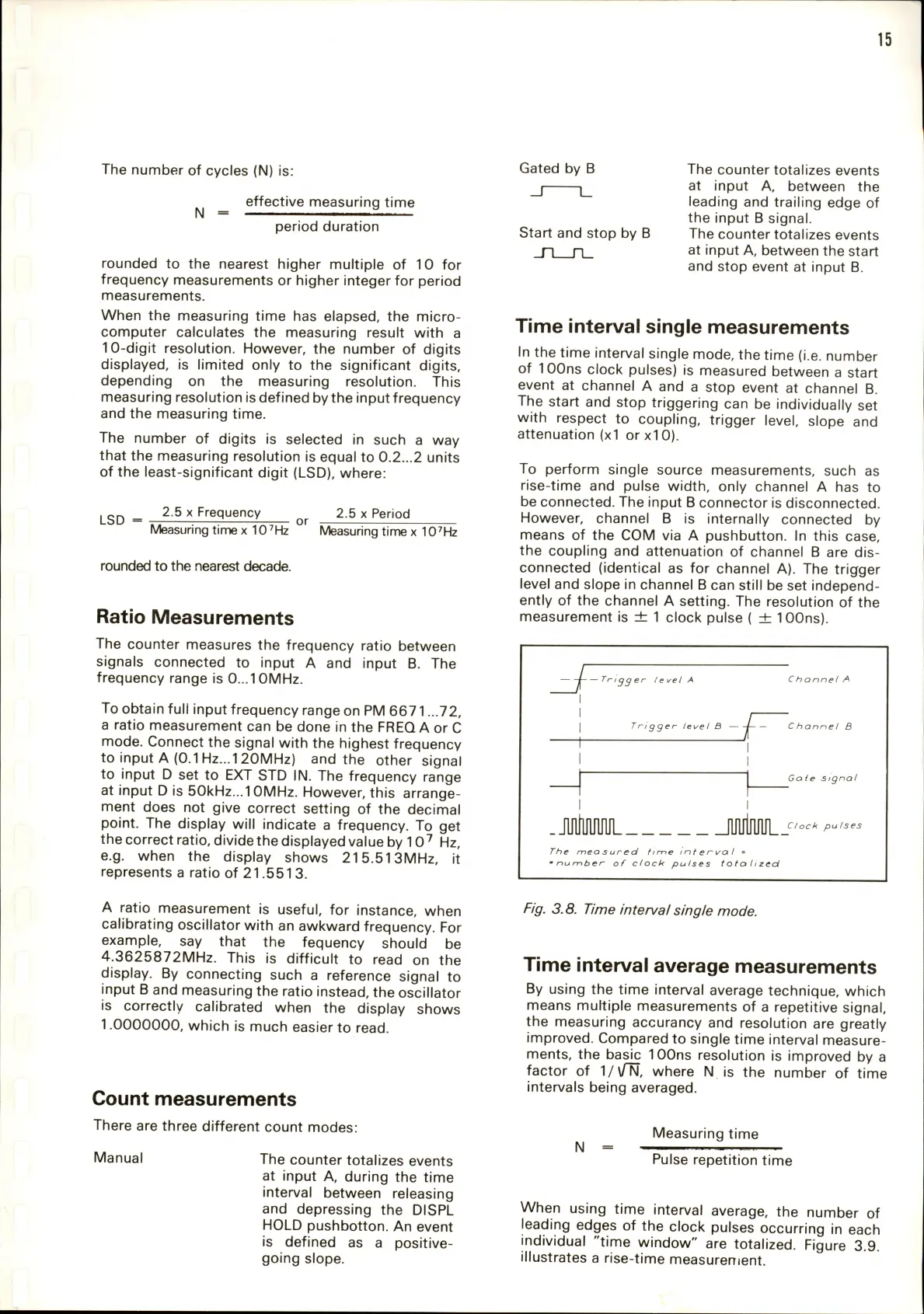
Time
Interval
single
measurements
In
the
time
interval
single
mode,
the
time
(i.e.
number
of
100ns
clock
pulses)
is
measured
between
a
start
event
at
channel
A
and
a
stop
event
at
channel
B.
The
start
and
stop
triggering
can
be
individually
set
with
respect
to
coupling,
trigger
level,
slope
and
attenuation
(x1
orxlO).
To
perform
single
source
measurements,
such
as
rise-time
and
pulse
width,
only
channel
A
has
to
be
connected.
The
input
B
connector
is
disconnected.
However,
channel
B
is
internally
connected
by
means
of
the
COM
via
A
pushbutton.
In
this
case,
the
coupling
and
attenuation
of
channel
B
are
dis
connected
(identical
as
for
channel
A).
The
trigger
level
and
slope
in
channel
B
can
still
be
set
independ
ently
of
the
channel
A
setting.
The
resolution
of
the
measurement
is
±
1
clock
pulse
(
±
100ns).
Trigger
level
A
Channel
A.
Trigger
level
B
4-
C
honnel
B
f
Gale
signal
I
I
.
JUllllUUUl
fUUllUULJ''"''''
The
measured
time
interval
-
'number
of
clock
pulses
totalized
Fig.
3.8.
Time
interval
single
mode.
Time
interval
average
measurements
By
using
the
time
interval
average
technique,
which
means
multiple
measurements
of
a
repetitive
signal,
the
measuring
accurancy
and
resolution
are
greatly
improved.
Compared
to
single
time
interval
measure
ments,
the
basic
100ns
resolution
is
improved
by
a
factor
of
I/iTN,
where
N
is
the
number
of
time
intervals
being
averaged.
N
=
Measuring
time
Pulse
repetition
time
When
using
time
interval
average,
the
number
of
leading
edges
of
the
clock
pulses
occurring
in
each
individual
"time
window"
are
totalized.
Figure
3.9.
illustrates
a
rise-time
measurement.

Related product manuals