EasyManua.ls Logo

Philips PM 6670 - Pulse Width Measurement Technique; Phase Delay Measurement Method

Philips PM 6670
21 pages
Print Icon
To Next Page IconTo Next Page
To Previous Page IconTo Previous Page
Loading...
16
rmjL
/OOns
clock
cycles
!
cou
Measuring
Trigger
let/ei
3
Trigger
level
A
Mam
Gate
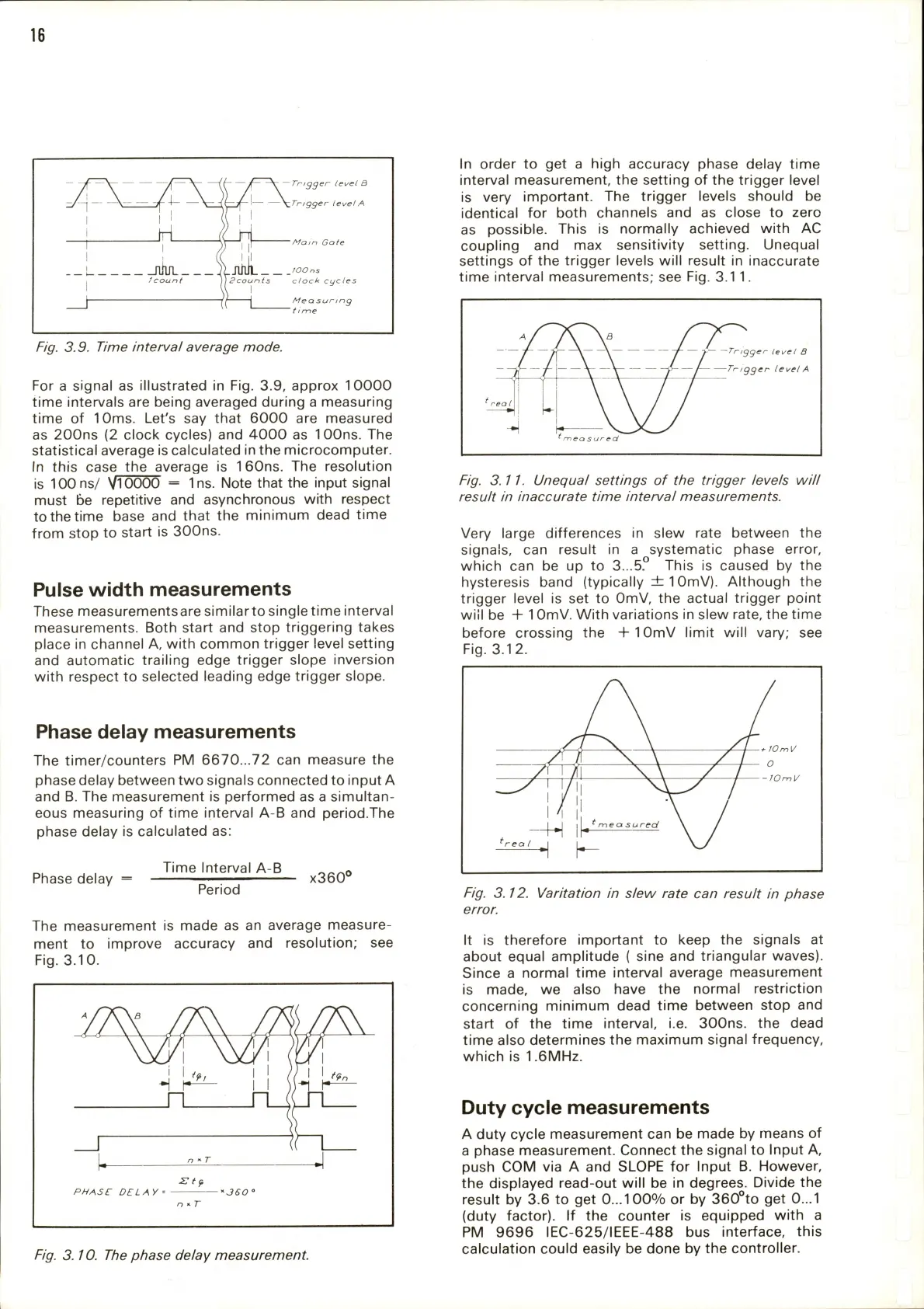
Fig.
3.9.
Time
interval
average
mode.
For
a
signal
as
illustrated
in
Fig.
3.9,
approx
10000
time
intervals
are
being
averaged
during
a
measuring
time
of
10ms.
Let's
say
that
6000
are
measured
as
200ns
(2
clock
cycles)
and
4000
as
100ns.
The
statistical
average
is
calculated
in
the
microcomputer.
In
this
case
the
average
is
1
60ns.
The
resolution
is
100ns/
VI0000
=
Ins.
Note
that
the
input
signal
must
be
repetitive
and
asynchronous
with
respect
to
the
time
base
and
that
the
minimum
dead
time
from
stop
to
start
is
300ns.
Pulse
width
measurements
These
measurementsare
similarto
singletime
interval
measurements.
Both
start
and
stop
triggering
takes
place
in
channel
A,
with
common
trigger
level
setting
and
automatic
trailing
edge
trigger
slope
inversion
with
respect
to
selected
leading
edge
trigger
slope.
Phase
delay
measurements
The
timer/counters
PM
6670...72
can
measure
the
phase
delay
between
two
signals
connected
to
input
A
and
B.
The
measurement
is
performed
as
a
simultan
eous
measuring
of
time
interval
A-B
and
period.The
phase
delay
is
calculated
as:
Phase
delay
=
Time
Interval
A-B
Period
x360°
The
measurement
is
made
as
an
average
measure
ment
to
improve
accuracy
and
resolution;
see
Fig.
3.10.
/7\\
/
\\
A
A
\\
\y/1
w/i
'
1
•'?/
1
1
^
1
1
n
n
_j
—j
PHASC
DELAY
=
"
n^T
In
order
to
get
a
high
accuracy
phase
delay
time
interval
measurement,
the
setting
of
the
trigger
level
is
very
important.
The
trigger
levels
should
be
identical
for
both
channels
and
as
close
to
zero
as
possible.
This
is
normally
achieved
with
AC
coupling
and
max
sensitivity
setting.
Unequal
settings
of
the
trigger
levels
will
result
in
inaccurate
time
interval
measurements;
see
Fig.
3.11.
Trigger
level
B
L
Trigger
level
A
Fig.
3.11.
Unequal
settings
of
the
trigger
levels
will
result
In
inaccurate
time
interval
measurements.
Very
large
differences
in
slew
rate
between
the
signals,
can
result
in
a
systematic
phase
error,
which
can
be
up
to
3...5.°
This
is
caused
by
the
hysteresis
band
(typically
±
10mV).
Although
the
trigger
level
is
set
to
OmV,
the
actual
trigger
point
will
be
+
10mV.
With
variations
in
slew
rate,
the
time
before
crossing
the
-FlOmV
limit
will
vary;
see
Fig.
3.12.
-WmV
Fig.
3.10.
The
phase
delay
measurement.
Fig.
3.12.
Varitation
in
slew
rate
can
result
in
phase
error.
It
is
therefore
important
to
keep
the
signals
at
about
equal
amplitude
(
sine
and
triangular
waves).
Since
a
normal
time
interval
average
measurement
is
made,
we
also
have
the
normal
restriction
concerning
minimum
dead
time
between
stop
and
start
of
the
time
interval,
i.e.
300ns.
the
dead
time
also
determines
the
maximum
signal
frequency,
which
is
1.6MFIz.
Duty
cycle
measurements
A
duty
cycle
measurement
can
be
made
by
means
of
a
phase
measurement.
Connect
the
signal
to
Input
A,
push
COM
via
A
and
SLOPE
for
Input
B.
However,
the
displayed
read-out
will
be
in
degrees.
Divide
the
result
by
3.6
to
get
0...100%
or
by
360°to
get
0...1
(duty
factor).
If
the
counter
is
equipped
with
a
PM
9696
IEC-625/IEEE-488
bus
interface,
this
calculation
could
easily
be
done
by
the
controller.

Related product manuals