EasyManua.ls Logo

Philips PM 6670 - SPECIAL FUNCTIONS; Arming and External Reset Functionality; Burst Frequency Measurement Techniques

Philips PM 6670
21 pages
Print Icon
To Next Page IconTo Next Page
To Previous Page IconTo Previous Page
Loading...
17
SPECIAL
FUNCTIONS
Arming
Arming
enables
the
counter
to
be
prevented
from
starting
on
unwanted
signals.
The
external
ARMING
input
(input
E
on
the
rear
panel)
allows
an
additional
trigger
condition.
When
input
E
is
set
to
high
logic
level
(
>
2V),
the
counter
is
prevented
from
starting
a
new
measurement.
However,
the
counter
makes
all
preparations
for
a
measurement.
When
input
E
returns
to
low
(<
0.5V),
the
measurement
will
start
with
a
minimum
of
delay.
The
delay
is
approx
O.Sps.
Note
that
arming
cannot
be
used
in
the
COUNT
A
manual
mode.
-m
/mp
u
{
E
—n
'
^
le
s
IMlt-
Burst
to
be
^
10
«
-
»
iiil/il
lliilii
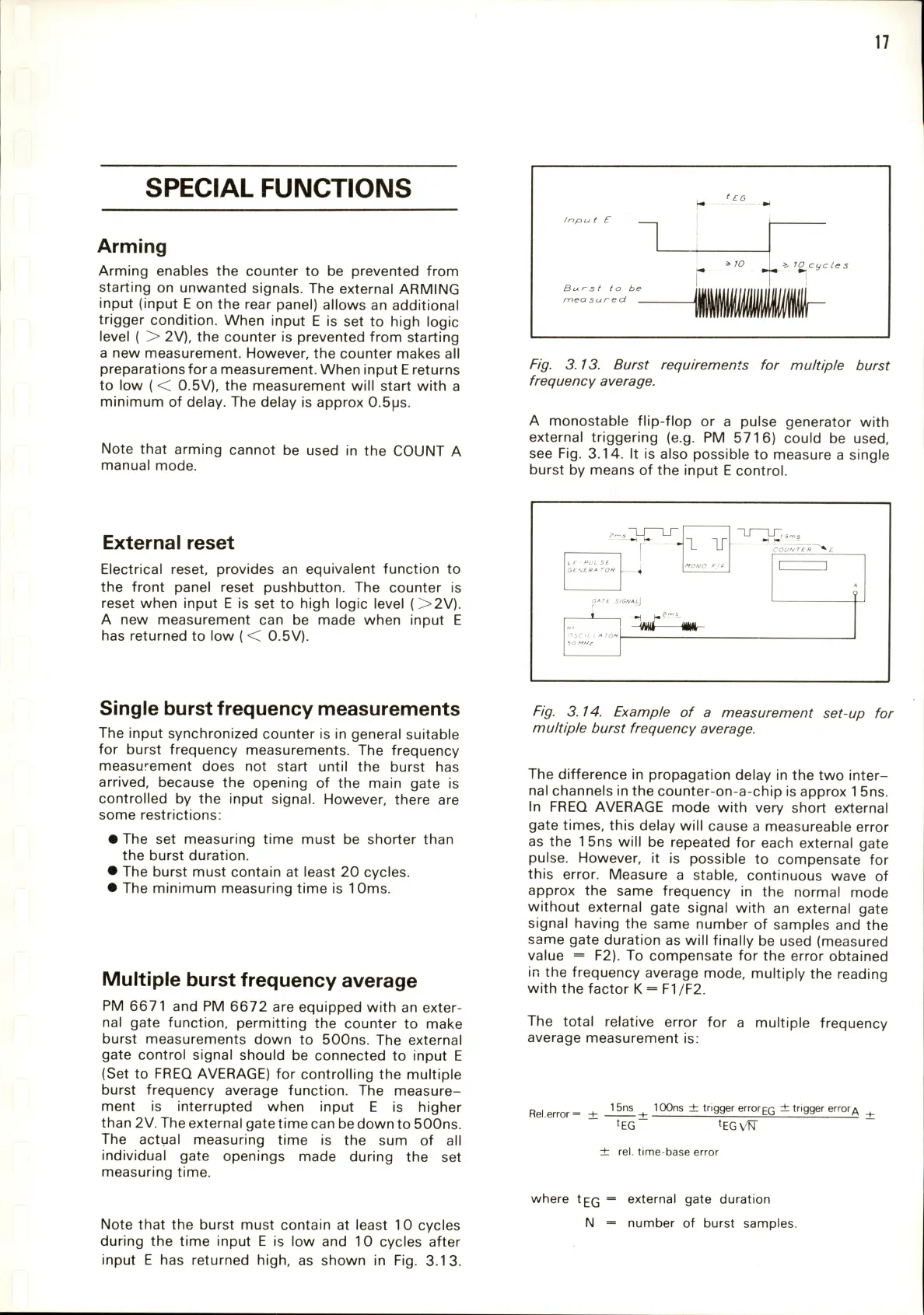
Fig.
3.13.
Burst
requirements
for
muitipie
burst
frequency
average.
A
monostable
flip-flop
or
a
pulse
generator
with
external
triggering
(e.g.
PM
5716)
could
be
used,
see
Fig.
3.14.
It
is
also
possible
to
measure
a
single
burst
by
means
of
the
input
E
control.
External
reset
Electrical
reset,
provides
an
equivalent
function
to
the
front
panel
reset
pushbutton.
The
counter
is
reset
when
input
E
is
set
to
high
logic
level
(>2V).
A
new
measurement
can
be
made
when
input
E
has
returned
to
low
(
<
0.5V).
Single
burst
frequency
measurements
The
input
synchronized
counter
is
in
general
suitable
for
burst
frequency
measurements.
The
frequency
measurement
does
not
start
until
the
burst
has
arrived,
because
the
opening
of
the
main
gate
is
controlled
by
the
input
signal.
However,
there
are
some
restrictions:
The
set
measuring
time
must
be
shorter
than
the
burst
duration.
The
burst
must
contain
at
least
20
cycles.
The
minimum
measuring
time
is
10ms.
Multiple
burst
frequency
average
PM
6671
and
PM
6672
are
equipped
with
an
exter
nal
gate
function,
permitting
the
counter
to
make
burst
measurements
down
to
500ns.
The
external
gate
control
signal
should
be
connected
to
input
E
(Set
to
FREQ
AVERAGE)
for
controlling
the
multiple
burst
frequency
average
function.
The
measure
ment
is
interrupted
when
input
E
is
higher
than
2V.
The
external
gate
time
can
be
down
to
500ns.
The
actual
measuring
time
is
the
sum
of
all
individual
gate
openings
made
during
the
set
measuring
time.
Note
that
the
burst
must
contain
at
least
10
cycles
during
the
time
input
E
is
low
and
10
cycles
after
input
E
has
returned
high,
as
shown
in
Fig.
3.13.
Fig.
3.14.
Example
of
a
measurement
set-up
for
multiple
burst
frequency
average.
The
difference
in
propagation
delay
in
the
two
inter
nal
channels
in
the
counter-on-a-chip
is
approx
1
5ns.
In
FREQ
AVERAGE
mode
with
very
short
external
gate
times,
this
delay
will
cause
a
measureable
error
as
the
15ns
will
be
repeated
for
each
external
gate
pulse.
However,
it
is
possible
to
compensate
for
this
error.
Measure
a
stable,
continuous
wave
of
approx
the
same
frequency
in
the
normal
mode
without
external
gate
signal
with
an
external
gate
signal
having
the
same
number
of
samples
and
the
same
gate
duration
as
will
finally
be
used
(measured
value
=
F2).
To
compensate
for
the
error
obtained
in
the
frequency
average
mode,
multiply
the
reading
with
the
factor
K
=
F1/F2.
The
total
relative
error
for
a
multiple
frequency
average
measurement
is:
Rel
error
=
-(-
^
100ns
±
trigger
errorgg
±
trigger
error
"
'EG~
tEGVN
±
rel.
time-base
error
where
tgQ
=
external
gate
duration
N
=
number
of
burst
samples.

Related product manuals