EasyManua.ls Logo

Philips PM2519 - Page 28

Philips PM2519
126 pages
Print Icon
To Next Page IconTo Next Page
To Previous Page IconTo Previous Page
Loading...
2-12
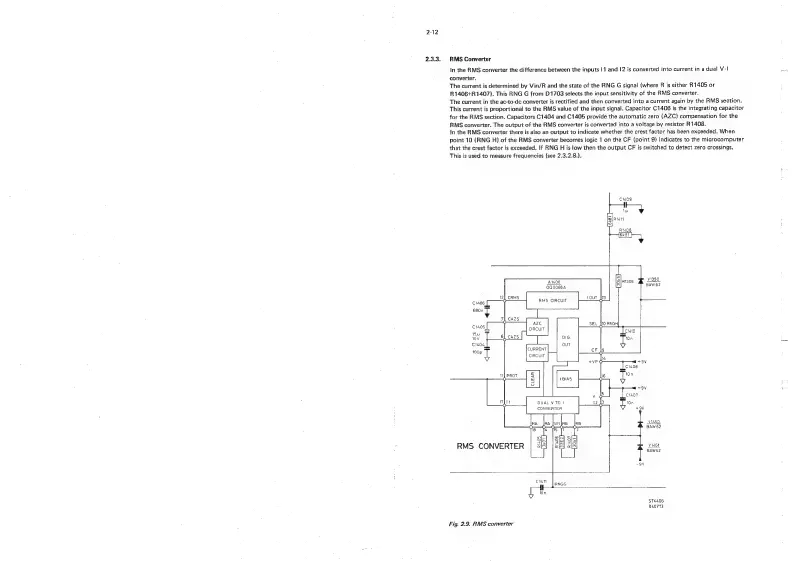
2.3.3.
RMS
Converter
in
the
RMS
converter
the
difference
between
the
inputs
11
and
12
is
converted
into
current
in
a
dual
V-I
converter.
The
current
is
determined
by
Vin/R
and
the
state
of
the
RNG
G
signal
(where
R
is
either
R1405
or
R1406+R1407).
This
RNG
G
from
D1703
selects
the
input
sensitivity
of
the
RMS
converter.
The
current
in
the
ac-to-de
converter
is
rectified
and
then
converted
into
a
current
again
by
the
RMS
section.
This
current
is
proportional
to
the
RMS
value
of
the
input
signal.
Capacitor
C1406
is
the
integrating
capacitor
for
the
RMS
section.
Capacitors
C1404
and
C1405
provide
the
automatic
zero
(AZC)
compensation
for the
RMS
converter.
The
output
of
the
RMS
converter
is
converted
into
a
voltage
by
resistor
R1408.
In
the
RMS
converter
there
is
also
an
output
to
indicate
whether
the
crest
factor
has
been
exceeded.
When
point
10
{RNG
H)
of
the
RMS
converter
becomes
logic
1
on
the
CF
(point
9)
indicates
to
the
microcomputer
that
the
crest
factor
is
exceeded.
If
RNG
H
is
low
then
the
output
CF
is
switched
to
detect
zero
crossings.
This
is
used
to
measure
frequencies
(see
2.3.2.8.).
RMS
CONVERTER
A1400
OQ0066A
-—__——
RMS
CIRCUIT
Cos
Ww
RIS
{6x81
R1408
R1306
V1350
BAW
62
CURRENT
CIRCUIT
DUAL
V
TO
|
CONVERTER
Fig.
2.9.
RMS
converter
¥1450
BAW
62
Vi451
BAW62
“ov
C4
|
NGG
it
On
$T4406
840713

Related product manuals