Need help?
Do you have a question about the Phoenix KS10002 and is the answer not in the manual?
This document provides assembly and operating instructions for a 4-burner stainless steel gas BBQ, model KS10002. It is designed for outdoor use only and is not intended for commercial purposes.
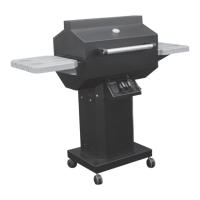
The device is a 4-burner stainless steel gas barbecue, designed for outdoor cooking. It utilizes LPG bottled gas and requires a 37mbar propane regulator for safe and efficient operation. The BBQ features a main grilling area with four burners, a side burner, a warming rack, and cooking grills. It also includes a roasting hood, allowing for oven-style cooking such as roasting joints of meat or whole chickens. The unit is equipped with casters for mobility and side tables for convenience during cooking.
The barbecue is designed for use with LPG bottled gas only. Propane bottles are recommended for year-round use, even in cold weather. The gas bottle should never be placed directly underneath the barbecue or stored/used in a horizontal position. A proper regulator is crucial for safe operation, and an incorrect or faulty regulator will invalidate the warranty.
Location and Safety: The barbecue must be used outdoors in a well-ventilated area, at least 1 meter away from any combustible structure or surface. Flammable materials should be kept clear of the unit. Ventilation openings in the barbecue body must not be obstructed. The gas bottle should be secured on the cylinder holder with the provided black strap.
Lighting the Barbecue: Before lighting, the barbecue hood must be open, and all control knobs should be in the "off" position. The gas control valve on the bottle or regulator should be open. To light a main burner, push in and turn the leftmost control knob anti-clockwise until resistance is felt (pause 4 seconds), then continue turning until a click is heard and the burner ignites. If it fails to ignite, turn all knobs to "off," close the gas valve, wait 5 minutes, and repeat. Manual ignition involves inserting a lit match through the match-lighting hole on the right side, then pushing in and turning the control knob anti-clockwise to the max position. Subsequent burners can be lit automatically once the leftmost burner is ignited. For the side burner, keep it free, set the control knob to "off," turn on gas supply, then push in and turn the control knob anti-clockwise until resistance is felt, then continue turning until a click is heard and it ignites. Manual ignition for the side burner involves applying a lit match to the burner ports while pushing in and turning the control knob anti-clockwise to the max position.
Preheating and Cooking: After ignition, burners should be run at the high position for 3-5 minutes to preheat the barbecue, with the hood open. For roasting, turn the burner under the food to the "off" position, close the hood, and turn other burners to a lower setting (low to medium) to achieve the desired temperature. Overheating the barbecue should be avoided, and the hood should not be lifted unnecessarily to prevent heat loss.
End of Cooking Session: After cooking, turn the barbecue burner to the "max" position and burn for 5 minutes with the hood open to burn off residue, making cleaning easier. Once finished, turn all control valves fully clockwise to "off," then switch off the gas at the bottle. Allow the barbecue to cool completely before closing the hood.
Important Warnings:
Regular Cleaning: The barbecue should be cleaned regularly between uses, especially after extended storage periods. Ensure the barbecue and its components are sufficiently cool before cleaning.
Cooking Grill Preparation: Before each barbecuing session, apply a light coat of cooking or vegetable oil to the cooking grill with a long-handled brush to prevent food from sticking.
Burner Maintenance: The burner should be checked periodically for optimal flame performance. A normally good flame is blue with a small yellow tip. If the flame pattern is significantly yellow, or if spiders/insects block the burner or orifices, this indicates a problem. In such cases, the gas should be immediately turned off, and the burner should be inspected and cleaned. This involves removing the burner, cleaning the burner tube with a pipe cleaner or piece of wire, and cleaning the insect screen on the end of the venturi tube.
Barbecue Body Maintenance: Regularly remove excess grease or fat from the barbecue body with a soft plastic or wooden scraper. If necessary, clean the body with hot soapy water and a cloth or non-bristled brush. Do not immerse the gas controls or manifold in water.
Fixings: All screws and bolts should be checked and tightened on a regular basis.
Storage: Store the barbecue in a cool, dry place.
Leak Testing: Perform a leak test annually and each time the gas bottle is removed or replaced. This should be done in a well-ventilated area. Confirm all control knobs are in the "off" position. Open the gas control valve on the bottle or regulator. Brush a solution of ½ water and ½ soap over all gas system joints (valve connections, hose connections, regulator connections). If bubbles form, there is a leak. Turn off the gas supply, retighten all joints, and repeat the test. If bubbles still form, do not use the barbecue and contact a local dealer. NEVER use an open flame to test for leaks.
Hose Inspection: Inspect the gas hose to ensure it is free of twisting, tension, bends, folds, or kinks. No part of the hose should touch hot barbecue parts. Inspect for cuts, cracks, or excessive wear. If damaged, it must be replaced with a suitable LPG hose meeting national standards, with a length not exceeding 1.5m.


 To Next Page
 General