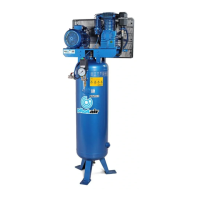
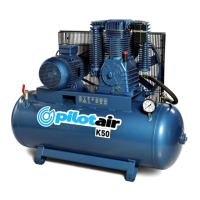
This document is an instruction and parts list for the Pilot Air K30 air compressor, a device designed for generating compressed air. It provides essential information for safe operation, maintenance, and identification of components.
Function Description:
The Pilot Air K30 is an air compressor designed to provide compressed air for various applications. It operates by compressing ambient air and storing it in an air receiver (tank) for later use. The unit is equipped with a pressure switch that automatically starts and stops the compressor based on pre-set cut-in and cut-out pressures, ensuring a consistent supply of compressed air. Safety features, such as a safety valve, are integrated to prevent over-pressurization. The compressor is available in electric (240V & 415V) and petrol/diesel driven models, catering to different power source requirements.
Important Technical Specifications:
- Model: K30
- Maximum Pressure: 10 BAR (for "TM" or "K" series)
- Electrical Specifications (for 240V units, extension lead recommendations):
- 1.65 KW (2.25 HP) requires 1.5mm square heavy-duty wire (max length 20 M)
- 2.20 KW (3.00 HP) requires 1.5mm square heavy-duty wire (max length 10 M)
- Battery Wiring (for Petrol powered units with electric start):
- Max. Cable length: 1.5 M, Cable size: 8 mm/sq.
- Over 1.5 M in length requires cable size of 15 mm/sq.
- Recommended Oil: PILOT PCO-40G (Stationary models) or PILOT PCO-30G (Portable models) or equivalent.
Usage Features:
- Location: For optimum efficiency, the unit should be located in a clean, dry, and cool environment with good ventilation. Obstacles should be avoided to facilitate maximum air flow and cooling.
- Operation (Electric Units):
- Ensure the ON/OFF switch on the pressure switch is in the OFF (down) position before plugging into a power point.
- Switch the unit on using the ON/OFF switch. The pressure switch will automatically manage starting and stopping based on air receiver pressure.
- Always switch the unit ON and OFF via the pressure switch to prevent starting against high pressure.
- Do not modify, bypass, or remove the pressure switch or safety valve.
- Operation (Petrol/Diesel Driven Units):
- Refer to OEM documentation for engine care and operation.
- Units "idle down" to minimum operating speeds when cut-out pressures are reached, saving fuel and reducing wear.
- For easy starting (especially with electric starters), open the "EASY START" valve until the unit is operating, then close it for normal operation. The valve location varies by model (motor/pump platform for K25P, K30P; discharge pipe for other models).
- Safety:
- Check oil level before use, especially after shipping.
- Drain all residual air pressure after use or engage the outlet tap to prevent accidental discharge.
- Keep clear of the compressor pump during and after operation due to heat build-up.
- Never operate without the factory-fitted belt guard (belt drive models) or pump shroud (direct drive models).
- Do not operate with damaged or exposed electrical wiring.
- Do not alter, adjust, or remove any components without technical support from Pilot Air or an authorized agent.
- Drain all air from the receiver before transporting.
- Pressure vessels (air receivers) may require registration with the relevant statutory authority in your state.
- Never point compressed air tools or equipment towards another person.
- Do not bolt the compressor directly onto the floor; use rubber vibration pads if bolting is necessary, ensuring a gap between the bolt head/nut and compressor foot to avoid metal-to-metal contact.
Maintenance Features:
- Fuses/Circuit Breakers: Check that they correspond to the motor rating.
- Rotation (415-Volt units): Check rotation as indicated by the arrow on the unit.
- Extension Leads (240-Volt units): Avoid using extension leads due to potential voltage drop and power loss; if used, follow recommended wire size guidelines.
- Oil Level: Maintain oil level at the center of the oil sight glass on the compressor pump. Do not overfill.
- Oil Replacement: Replace oil every 1000 working hours or every six (6) months.
- Condensate Drainage: In humid/low duty cycle environments, drain residual water from the sump regularly and/or change oil more frequently. Condensation must be drained from the air receiver at least weekly.
- Cleanliness: Keep the unit clean for proper cooling. Clean the crankcase breather to allow proper breathing.
- Routine Maintenance: Perform routine maintenance at least every six (6) months.
- Maintenance Safety: Isolate power and release all pressure from the receiver before any maintenance.
- Spare Parts/Service: Always quote the model and serial number when requesting information.
Compressor Component Descriptions:
- Pressure Switch (240V & 415V models only): Located on top of the air receiver, functions as a manual on/off switch and automatically controls compressor start/stop.
- Pressure Gauge: Located on the air receiver, indicates pressure in PSI and KPA.
- Safety Valve: Located on the air receiver, releases pressure if the pressure switch fails.
- Overload Protection: Electric models have an overload protector (reset buttons on pressure switch or motor) to protect the motor from over-temperature conditions.
- Check Valve (240V & 415V models only): Located at the junction of the pump discharge pipe and air receiver, prevents air pressure return to the pump.
- Easy Start Valve (Petrol/Diesel models only): Located on the check valve (portable units) or compressor platform (stationary units), aids engine starting.
- Receiver Drain: Located on the underside of the air receiver, used for draining condensate.
- Oil Sight Glass: Located on the side of the compressor pump (opposite the flywheel), used to check oil level.
- Pilot Air Manufactured Goods: 1-year warranty for defects in factory workmanship or materials.
- Pilot Air Branded Accessories: 1-year warranty for defects in factory workmanship or materials.
- Compressor Pump Only (TM Series, Classic K Series, Petrol Industrial Series, Three Phase Industrial Series): 3-year warranty for defects in factory workmanship or materials.
- 'DCR' and 'FP' Series Rotary Screw Compressors: 3,000 working hours in the first 12 months for defects; 2-year extension for the air end.
- Engines (Petrol/Diesel): Subject to the engine manufacturer's warranty.
- Non-Pilot Air Accessories: Not covered by Pilot Air warranty; refer to individual manufacturer's warranty.
- Warranty Conditions: Require proof of purchase, written claim within 30 days of defect becoming apparent, non-transferable, strict adherence to installation/operation/maintenance literature, and use of specified components. Remedies include replacement, rectification, or payment for costs.
- Exclusions: Misuse, negligence, accidental damage, improper maintenance/storage, non-genuine parts, normal wear and tear, unauthorized work, removed/obscured serial/model label, operating continuously under excessive load, or use for unintended purposes.
- Warranty Repairs: 240 Volt and portable units are back-to-base; claimant returns product to nominated agent. Pilot Air's decision on defective parts is final. Claimant is responsible for reasonable and proximate expenses incurred in claiming, provided written notification and receipts are submitted within 21 days. Pilot Air is not responsible for unapproved courier/transport/freight costs.
For further information or to make a claim, contact Pilot Air Compressors Pty Ltd via phone (1300 667 579), email (via www.pilotair.com.au), or mail (115 Beaconsfield St, Silverwater NSW 2128, PO Box 277 Ermington NSW 1700).

 Need help?
 General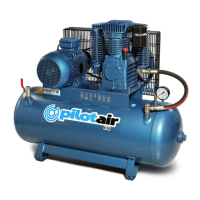

 To Next Page