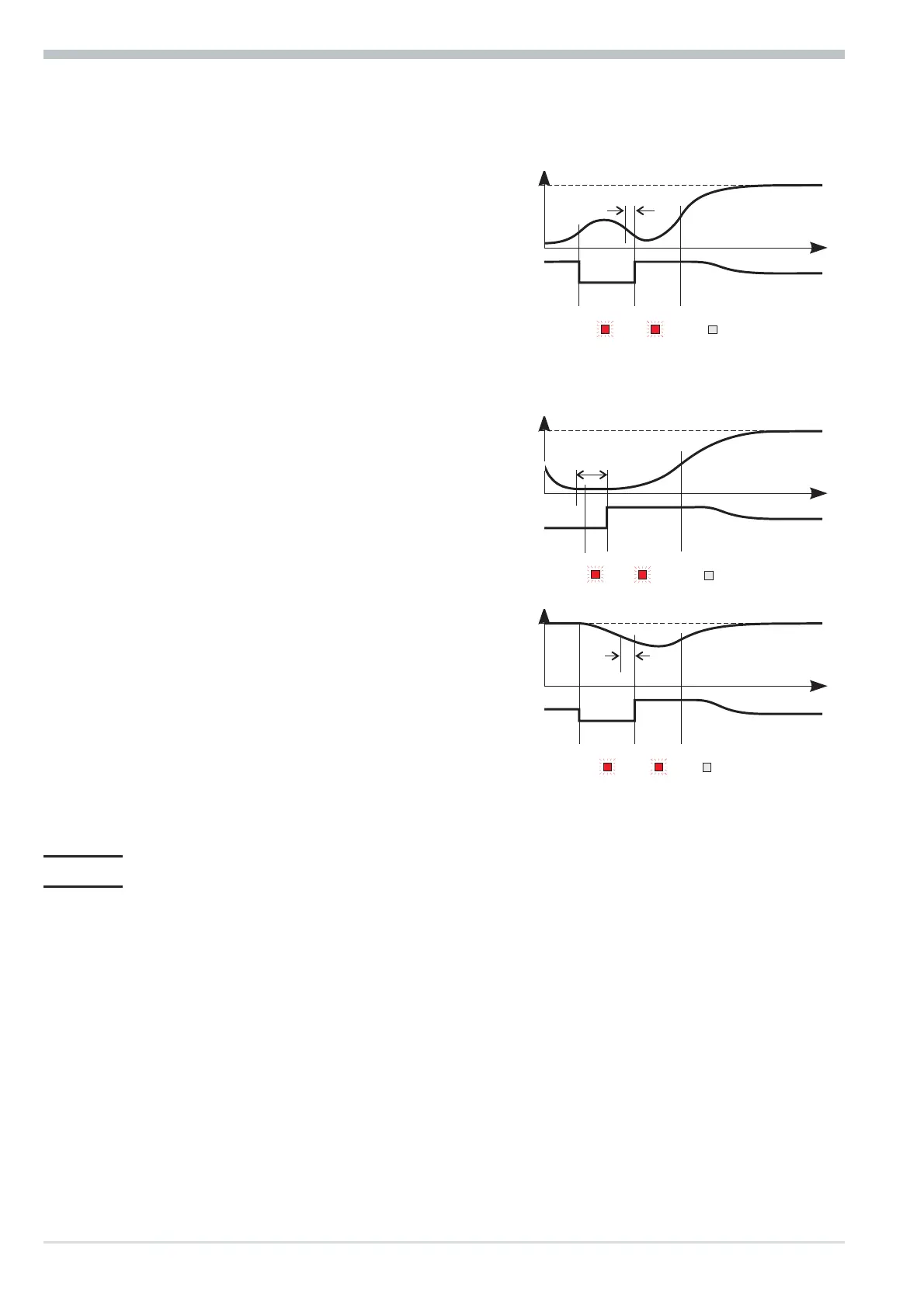
4.3.4 Examples for self-tuning attempts
4.3.5 (controller inverse, heating or heating/cooling)
Start: heating power switched on
Heating power Y is switched off (1).
When the change of process value X
was constant during one minute (2),
the power is switched on (3).
At the reversal point, the self-tuning at
-
tempt is finished and the new parameter
are used for controlling to set-point W.
Start: heating power switched off
The controller waits 1,5 minutes (1).
Heating power Y is switched on (2).
At the reversal point, the self-tuning at
-
tempt is finished and control to the
set-point is using the new parameters.
Start: at set-point
Heating power Y is switched off (1).
If the change of process value X was
constant during one minute and the con-
trol deviation is > 10% of SP.Hi -
SP.LO (2), the power is switched on
(3). At the reversal point, the self-tu-
ning attempt is finished, and control to
set-point W is using the
new parameters.
4.4 Manual tuning
The optimization aid should be used with units on which the control parameters
shall be set without self-tuning.
For this, the response of process variable x after a step change of correcting varia
-
ble y can be used. Frequently, plotting the complete response curve (0 to 100%)
is not possible, because the process must be kept within defined limits. Values T
g
and x
max
(step change from 0 to 100 %) or ∆t and ∆x (partial step response) can
be used to determine the maximum rate of increase v
max
.
Controller
Digital 280-1 Manual tuning 20
t
2
100%
Y
0%
X
W
start r
1
3
t turning point
blinks
lit off
t
100%
Y
0%
X
W
start r
1
2
t turning point
blinks lit off
t
2
100%
Y
0%
X
W
start r
1
3
t turning point
blinks lit
off


 To Next Page