P-1500/P-1700-manual from PMV 14321-99.6
– 4 –
Function
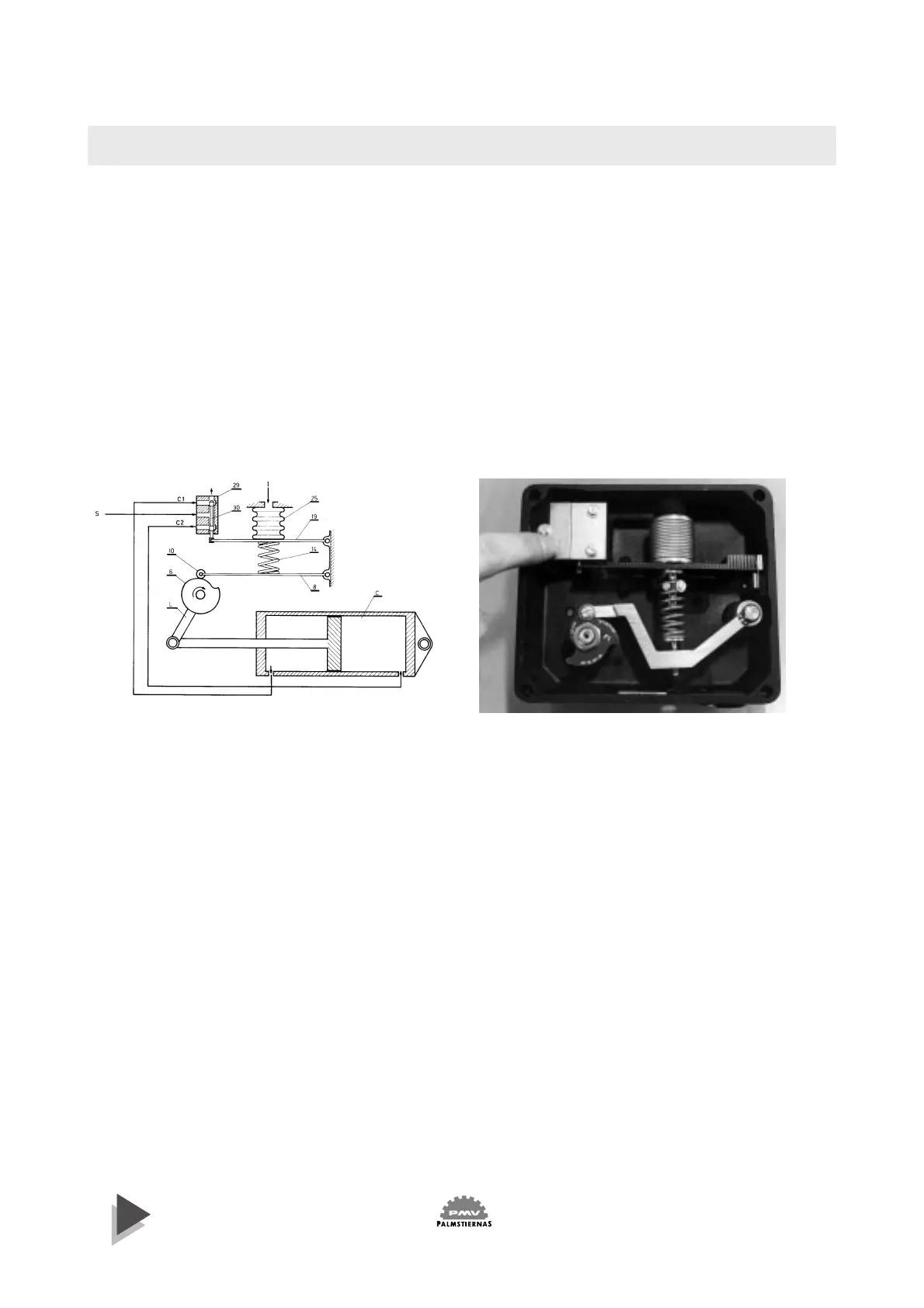
The positioning is based on the principle of balanced forces. One force is
originated by the signal pressure transmitted through bellows (25) on balance
arm (19). The otherforce is from the feed back spring (14) and is proportional
to the level of the lower arm (8).
The lower arm (8) level is determined by the position ofthe cam (6) which is
secured to the spindle (2). The spindle (2) is activated by the cylinder rod.
When these two forces are equal, the balance arm (19) isinacentralneutral
position, as is the spool (30). There is a slight leakage of air past the close
tolerances between the pilot valve parts (29 and 30). A small flow runs from
supply S past the pilot valve ports into the cylinder through
connections C1 and C2. Another small flow leaks out into the positioner
housing.
The PMVPositioner without cover.For figures of components see EXPLODED
DRAWING on page?)
Assume an equilibrium position
If the control pressure is increased the bellows (25) will be deflected
downwords, compressing the spring (14). The end of the balance arm (19)
moves the spool (30) in the bore of the valve body (29) guiding the
supplyairtothe rightside ofthe piston and, at the same time, exhausts air from
the left side of the piston through connection C1 into the positioner housing.
The cylinder piston moves to the left ”rotating the spindle (2) with the cam (6)
clockwise” forcing the lower arm (8) upward compressing the feed-back
spring (14). These motions will continue until the additional force from spring
(14) on the balance arm (19) overcomes the additional force from the bellows
(25). The balance arm (19) will then return to its neutral, centre position, as will
the spool (30). There will be no futher motion. Cylinder position is stable at
this new position.
There is only one cylinder position for each signalpressure value. If an
external force acts upon the cylinderpiston rod, it will move momentarily in
the direction of the force. The cam (6), lower arm (8), spring (14), balance arm
(19) and spool (39) will move so that the pressure difference created in the
cylinder will counter-balance the external force.


 To Next Page
 Loading...