Need help?
Do you have a question about the Polaris MTX Audio 2881115 and is the answer not in the manual?
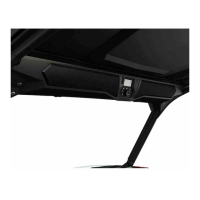
Details the physical arrangement and components of the overhead audio unit's control panel.
Identifies and explains the function of each button and control on the unit.
Details the two ways the rotary knob can be used to control the unit's functions.
Describes how to use the menu key for opening, navigating, and exiting menus.
Provides solutions for common problems and instructions for resetting the unit.
Instructions for adjusting audio volume and other levels using the unit's controls.
Explains the procedure for navigating through the unit's various settings menus.
Details on how to navigate through nested menus to reach specific settings.
Provides step-by-step guidance and diagrams for physically connecting the overhead unit.
Instructions for turning the overhead audio unit on and off correctly.
Explains how to cycle through and view different audio input source screens.
Guides on how to adjust the audio volume level of the overhead unit.
Instructions for muting and unmuting the audio output of the overhead unit.
Explains how to play audio content from a Bluetooth-enabled device.
Details the screen displayed for Bluetooth input and device pairing.
How to control Bluetooth audio playback using the unit's keys.
Explains how to select and play audio from an auxiliary input source.
Describes the screen displayed when the auxiliary input source is selected.
Explains the different methods for tuning radio frequencies: auto, manual, and preset.
The Polaris Overhead Audio Unit, available as an accessory (Model 2881115) or OEM part (Model 2635986), is designed to provide an integrated audio experience for Polaris vehicles. This unit combines a user-friendly interface with multiple audio input options, allowing users to enjoy their preferred music and radio stations while on the go. The design emphasizes ease of use and seamless integration into the vehicle's existing systems.
The primary function of the Polaris Overhead Audio Unit is to serve as a central audio system for the vehicle. It integrates several audio sources, including AM/FM radio, Bluetooth connectivity, and an auxiliary input, providing a versatile listening experience. The unit is controlled through a combination of physical keys and a rotary knob, all designed for intuitive operation even in dynamic environments.
The unit features a built-in tuner that supports both AM and FM radio bands. Users can tune into their favorite stations using automatic, manual, or preset tuning methods. The ability to store up to 15 presets per radio band allows for quick access to frequently listened-to stations, enhancing convenience. The tuning process is straightforward, utilizing the rotary knob for fine-tuning and the forward/backward keys for stepping through frequencies or presets.
Bluetooth connectivity is a core feature, enabling wireless audio streaming from compatible devices such as smartphones or tablets. This allows users to play their personal music libraries or stream content from various audio applications without the need for physical cables. The pairing process is simple, requiring users to select the Bluetooth input and connect to "MTX AUDIO" from their device. Once paired, the unit displays a "Connected" status and emits an audible beep, confirming a successful link. Playback controls, including back, forward, and play/pause, are available directly on the overhead unit, providing convenient management of the connected Bluetooth device.
For devices without Bluetooth capabilities, the overhead unit includes a 3.5mm auxiliary input. This allows for a wired connection to a wide range of audio sources, ensuring compatibility with older devices or those preferred for a direct connection. Switching between the auxiliary input and other sources is done via the input source key, cycling through AM, FM, Bluetooth, and Aux options.
The unit also incorporates essential audio adjustment features, such as volume control, tone adjustment (bass and treble), and muting capabilities. These settings can be accessed and modified through the rotary knob and menu key, allowing users to customize their audio output to their preferences. The screen brightness and contrast are also adjustable, ensuring optimal visibility in various lighting conditions.
The Polaris Overhead Audio Unit is designed for straightforward operation, with a clear control panel layout and intuitive key functions.
Powering On/Off: The unit is powered on or off by momentarily pressing the Power key. Upon startup, a splash screen is displayed briefly before transitioning to the most recently selected input source. This ensures a quick return to the user's preferred audio.
Input Source Selection: The Input Source key allows users to cycle through available audio sources: AM, FM, Bluetooth, and Auxiliary Input. Each selection displays a dedicated source screen, providing relevant information for the active source, such as frequency for radio or connection status for Bluetooth.
Volume Adjustment: Volume is controlled using the rotary knob. Turning the knob opens a volume screen, allowing for precise adjustment. The Menu key can be pressed to exit the volume screen, or it will time out automatically after a period of inactivity.
Muting Output: The Mute key provides instant muting of the audio output. When active, a mute icon is displayed on the screen. Pressing the Mute key again unmutes the audio, returning to the previously set volume level.
Tone Adjustment: Users can adjust bass and treble levels through the Settings menu. By pressing the Menu key, navigating to Settings > Tone with the rotary knob, and then selecting the desired adjustment, users can fine-tune the audio output. The rotary knob is used to make the adjustments, and the Menu key saves changes and exits.
Screen Brightness and Contrast: The display's brightness and contrast can be adjusted via the Settings > LCD menu. This feature helps optimize screen readability in different lighting conditions, from bright daylight to nighttime operation.
Bluetooth Playback: Once a Bluetooth device is paired and connected, users can control playback (back, forward, play/pause) directly from the overhead unit using the dedicated keys.
Menu Navigation: The Menu key is central to accessing and exiting menus. A single press opens a menu, and subsequent presses navigate back through menu levels. Pressing and holding the Menu key exits all menus completely. A time-out feature automatically saves changes and exits menus after a few seconds of inactivity. The rotary knob is used to highlight and select menu items, including multi-level menu structures.
The Polaris Overhead Audio Unit is designed for durability and minimal maintenance, primarily focusing on ensuring consistent operation.
Troubleshooting - Resetting the Unit: In the event that the overhead unit becomes unresponsive, a simple reset procedure is provided. Users are instructed to remove power from the unit for 5 minutes and then reconnect it. This hard reset can resolve many software-related issues, restoring the unit to its normal operating state.
Beyond this, the manual implies that the unit is largely self-contained and does not require regular user-performed maintenance beyond basic cleaning. The robust design is intended to withstand the environmental conditions typically encountered in Polaris vehicles. Any complex issues or repairs would likely require professional service, as the manual does not detail internal components or advanced troubleshooting steps. The FCC statements also emphasize that unauthorized modifications could void the user's authority to operate the equipment, suggesting that internal tampering is discouraged.
 General
| Bluetooth | Yes |
|---|---|
| Color | Black |
| Category | Car Stereo System |
| Power Output | 50W x 4 |
| Type | Audio System |
| Model | 2881115 |

 To Next Page