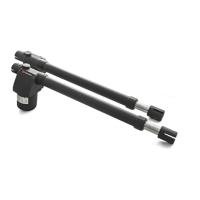
The device described in this manual is the TOP500 operator, a product designed for residential use, specifically adaptable to various types of sliding gates. Its primary function is to automate the opening and closing of these gates, providing convenience and security for residential properties.
Function Description
The TOP500 operator serves as the central mechanism for automating sliding gates. It works by engaging with a gear rack attached to the gate, using a pinion to drive the gate along its track. The system is designed to facilitate smooth and controlled movement of the gate throughout its entire stroke.
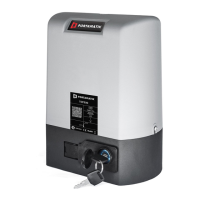
The operator includes a release mechanism that allows for manual operation of the gate in case of power failure or a system fault. This involves opening a protective cover, inserting a key, turning it 90 degrees, and pulling out the unlocker. This feature ensures that the gate can always be opened or closed, even without electrical power. To return to normal operation, the unlocker must be pushed back in, the key turned to its original position, and the cover closed. A test maneuver is recommended to confirm proper function.
The system incorporates limit switches to define the gate's opening and closing positions. These can be either magnetic, activating when a magnet on the rack aligns with a motor reader, or mechanical, activating when a plate on the rack tilts a motor spring. Proper adjustment of these limit switches is crucial to ensure the gate stops before physically hitting its end stops, preventing damage to the gate or the operator.
The installation process involves securing the motor onto a fixation plate, which is either embedded in a new concrete foundation or mounted onto an existing one. Careful attention to distances and leveling is required to ensure optimal performance. The gear rack, which can be made of nylon or steel, is then installed along the gate, engaging with the motor's pinion. For nylon racks, spacers are used to secure it to the gate, while for steel racks, welding the spacers to the gate is necessary. The alignment and engagement of the rack teeth with the pinion are critical for smooth operation.
The operator is controlled by a control board (MC1) which manages the gate's movements and interacts with various accessories such as photocells and remote controls. The manual provides guidance on connecting power wires, operator wires, and a capacitor to the terminal for proper electrical setup.
Usage Features
The TOP500 operator is designed for ease of use in residential settings. Once installed and configured, it allows for automated gate operation, typically controlled via remote controls. The manual unlock feature provides a practical solution for manual gate access during power outages or system malfunctions, ensuring continuous usability.
During installation, the gate must be in the open position and the engine unlocked when installing the gear rack. This ensures that all rack elements properly engage with the pinion throughout the gate's course. Spacers, whether for nylon or steel racks, must not be welded directly to the rack itself, but rather to the gate, to allow for proper adjustment and movement.
The system emphasizes safety, requiring that the end-of-stroke settings are correctly tuned to prevent the gate from hitting physical stops. Testing the drive manually with the door unlocked before connecting to electrical current is advised to avoid issues arising from poor configuration.
The troubleshooting section provides a systematic approach to diagnosing common issues, such as the motor not working, making noise but not moving, or not completing its route. This involves checking power supply, examining the motor's mechanical movement, inspecting the capacitor, and evaluating the control board's LEDs to identify anomalies in safety systems (photocells, safety edges) or start circuits (key selector, push button, video intercom). The manual also suggests performing direct connection tests to a 230V power supply, using a new capacitor, to isolate problems between the control panel and the motor.
Maintenance Features
Regular maintenance is essential to ensure the correct and long-lasting operation of the TOP500 operator. The manual recommends several maintenance measures to be carried out within six months of installation.
Key maintenance tasks include:
- Checking all operator controls: This involves inspecting the floor plate, limit switches, the motor, and the gear rack to ensure they are in good working order.
- Checking friction between rack and pinion: It is crucial to verify that the distance between the rack and motor remains consistent and that the rack teeth correctly engage with the motor pinion. Over time, some distortion may occur, which could affect performance. Adjustments may be needed to maintain proper engagement.
- Lubricating components: All gate drive systems/shafts, the pinion, and the rack should be lightly lubricated. This reduces friction, ensures smooth operation, and extends the lifespan of these components.
The manual also implicitly suggests that during installation, leaving pipes in the foundation for cable passage facilitates future maintenance or repairs of electrical connections. Furthermore, the ability to fine-tune the spacers in the ovalized rack holes during installation allows for precise adjustments, which can contribute to easier maintenance and optimal performance over time.
The troubleshooting guide, while primarily for issue resolution, also serves as a maintenance tool by helping users identify and address potential problems before they escalate, thus contributing to the overall upkeep of the system. For instance, regularly checking the LEDs on the control board can help detect malfunctions in safety devices or start circuits early.


 To Next Page
 General