
 Need help?
Do you have a question about the Porter-Cable OMNIJIG 5116 and is the answer not in the manual?
Covers work area, environment, attire, alertness, and tool handling.
Emphasizes wearing safety glasses and ear protection.
Covers cord care, securing work, tool maintenance, and proper storage.
Addresses electric shock, unintentional starting, and damaged parts.
Ensure the OMNIJIG® and workpiece are securely anchored to prevent movement.
Covers cord safety, keeping hands clear, firm grip, and motor stopping.
Emphasizes secure templets and caution with treated wood.
When servicing, always use identical replacement parts for safety and performance.
Describes the OMNIJIG®'s use for creating various dovetail and sliding joints.
Mount the OMNIJIG® securely to a sturdy bench or stand to prevent movement.
Adjust clamps by turning nuts to secure boards for dovetailing.
Position templets using spacers and rod nuts for precise alignment.
Lists the specific templets, bits, and guides needed for 1/2" half-blind dovetails.
Steps to set up the OMNIJIG® for cutting 1/2" half-blind dovetails.
Instructions for preparing the router, including bit and templet guide installation.
Recommends using scrap lumber for initial cuts to check adjustments and fits.
Instructions for temporarily clamping the drawer side piece.
Instructions for placing and clamping the drawer front piece.
Guides on positioning the templet for accurate dovetail cuts.
Specifies the direction for the first cut to prevent edge chipping.
Describes the process of moving the router around the templet and slots.
How to increase cut depth for loose joints.
How to decrease cut depth for tight joints.
Steps to check and adjust the fit between drawer front and side.
Instructions for routing the opposite end for symmetrical pin placement.
Lists the specific templets, bits, and guides needed for 1/4" half-blind dovetails.
Setup instructions for OMNIJIG® and router for 1/4" half-blind dovetails.
Guidance on clamping parts and performing the routing for 1/4" half-blind dovetails.
Lists accessories needed for rabbeted dovetails, depending on size.
Setup procedures for OMNIJIG® and router for rabbeted dovetails.
Instructions for preparing the drawer front with a rabbet cut.
Steps for clamping parts and routing rabbeted dovetails.
Lists templets, bits, and guides for 1/2" hand dovetails with 2" spacing.
Setup for OMNIJIG® and router, using separate templets for pins and tails.
Discusses ideal material widths and adjustments for centering dovetails.
Detailed steps for routing the tail boards for hand dovetails.
Instructions on using scrap material to prevent tear-out when routing pin boards.
Steps for positioning and securing the pin board for routing.
How to perform the routing operation for the pins.
Procedures for dealing with partial pins on non-ideal material widths.
Lists necessary accessories for cutting adjustable through dovetails.
Steps to prepare the OMNIJIG® for cutting the tail board (female dovetails).
Guide on positioning spacers and rod nuts for templet alignment.
Instructions for placing and securing the through dovetail templet.
Steps for clamping the tail board in position for routing.
How to loosen, slide, and tighten templet forks for desired spacing.
Instructions on how to carefully rout tails using the guide slots in each fork.
How to set the depth of cut for the dovetail cutter.
Steps to reposition the templet for cutting male dovetails (pins).
How to adjust the left stop bar for pin board setup.
Steps for placing and securing the pin board for routing.
Instructions on changing bits for cutting male dovetails.
How to set the router bit depth for cutting male dovetails (pins).
How to make pins smaller by turning bracket rod nuts clockwise.
How to make pins larger by turning bracket rod nuts counterclockwise.
Advice to cut new pin boards until the desired fit is achieved.
Lists the specific templets, bits, and guides for 1/2" box joints.
Setup instructions for the OMNIJIG® for cutting box joints.
Steps to position the box templet accurately on the jig.
How to mark the center of the board for alignment with the templet.
Detailed instructions for carefully routing the box joints.
Steps to route the opposite end of the board for complete box joints.
Lists the templets, bits, and guides for tapered sliding dovetails.
Instructions for router setup, including depth adjustment.
Notes on the two-slot tapered sliding templet and safety precautions.
Steps to prepare the OMNIJIG® for cutting male dovetails.
Instructions for routing the male dovetail using the templet guide.
Steps to prepare the OMNIJIG® for cutting female dovetails.
How to perform the routing operation for female dovetails.
Reduce router bit depth if male board tightens before full seating.
Increase router bit depth if male board is too loose.
Adjust templet using rod nuts to center the male board between slots.
Clean plastic parts with soft cloth; coat steel parts with wax.
Advice on information needed when contacting for technical questions.
Lists accessories tested and recommended for use with the OMNIJIG®.
Details the one-year warranty, repair/replacement process, and exclusions.
Duration of implied warranties of merchantability and fitness.
Contact information for warranty performance inquiries.
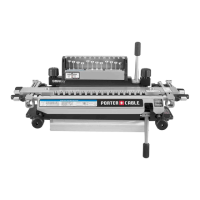
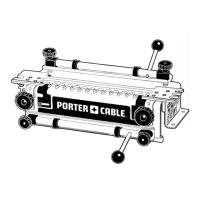
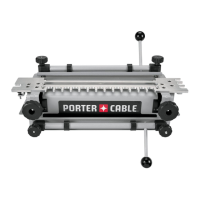
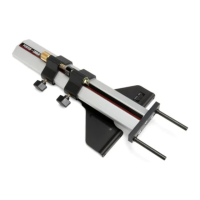
The Porter-Cable OMNIJIG® is a professional power tool designed for creating various types of woodworking joints, primarily dovetails and box joints. It is used in conjunction with a Porter-Cable router, templet guides, and router bits to produce precise and strong corner joints for drawers and boxes, as well as sliding joints for shelves.
The OMNIJIG® facilitates the routing of different joint types by providing a stable clamping system for workpieces and a templet guide for the router. The user secures the wood pieces in the jig, positions the appropriate templet, and then guides a router with a specific bit along the templet's contours to cut the desired joint. This process ensures consistent and accurate cuts, making it suitable for both hobbyists and professional woodworkers.
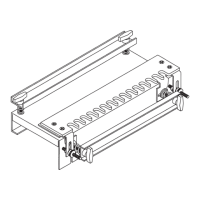
The OMNIJIG® comes in two main models:
Accessory Templets and Bits: The manual lists several accessory templets and corresponding router bits for different joint types:
1/2" Half-Blind Dovetails:
1/4" Half-Blind Dovetails:
1/2" Hand Dovetails (2" Spacing):
Adjustable Through Dovetails:
1/2" Box Joints:
Tapered Sliding Dovetails:
The OMNIJIG® base includes two clearance holes for 3/8" dia. bolts for secure mounting to a workbench or stand.
The OMNIJIG® is designed for versatility and precision in woodworking joinery. Key usage features include:
Secure Clamping System: The jig features front and top clamps (items 2 and 3 in Fig. 2) with clamp nuts (item 11) and clamping levers & knobs (item 13) to securely hold workpieces. The clamp nuts can be adjusted to maintain uniform clamping pressure.
Adjustable Templet Location: The front-to-back positioning of the templets (item 4) is adjustable using spacers (item 14) and rod nuts (item 15), allowing for fine-tuning of the templet position for different joint requirements.
Stop Bars: The jig incorporates top and front stop bars (items 6, 7, 8, 9) with locking screws (item 10) to accurately position workpieces for routing.
Router Setup: The manual provides detailed instructions for setting up the router, including inserting the correct templet guide and dovetail bit, and adjusting the bit projection for specific joint types (e.g., 19/32" for 1/2" half-blind dovetails, 5/8" for 1/4" half-blind dovetails).
Joint Types: The OMNIJIG® supports a wide range of joint types:
Safety Precautions: The manual emphasizes several safety rules, including securing the work, keeping hands clear of cutters, maintaining a firm grip on the router, ensuring the motor has stopped before adjustments, and using safety glasses and ear protection. It also warns about toxic preservatives in some wood and the importance of reading all instructions.
The OMNIJIG® requires minimal but consistent maintenance to ensure longevity and proper function:
The OMNIJIG® is a robust and versatile tool designed to simplify complex woodworking joinery, offering precision and repeatability for a variety of projects.
 General
| Brand | Porter-Cable |
|---|---|
| Model | OMNIJIG 5116 |
| Category | Tools |
| Language | English |


 To Next Page