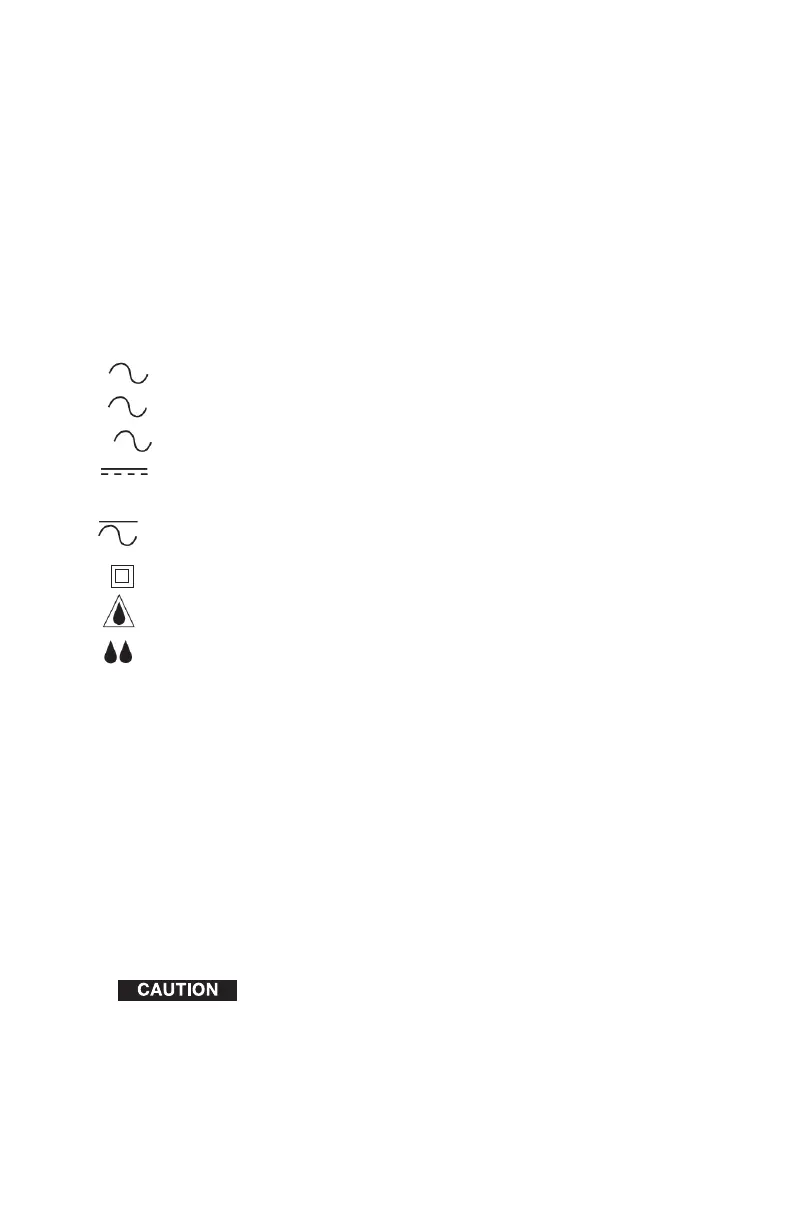
SYMBOL DEFINITION
V ........................ volts
A ........................ amperes
Hz ........................ hertz
W ........................ watts
kW ........................ kilowatts
µF ........................ microfarads
l ........................ liters
kg ........................ kilograms
N/cm
2
........................ newtons per square centimeter
Pa ........................ pascals
h ........................ hours
min ........................ minutes
s ........................ seconds
........................ alternating current
3 ........................ three-phase alternating current
3
N ........................ three-phase alternating current with neutral
........................ direct current
n
0
........................ no load speed
........................ alternating or direct current
....................... Class II Construction
........................ splash-proof construction
........................ watertight construction
…/min ........................ revolutions or reciprocation per minute
REPLACEMENT PARTS
When servicing use only identical replacement parts.
MOTOR
Many Porter-Cable tools will operate on either D.C., or single phase 25 to
60 cycle A.C. current and voltage within plus or minus 5 percent of that
shown on the specification plate on the tool. Several models, however, are
designed for A.C. current only. Refer to the specification plate on your tool
for proper voltage and current rating.
Do not operate your tool on a current on which the
voltage is not within correct limits. Do not operate tools rated A.C.
only on D.C. current. To do so may seriously damage the tool.
EXTENSION CORD SELECTION
If an extension cord is used, make sure the conductor size is large enough
to prevent excessive voltage drop which will cause loss of power and
possible motor damage. A table of recommended extension cord sizes will
be found in this section. This table is based on limiting line voltage drop to
6



 To Next Page