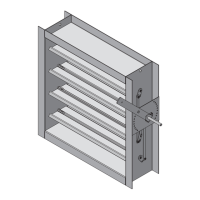
Industrial Damper
Installation, Operation, and Maintenance Manual
Troubleshooting
Manually operated damper blades not moving
1. Make sure the damper is free of obstructions.
2. Inspect damper for failed clevis pins, clevises, cams, link bars, or
crank arms and replace as necessary.
3. Check that the damper is installed correctly as any twist or bend in
the frame of the damper could prohibit smooth operation.
Actuator not responding
1. Electrical actuators: make sure the actuator is wired correctly and
receiving correct voltage. Refer to the actuator installation manual for
details on the actuator.
2. Pneumatic actuators: make sure the actuator is plumbed correctly
and receiving correct air pressure. Refer to the actuator installation
manual for details on the actuator.
3. If installed, check limit switches to make sure they are set correctly.
4. If equipped with a manual override, check operation of handwheel.
Confirm that clutch is engaging and/or disengaging correctly.
5. Power actuator independently by loosening bolts that secure the
actuator to the drive axle. Check to see that it operates properly and
that the amp draw is normal.
Actuator is operating, but the blade(s) fail to move or only move
limited distance.
1. Make sure the damper is free of obstructions.
2. Inspect damper for failed clevis pins, clevises, cams, link bars, or
crank arms and replace as necessary.
3. Check that the damper is installed correctly as any twist or bend in
the frame of the damper could prohibit smooth operation.
4. If installed, make sure that the limit switches in the actuator are set
correctly.
5. Make sure that end travel screws of the actuator are set correctly.
High noise level
1. Check the airflow as high velocity/flow can cause excessive noise.
Reduce flow through damper and check noise level.
2. Check the damper to make sure it is closed fully as partially open
dampers can cause excessive noise. If it is, re-adjust to fully close
damper.
Excessive leakage
1. Check the damper to make sure it is closed fully. If it is not, re-adjust
the actuator or drive linkage to fully close damper.
2. Inspect blade seals and stop seals for tears or nicks. If they are
damaged, replace damaged seals.
3. Check stops and perimeter frames for air passage. Caulk gaps with
silicone sealant as required. Do not apply caulk to the jamb seals
as these are flexible metal seals that have to be able to move to
function properly.
For more information and troubleshooting for actuators, refer to the
actuator installationmanual.
Industrial Damper IOM 4 of 4, February, 2024 pottorff.com
Field Service
Installation, testing, inspecting, and commissioning the supplied
dampers in the field is not part of POTTORFF’s scope. POTTORFF is not
responsible for, and will not perform, the work for electrical connections
for field power, and will not perform work for connections for control
system equipment and components. If field service such as startup
assistance, troubleshooting, or repair are found to be an issue that
requires factory support or warranty claims, please contact your Pottorff
representative immediately.


 To Previous Page
 Loading...