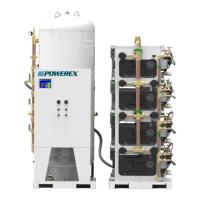
Scroll Medical & Laboratory Compressed Air Systems
Powerex • 150 Producon Drive • Harrison, OH 45030 • USA
P 1.888.769.7979 • F 513.367.3125 • www.powerexinc.com
IN907800AV • 08/2018
Page 3 of 40
The compressed air is then carried to the aer cooler. During aer
cooling, condensaon is formed and captured in the condensate trap
downstream from the aer cooler. The condensate trap collecon
bowl is piped to an automac drain system. The liquid formed is
condensed atmospheric water vapor and it may be allowable to
drain into your local sewer system. Check local regulaons for actual
requirements.
The compressor pumps are driven by three phase electric motors
acng through vee belt drives. The belts are carefully engineered
and selected for durability and reliability. When the vee belts run,
especially in the rst few hundered hours of operaon, dust is
generated as the prole of the belt wears in to match the grooves in
the drive and driven sheaves. The dust is normal and will not cause
any operang problems. If the belts are not slipping, no adjustement
of tension is necessary. If tension adjustement or belt replacement
does become necessary, the motor mount is designed to act as a slide
base tensioning systems and detailed instrucons are provided in this
manual.
Aer the condensate trap, a check valve and a ball valve is installed
in each branch of the compressor system. This valve allows an unused
branch to be closed o from the system. If the valve is ulized to allow
service to be performed, a locking cover must be installed to meet
Lock out Tag out requirements. A relief valve is installed upstream
of the ball valve, so that if the ball valve is closed and the pump is
started, the relief valve will open and prevent catastrophic pressure
rise and damage. The relief valve is not intended to allow connuous
operaon of the pump with the ball valve closed.
Compressed air systems contain electrical energy.
Remove and lock out all energy sources from the
system if any maintenance is being performed where the energy may
cause the pump or motor to operate.
Compressed air is collected and piped to the air receiver. The air
receiver has a bypass valve manifold installed for use if necessary. The
air receiver has an an-corrosion lining. Each air receiver has an ASME
safety relief valve to prevent system pressure from exceeding the
design capability of the vessel. A mechanical pressure gauge allows
visual vericaon of the system pressure. Condensaon that forms
aer the aer cooler will collect in the receiver. An automac tank
drain is installed along with a manual drain valve to remove the liquid.
Since the compressors are oilless, the liquid formed is condensed
atmospheric water vapor and it may be allowable to drain into your
local sewer system. Check local regulaons for actual requirements.
A transparent tube is installed in the lower secon of the air receiver
to allow visual vericaon that the condensate is being removed from
the vessel.
Risk of Injury or death. Do not modify the air
receiver or the ASME safety relief valve. Do not
obstruct or restrict the outlet of the ASME safety relief valve. Do not
operate the system at pressures higher than the rated pressure. Do not
perform any work on the receiver or connected components while energy
(compressed air) is present.
Compressed air from the receiver is routed to the dryer secon
where duplex desiccant dryers remove water vapor to the specied
dew point of the system. A desiccant dryer uses chemical reacons
with water vapor and the surface of the desiccant material to hold
water molecules when compressed air is owing through the bed.
The bed is then regenerated using some of the dry air in the “purge”
mode at low pressure to reverse the chemical reacon. The dryer
controls automacally cycle the beds to extract moisture from the
compressed air. Each branch of the duplex desiccant dryer system is
equipped with isolaon valves so that one dryer can be online and
in use while the other is idle. Each branch has lters and pressure
regulators as needed. Dryer inlet ltraon includes mechanical
cyclonic water droplet separaon as well as coalescing lters. Dryer
outlet ltraon prevents any desiccant dust from leaving the system.
Aer the dryers, the compressed air is connected to dew point and
CO monitors. (CO monitor is oponal for laboratory systems). The
monitors take a small amount of sample air. The dew point monitor
works with the dryer controls to minimize the amount of purge air
used to regenerate the desiccant beds. The Dew Point and CO monitor
go into alarm mode if allowable parameters are exceeded.
Controls
The disconnects and protecon devices in the Powerex control
system are for the motor branch circuits, accessory supply circuits and
for the control circuit only. The controls on the Powerex Laboratory
Open Scroll System do not include a service disconnect and circuit
protecon for the supply circuit. Selecon and installaon of these
items must be provided in compliance to local and naonal codes in
accordance with each facility’s need.
The PLC automacally alternates the lead designaon and brings
on lag pumps as needed, equalizing run me on the pumps in the
system. The touch screen HMI (Human Machine Interface) panel on
the front allows operaon and monitoring of the system. The touch
screen provides the user with displays showing the operang status
and allows the user to access features of the control system. The
control panel also allows communicaon using the BACnet® protocol.
The control panel includes Hand-O-Auto selector switches for
each pump so that a pump can be held on (or o). This can be useful
if maintenance or diagnosc procedures are being performed.
The transformer is sized for the loads imposed by the Powerex
factory controls and should not be ulized for any other purpose.
Premium control panels ulize a backup transformer with a reserve
transformer in use alarm.
Local alarms are provided for low pressure and general fault
condions. The general fault alarm includes high temperature,
reserve transformer in use, motor overload and reserve pump in use
(when specied). The wiring connecon point for the alarms is on the
terminal strip in the control panel box, with good condions being
contacts closed. (If a wire connecon is lost, the result is an alarm.)


 To Next Page
 Loading...