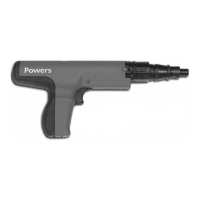
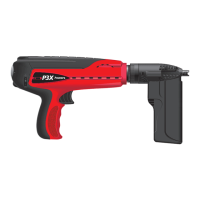
3 P3500
CAT NO. DESCRIPTION STD CTN.
52000 P3500 Powder Tool (Deluxe Kit) 1
52001 P3500 Powder Tool (Blister Pack) 1
52102 P3500 Piston Flat End w/ring 1
52108 Guide 2/F-3 1
52110 Base Plate 2/S-13 1
52120 Shear Clip 1
52112 Piston Stop 1
52122 Steel Annular Ball 1
The piston for installing 8mm drive pins is listed in the following table. For applications in tight
areas, a limited access base plate/guide is also available.
CAT NO. DESCRIPTION STD CTN.
52100 Piston 2/DN-1 1
52114 Guide 2/F-4 Limited Access 1
52116 Baseplate 2/F-14-1 Limited Access 1
For fastening ceiling clips overhead, 6' and 8' di-electric pole tools are available.
CAT NO. DESCRIPTION STD CTN.
50065 6' Di-electric Pole Tool 1
50066 8' Di-electric Pole Tool 1
FASTENER FUNCTIONING
Prior to learning the safe operating procedures for this tool, it is important to understand how a
powder actuated fastener works. A powder actuated fastener is considered to be a direct drive or
forced entry type of fastener because it is driven directly into the base material. The driving action
causes tremendous forces to be applied to the fastener. Powers powder actuated fasteners are
specially designed and manufactured using an austempering process to withstand the forces
imposed during the driving operation. Only fasteners manufactured or supplied by Powers
Fasteners should be used in this tool.
FUNCTIONING IN CONCRETE
The performance of a powder actuated fastener when installed into concrete or masonry base
materials is based on the following factors:
1. Strength of the base material
2. Hardness and concentration of the aggregate
3. Shank diameter of the fastener
4. Depth of embedment into the base material
5. Fastener spacing and edge distance
In addition to these factors, installation tool accessories such as a stop spall which reduces the
tendency of the concrete surface to spall during the driving action can increase the performance
of the fastener.
When a powder actuated fastener is driven into concrete, it displaces the volume of concrete
around the embedded area of the fastener shank. As this occurs, the concrete directly
surrounding the fastener is compressed and in turn presses back against the shank of the
fastener. Additionally, the driving action generates heat which causes particles within the
concrete to fuse to the shank of the fastener. This combination of compression and fusion holds
the fastener in the concrete base material. A similar action occurs when fastening into
block masonry.


 To Next Page
 Loading...