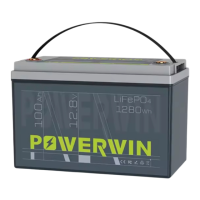
The POWERWIN BT5120 is a 51.2V 100Ah LiFePO4 battery designed for various applications, offering reliable power and a long service life. This user manual provides comprehensive guidance on its operation, charging methods, connection procedures, storage, and troubleshooting, ensuring users can maximize its performance and longevity.
Function Description
The BT5120 battery serves as a robust power source, utilizing LiFePO4 (Lithium Iron Phosphate) technology, known for its stability, safety, and extended cycle life. It is designed to deliver a consistent 51.2V output with a capacity of 100Ah, making it suitable for applications requiring significant energy storage. The battery's internal structure is configured as 16S1P, meaning 16 cells are connected in series and 1 cell in parallel, to achieve the specified voltage and capacity. Its primary function is to store electrical energy and discharge it on demand, powering a wide range of devices and systems.
Usage Features
The BT5120 battery offers several usage features that enhance its versatility and user experience:
- Initial Charging: Before first use, the battery must be fully charged. This ensures optimal performance from the outset and prepares the battery for its intended application.
- Charging Modes: The battery supports two main charging phases: Constant Current (CC) and Constant Voltage (CV). In the CC phase, the battery charges at a steady current until it reaches a specific voltage. Subsequently, in the CV phase, the voltage remains constant while the current gradually decreases. This two-phase charging method is crucial for efficiently and safely charging LiFePO4 batteries.
- Multiple Charging Methods: The BT5120 can be charged using various methods:
- Dedicated Battery Charger: A 58.4V LiFePO4 battery charger is recommended for maximizing capacity. Users should connect the charger to the battery first, then to the power outlet, and disconnect the charger once the battery is fully charged. Reversing terminals should be avoided.
- Solar Panel and Controller: The battery can be charged using a 1200W solar panel system with a 48V (58.4V) solar charge controller. The duration and intensity of sunlight are key factors affecting charging efficiency. For manual controller configuration, specific parameters for undervoltage/overvoltage alarms, recovery, and low-voltage protection are provided, tailored for LiFePO4 batteries.
- Alternator/Inverter: Charging via an alternator or inverter is also possible. For DC output, a DC-DC charger between the battery and generator is recommended. For AC output, an appropriate battery charger should be added between the battery and generator, following the charger's recommendations.
- Series and Parallel Connection: The BT5120 can be connected in both series and parallel configurations to achieve higher voltage or capacity, respectively.
- Parallel Connection: When connecting batteries in parallel, the amperage (capacity) increases while the voltage remains the same. For example, two 51.2V 100Ah batteries in parallel result in a 51.2V 200Ah system. Up to 4 batteries can be connected in parallel.
- Series Connection: When connecting batteries in series, the voltage increases while the amperage remains the same. The manual illustrates connections for 2 and 4 parallel configurations, implying the potential for series connections to achieve higher voltages (e.g., 48V systems).
- Connection Steps: A clear three-step process is outlined for connecting batteries:
- Connect batteries to each other as per the wiring diagram.
- Connect positive output cables to a copper bar (ensuring proper series connection if applicable).
- Connect the load to the copper bar, ensuring the cables can support the total input/output current.
- Voltage Equalization: For systems with multiple batteries, especially in parallel connections, voltage equalization is recommended every six months. This addresses potential voltage differences that may arise over time, ensuring consistent performance across the battery pack.
- BMS Protection System: The battery incorporates a Battery Management System (BMS) that acts as a protection system. If the BMS is triggered, preventing battery output, reactivation steps are provided. These include disconnecting the battery for 30 minutes to allow it to return to normal voltage (above 40V) or using a charger with a "0V" function or an 18V-36V solar panel to reactivate it.
Maintenance Features
Proper maintenance is essential for extending the life and ensuring the safety of the BT5120 battery:
- Storage Conditions:
- For extended storage, the battery pack should be kept within the specified storage temperature range.
- Long-term storage (exceeding three months) requires a temperature of 25±5°C and a relative humidity of 65±20%RH.
- Before storage, it's advisable to charge the battery pack to approximately 50-70% of its capacity.
- Store the battery in a dry, well-ventilated location, away from corrosive substances, open flames, and heat sources.
- Periodic Cycling: If the battery is stored for more than six months, it should be periodically maintained by cycling through charging and discharging.
- Power Level Maintenance: During general maintenance, ensure the battery's power level remains between 40% and 70%.
- Recharging for Infrequent Use: For batteries not in regular use, recharging every six months for 1 to 2 hours with the charger is recommended.
- Prohibition of Disassembly: Unauthorized disassembly or dissection of the battery core is strongly discouraged due to potential negative impacts on performance and safety. Individual batteries should not be replaced or removed from the pack during maintenance.
- Safety Precautions:
- Always wear insulating gloves when making connections.
- Avoid reversing polarity or creating short circuits.
- Do not expose the battery to water, rain, fire, or extreme heat.
- Avoid puncturing the battery housing or subjecting it to physical impact.
- If unusual signs (odor, heat, deformation, discoloration) are observed, stop using and disconnect the battery immediately.
- In case of electrolyte contact with eyes, rinse immediately with water and seek medical help.
- Transportation: During transportation, the battery pack must be adequately packaged to prevent severe vibration, impacts, and compression. It should also be protected from direct sunlight and rain. Various transportation means (cars, trains, ships, planes) are permissible.
By adhering to these usage and maintenance guidelines, users can ensure the safe, efficient, and long-lasting operation of their POWERWIN BT5120 LiFePO4 battery.



 To Next Page
 General
 Weight and Dimensions