Page 20 For equipment technical questions, please call 1-888-866-5797. Item 59669
SAFETY SETUP OPERATION MAINTENANCE
Long-Term Storage
When the equipment is to remain idle longer than 20 days,
prepare the Engine and Pump for storage as follows:
1. CLEANING:
Wait for Engine to cool, then clean Engine with
dry cloth. NOTICE: Do not clean using water.
The water will gradually enter the Engine
and cause rust damage. Apply a thin coat
of rust preventive oil to all metal parts.
2. FUEL:
Gasoline Treatment/Draining the Fuel Tank
• To protect the Fuel Tank during storage,
fill the tank with fresh gasoline that has
been treated with a fuel stabilizer additive.
Follow fuel stabilizer manufacturer’s
recommendations for use. Refer to
Checking and Filling Fuel on page 18.
• Aged gasoline that has not been treated with
stabilizer ahead of time must be safely drained
away and not run through the Engine.
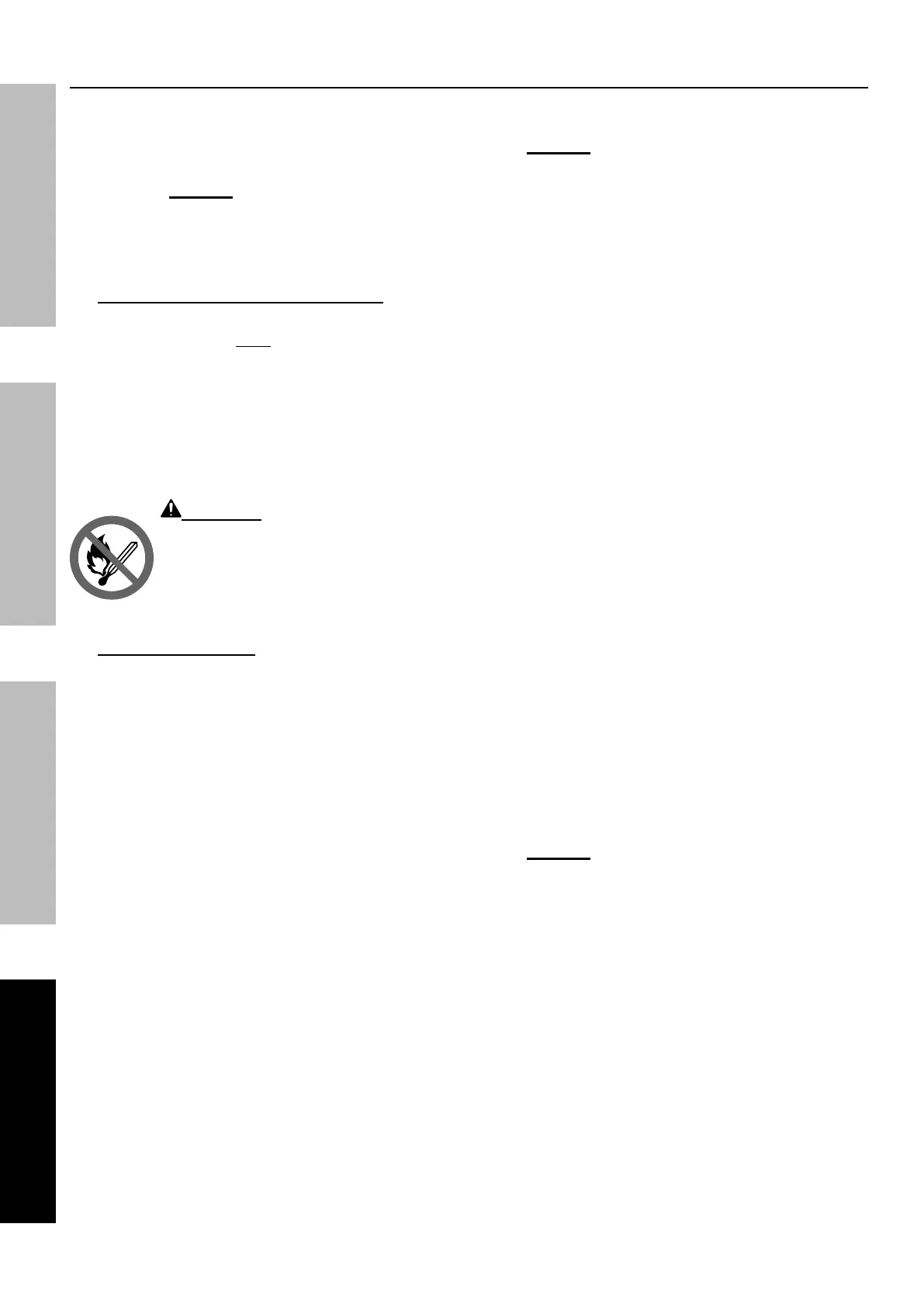
WARNING! TO PREVENT SERIOUS
INJURY FROM FIRE:
Drain the Fuel Tank in a well-ventilated
area away from ignition sources. If the
engine is hot from use, shut the engine off
and wait for it to cool before adding fuel.
Do not smoke.
Draining the Carburetor
• After closing the Fuel Valve, place an
appropriate container under the Carburetor
and carefully remove the Drain Bolt
from the bottom of the Carburetor Bowl,
allowing the fuel to drain completely.
Replace the Drain Bolt after draining.
WARNING! To prevent serious
injury and fire, close the Fuel Valve
before draining the Carburetor.
3. LUBRICATION:
a. Change engine oil.
b. Clean out area around spark plug.
Remove spark plug and pour one tablespoon of
engine oil into cylinder through spark plug hole.
c. Replace spark plug, but leave
spark plug cap disconnected.
d. Pull Starter Handle to distribute oil in cylinder.
Stop after one or two revolutions when you
feel the piston start the compression stroke
(when you start to feel resistance).
4. PUMP PREPARATION:
a. Disconnect the Pressure Hose and
water supply hose from the Pump.
b. Connect a short length of garden hose
with a male hose connector on one end
to the Pump’s water inlet connection.
c. Use a funnel to add approximately six
ounces of RV antifreeze to the Pump.
NOTICE: Use only RV antifreeze.
Other types of antifreeze are corrosive
and can damage Pump.
d. With spark plug cap disconnected and
Engine switch in OFF position, pull Starter
Handle several times until antifreeze begins
to come out of Pump outlet fitting.
e. Remove garden hose from Pump.
5. STORAGE AREA:
Cover and store in a dry, level, well-ventilated
area out of reach of children. Storage area should
also be away from ignition sources, such as
water heaters, clothes dryers, and furnaces.
6. EVERY 3 MONTHS, TO PROTECT ENGINE
AND WARRANTY COVERAGE:
a. Safely drain antifreeze, and dispose of properly.
b. Connect Pressure Hose and water supply hose.
c. Turn on water supply, remove nozzle, point
wand in safe direction, and hold down trigger
until all air is released from the system,
at least 30 seconds. Then release the
Trigger, lock it in the safety position and
replace Nozzle before starting engine.
d. Discharge nozzle in safe direction and
run engine for 15 – 20 minutes or the
Warranty is VOID. Turn off engine.
e. Discharge nozzle in safe direction, and
then disconnect hoses and drain water.
f. Connect a short length of garden hose
with a male hose connector on one end
to the Pump’s water inlet connection.
g. Use a funnel to add approximately six
ounces of RV antifreeze to the Pump.
NOTICE: Use only RV antifreeze.
Other types of antifreeze are corrosive
and can damage Pump.
7. AFTER STORAGE:
a. Before starting the Engine during or after
storage, keep in mind that untreated gasoline
will deteriorate quickly. Drain the Fuel
Tank and change to fresh fuel if untreated
gasoline has been sitting for a month, if
treated gasoline has been sitting beyond the
fuel stabilizer’s recommended time period,
or if the Engine does not start.
b. With spark plug cap disconnected and
Engine switch in OFF position, pull
Starter Handle several times to discharge
antifreeze out of the Pump outlet fitting
before using Pressure Washer.


 To Next Page
 Loading...