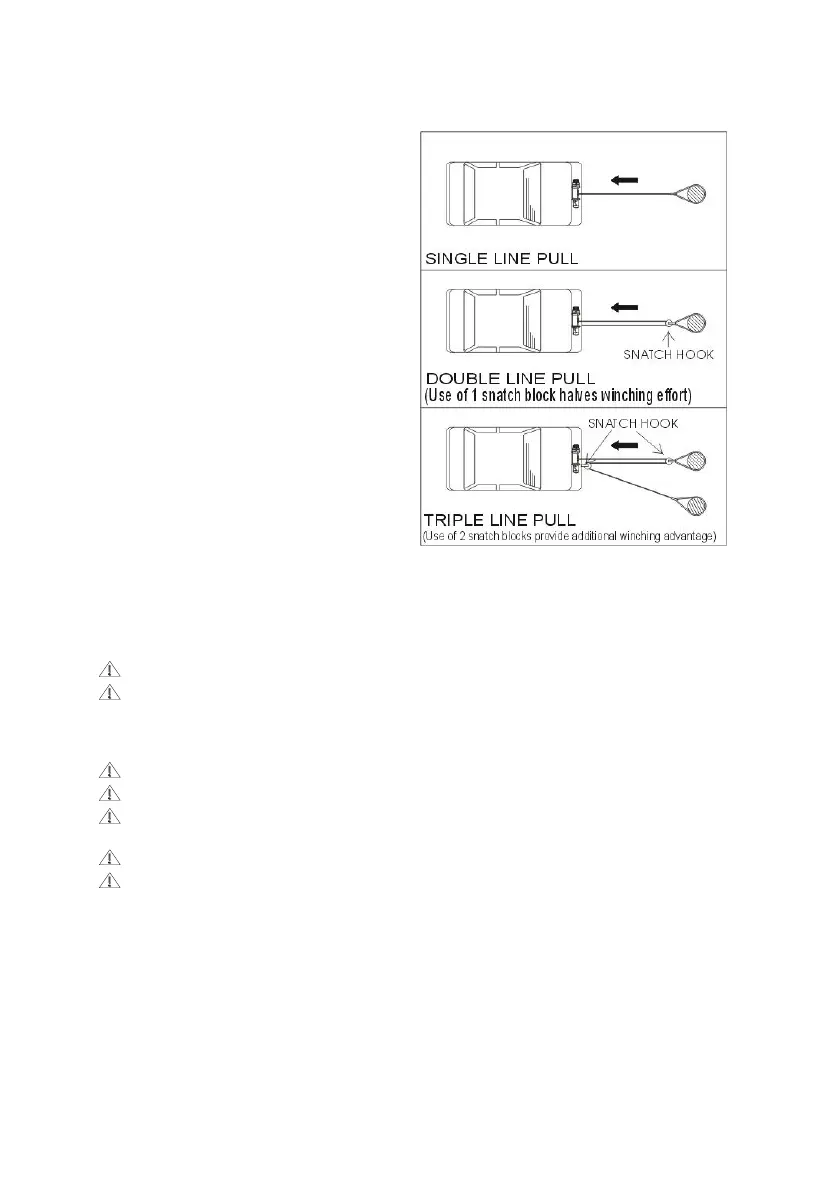
Recovery Procedures
Followings are some safety tips to get out
of trouble during a recovery.
1).When using a winch to rescue another car,
the safest and most efficient direction is
to pull in the same direction, which the
car was moving when it became stuck.
2).When a car is stuck on a slope, the safest
way to pull the car is up the slope
3).Using a snatch block will increase the
capacity, but the speed will decrease
accordingly.
4).Experience has shown the best wire rope
service is obtained when the maximum
fleet angle is not more than 15 degree.
Keep the wire rope as close as possible to
the centre line of the anchor point
5).It is the best to work with the most of
wire rope unreeled from the drum to get
more pulling power, but a minimum of
five (5) wraps of wire rope should be
wound around the drum to support the
rated load.
LIFTING
Although Premier DV-9000/DV-9000i have been designed primarily for winching operations , it’s
possible to use the product for hoisting.
Premier Self-Recovery Winches can be used for lifting if you follow these suggestions.
Remove freespool function or make sure freespool is fully engaged before using.
Divide your winches’ rated load by 5. Take this number and reduce it by 10% for the
second and each additional layer of wire rope to be pulled up onto the drum. The
result of this calculation will be the load that you can lift. Don’t forget friction is one
of the important factors.
Operators and all others need to stand well clear of the lifting area.
Never lift people of lift loads over people.
Check local building and machinery codes to be sure you are in compliance before
using your winches.
Please note the winches’ duty rating is S3 (intermittent-periodic).
Do not keep winching in / out if the motor is overheated , or motor will be burnt-out.



 To Next Page