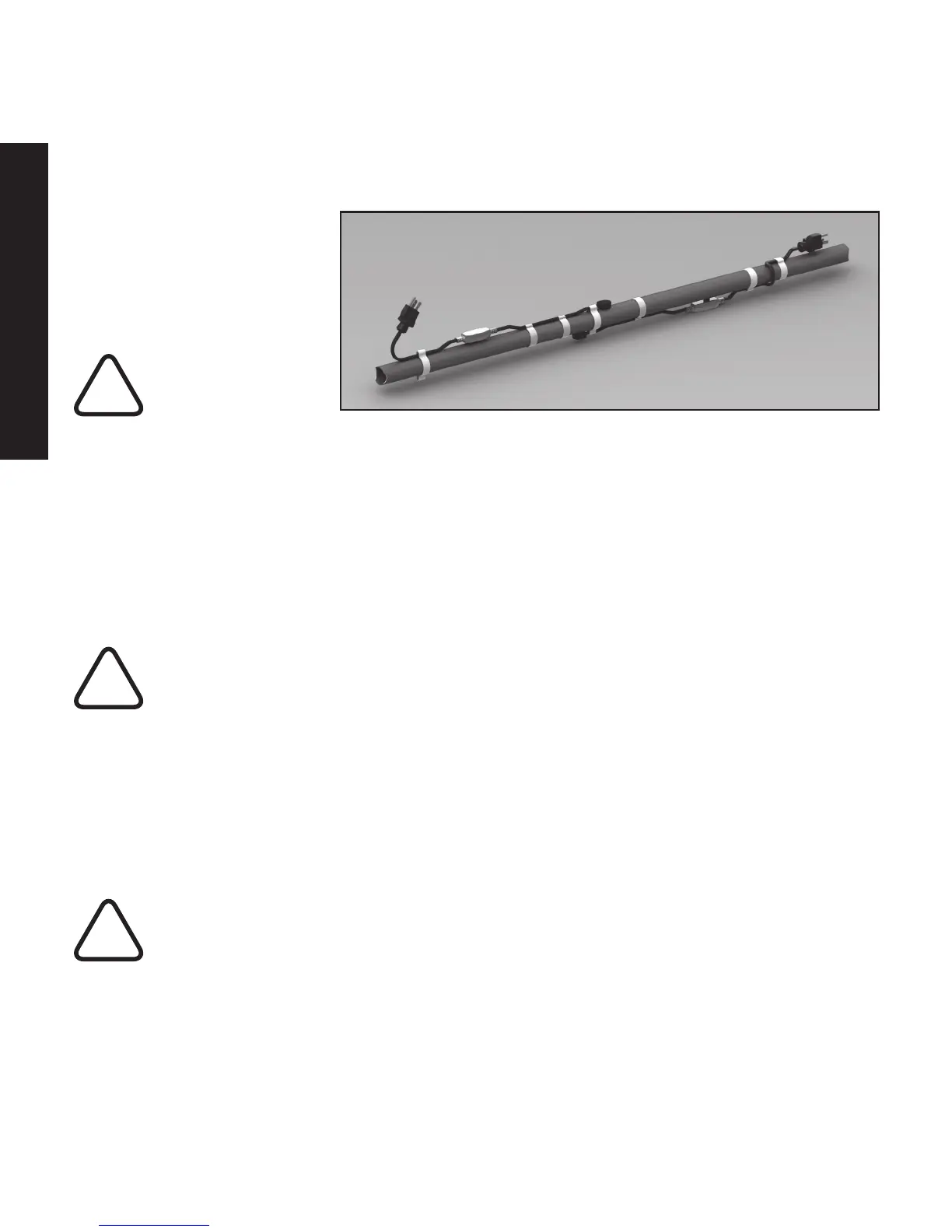
Non-standard lengths: to protect a pipe
with other than one standard length of
heating cable, apply two separate cables
on opposite sides of the pipe, starting
from opposite ends (Fig. 2). The overrun
should not exceed 4 feet.
Warning:
• Avoid pulling and jerking the cable and do not install against sharp edges.
• Do not kink or crush the cable, including walking on it or running it over with equipment.
Attachment
Once the heating cable has been run for the entire section, begin fastening it with application tape or good quality fiberglass tape
(fiberglass tape or other tape with a temperature rating higher than 175°F/79.4°C). In order to keep the thermostat and the entire length
of heating cable tightly in contact with the pipe, circumferential bands of tape should be installed at approximately 6in/ 15cm intervals.
The thermostat should be placed on the coldest end of the pipe. Hand-tightened plastic wire ties, which have a temperature rating
higher than 175°F/79.4°C may also be used to fasten the cable to pipes. For a plastic pipe system, wrapping the plastic pipe with
aluminum foil before installing the heating cable will improve heat transfer and provide more even heat distribution.
Warning:
• Substandard adhesive tapes may allow the cable to move at normal cable operating temperatures and could result in overheating,
fire, or electrical shock.
• Do not use metal attachments such as pipe straps or tie wire to attach the heater cable, as these may damage the heating cable and
cause electrical arcing or fire.
Bending, Crossing & Cutting the Heating Cable
The bending radius should be minimum .3in/8mm. Do not bend the heating cable along a flat plane. Sharp bends can damage the
heating element.
Warning:
• The PRIME Pipe Freeze Protection cable is not a parallel circuit cable. It cannot be cut to the desired length. Once cut, the heating
cable cannot be repaired. Also, the heating cable should never be overlapped.
English
6
!
!
!
Not to scale
Fig. 2



 To Next Page