EasyManua.ls Logo

PSC 101 - Theory of Operation

Default Icon
34 pages
Print Icon
To Next Page IconTo Next Page
To Previous Page IconTo Previous Page
Loading...
ЗЕСПОМ
3
THEORY
OF
OPERATION
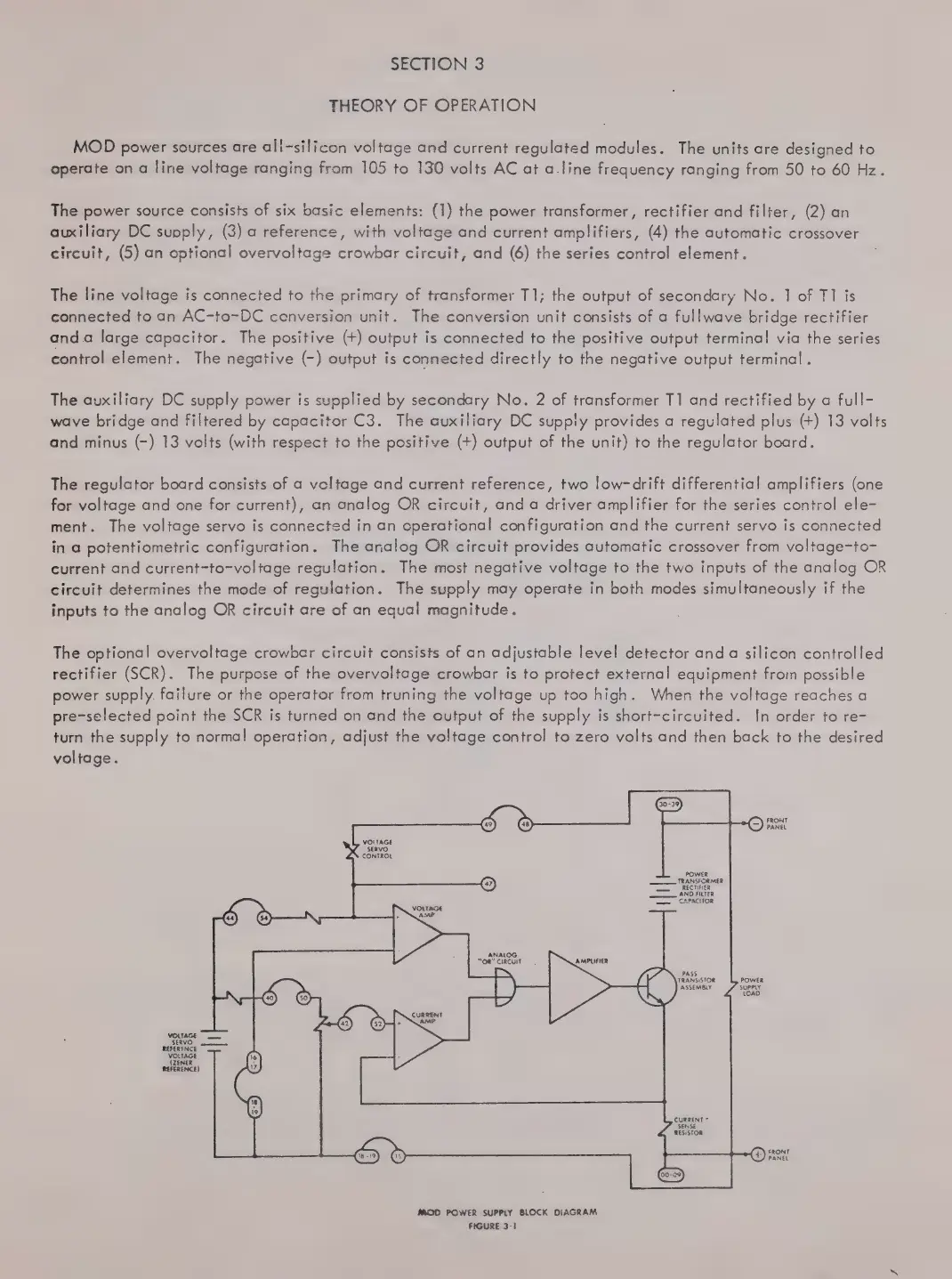
MOD
power
sources
are
all-silicon
voltage
and
current
regulated
modules.
The
units
are
designed
to
operate
on
a
line
voltage
ranging
from
105
to
130
volts
AC
at
a
line
frequency
ranging
from
50
to
60
Hz.
The
power
source
consists
of
six
basic
elements:
(1)
the
power
transformer,
rectifier
and
filter,
(2)
an
auxiliary
DC
supply,
(3)
a
reference,
with
voltage
and
current
amplifiers,
(4)
the
automatic
crossover
circuit,
(5)
an
optional
overvoltage
crowbar
circuit,
and
(6)
the
series
control
element.
The
line
voltage
is
connected
to
the
primary
of
transformer
Т1;
the
output
of
secondary
No.
1
of
TI
is
connected
to
an
AC-to-DC
conversion
unit.
The
conversion
unit
consists
of
a
fullwave
bridge
rectifier
anda
large
capacitor.
The
positive
(+)
output
is
connected
to
the
positive
output
terminal
via
the
series
control
element.
The
negative
(-)
output
is
connected
directly
to
the
negative
output
terminal.
The
auxiliary
DC
supply
power
is
supplied
by
secondary
No.
2
of
transformer
T1
and
rectified
by
a
full-
wave
bridge
and
filtered
by
capacitor
C3.
The
auxiliary
DC
supply
provides
a
regulated
plus
(+)
13
volts
and
minus
(-)
13
volts
(with
respect
to
the
positive
(+)
output
of
the
unit)
to
the
regulator
board.
The
regulator
board
consists
of
a
voltage
and
current
reference,
two
low-drift
differential
amplifiers
(one
for
voltage
and
one
for
current),
an
analog
OR
circuit,
anda
driver
amplifier
for
the
series
control
ele-
ment.
The
voltage
servo
is
connected
in
an
operational
configuration
and
the
current
servo
is
connected
in
a
potentiometric
configuration.
The
analog
OR
circuit
provides
automatic
crossover
from
voltage-to-
current
and
current-to-voltage
regulation.
The
most
negative
voltage
to
the
two
inputs
of
the
analog
OR
circuit
determines
the
mode
of
regulation.
The
supply
may
operate
in
both
modes
simultaneously
if
the
inputs
to
the
analog
OR
circuit
are
of
an
equal
magnitude.
The
optional
overvoltage
crowbar
circuit
consists
of
an
adjustable
level
detector
and
a
silicon
controlled
rectifier
(SCR).
The
purpose
of
the
overvoltage
crowbar
is
to
protect
external
equipment
from
possible
power
supply.
failure
or
the
operator
from
truning
the
voltage
up
too
high.
When
the
voltage
reaches
a
pre-selected
point
the
SCR
is
turned
on
and
the
output
of
the
supply
is
short-circuited.
In
order
to
re-
turn
the
supply
to
normal
operation,
adjust
the
voltage
control
to
zero
volts
and
then
back
to
the
desired
voltage.
FRONT
PANEL
VOLTAGE
POWER
TRANSFORMER
RECTIFIER
AND
FILTER
CAPACITOR
ANALOG
VOR”
CIRCUIT
PASS
TRANSISTOR
ASSEMBLY
CURRENT
-
NSE
RESISTOR
FRONT
PANEL
MOD
POWER
SUPPLY
BLOCK
DIAGRAM
FIGURE
3-1