Need help?
Do you have a question about the Pudu PuduBot PD2 Young and is the answer not in the manual?
Essential guidelines for safe operation and interaction with the robot to prevent accidents.
Resolving power-on self-test failures and unexpected stops during robot operation.
Troubleshooting signal loss, positioning errors, and boot-up failures.
Guidelines for operating environments, including floor types, slopes, clearances, and radar interference avoidance.
Guidelines for maintaining battery health, including charge levels and proper shutdown procedures.
Instructions for safe charging, including charger use, environmental considerations, and emergency actions.
Key safety rules, prohibitions, and precautions to prevent damage, injury, or malfunction.
Procedure for connecting the robot to the charging cable and confirming successful charging initiation.
Steps for powering the robot on, off, pausing operations, and resuming tasks.
Introduction to robot modes and detailed steps for food delivery to tables.
Explanation of common robot alarm messages and their corresponding solutions.
Instructions for using the physical emergency stop switch to halt the robot.
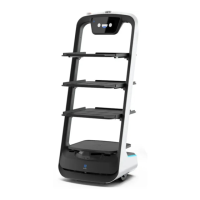
The PuduBot is a versatile wheeled robot designed for indoor environments, primarily for food delivery and plate collection services in various business scenarios. It offers a range of operational modes and features to enhance efficiency and customer experience in hospitality settings.
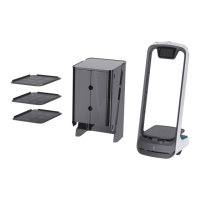
The PuduBot's core function is autonomous transportation of items within a defined indoor space. It is equipped to deliver food to multiple tables simultaneously, collect used plates, and even provide self-service options like drinks or snacks in a cruise mode. The robot navigates using a combination of vision positioning, depth vision sensors, and Lidar, ensuring precise movement and obstacle avoidance. Its design allows for adjustable tray heights, accommodating different types of items, and it can be configured with either three or four trays depending on the model.
The robot's operational modes include:
The PuduBot also features a user-friendly touch screen interface for task management, mode selection, and interaction. It provides voice prompts for various actions and alerts, ensuring clear communication with both staff and customers.
The PuduBot is designed for ease of use and integrates seamlessly into daily operations. Before each power-on, the robot should be moved directly below a visual mark for accurate positioning. Powering on involves pressing and holding the power button for three seconds, indicated by a blue light strip. The screen then enters the working mode, confirming successful boot-up. Powering off follows a similar process, with the light strip turning off and the screen going black.
During operation, the robot can be paused by touching the screen, allowing for temporary stops to pick up or drop off items. In cruise mode, if no action is taken during a pause, the robot automatically resumes walking after 20 seconds; in other modes, it resumes after 10 seconds. Users are advised not to pick up or drop food while the robot is moving to prevent spills or injury.
The robot's navigation system is robust, but users should ensure the environment is flat, free of debris, and has sufficient clearance (minimum 80cm pass width, 1m for long passes, and 1.2m for kitchen entrances). It can handle slight slopes (up to 10° climbing angle, but 5° recommended for stability of dishes) and avoids obstacles automatically. However, sudden blocking of the robot during high-speed operation is prohibited.
Charging is straightforward: connect the charging cable to the robot's charging port. The screen displays charging progress and indicates when the battery is full. It's crucial to charge the robot when the power is below 10% to maintain battery life and to disconnect the charger once fully charged. The robot will not perform tasks if the battery is below 2%.
The PuduBot offers customizable settings for various parameters:
Maintaining the PuduBot ensures its longevity and optimal performance. Regular cleaning and inspection are essential:
In case of alarms or malfunctions, the robot will stop working and provide an alarm tone and instructions on the screen. Common alarms include low battery (requiring charging) and loss of positioning (requiring the robot to be pushed back to the visual mark). For emergencies, an emergency stop switch is located on top of the robot.
The manual also outlines detailed after-sales service information, including free warranty conditions, exclusions, and the service process. It emphasizes using original rechargeable batteries and chargers, protecting the power cord, and charging in a dry, normal-temperature environment away from flammable objects. Regular checks for charger damage are also recommended.
 General
| Model | PuduBot PD2 Young |
|---|---|
| Charging Time | 4 hours |
| Operating Temperature | 0°C to 40°C |
| Category | Service Robot |
| Battery Life | 10 hours |
| Navigation | Visual SLAM |
| Speed | 1.2 m/s |
| Communication | Wi-Fi |


 To Next Page