www.PyleUSA.com
3
OPERATION
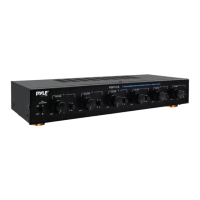
1. Speakers ON/OFF Button: Press button to turn ON all speaker pairs.
Press button again turn OFF.
2. Amplier A/B Selector Button: Press button to select amplier A and B.
3. Volume Controls: Turn the control knob clockwise to increase the volume and
counter-clockwise to decrease or o.
4. Speaker Connections: The control center divides the power from your receiver/
amplier dierently to its speaker terminals. (This is especially noticeable when
you connect only one pair of speakers. If you connect more than one pair of speakers,
see "Impedance Chart" on page 4 to selector the best terminals to connect.)
For the best performance, make the connections based on how frequently you use
each set of speakers.
Cautions:
To avoid damaging your speakers or receiver/amplier:
• Be sure your receiver/amplier's power is turned o before you make the
connections.
• Never let the speaker wire's bare ends touch each other or the adjacent terminals
on the control center.
• Do not connect more than one pair of sepakers to each set of terminals.
5. Amplier Connections: Connect the speaker output of your receiver or amplier
(100 watts max). lf you are using a second amplier, connect it to the B amp terminal.
Maximum Amplier input
• 100W RMS
• 150W AVG
Maximum Output per Speaker
• 18W RMS
• 50W AVG
• 100W PEAK
• 4 or 16 OHMS LOAD
Insert the speaker’s positive (+) wires in the positive terminals, and negative (-) wires
into the negative terminals, according to the respective L (left) and R (right) terminals.


 To Next Page
 Loading...