9
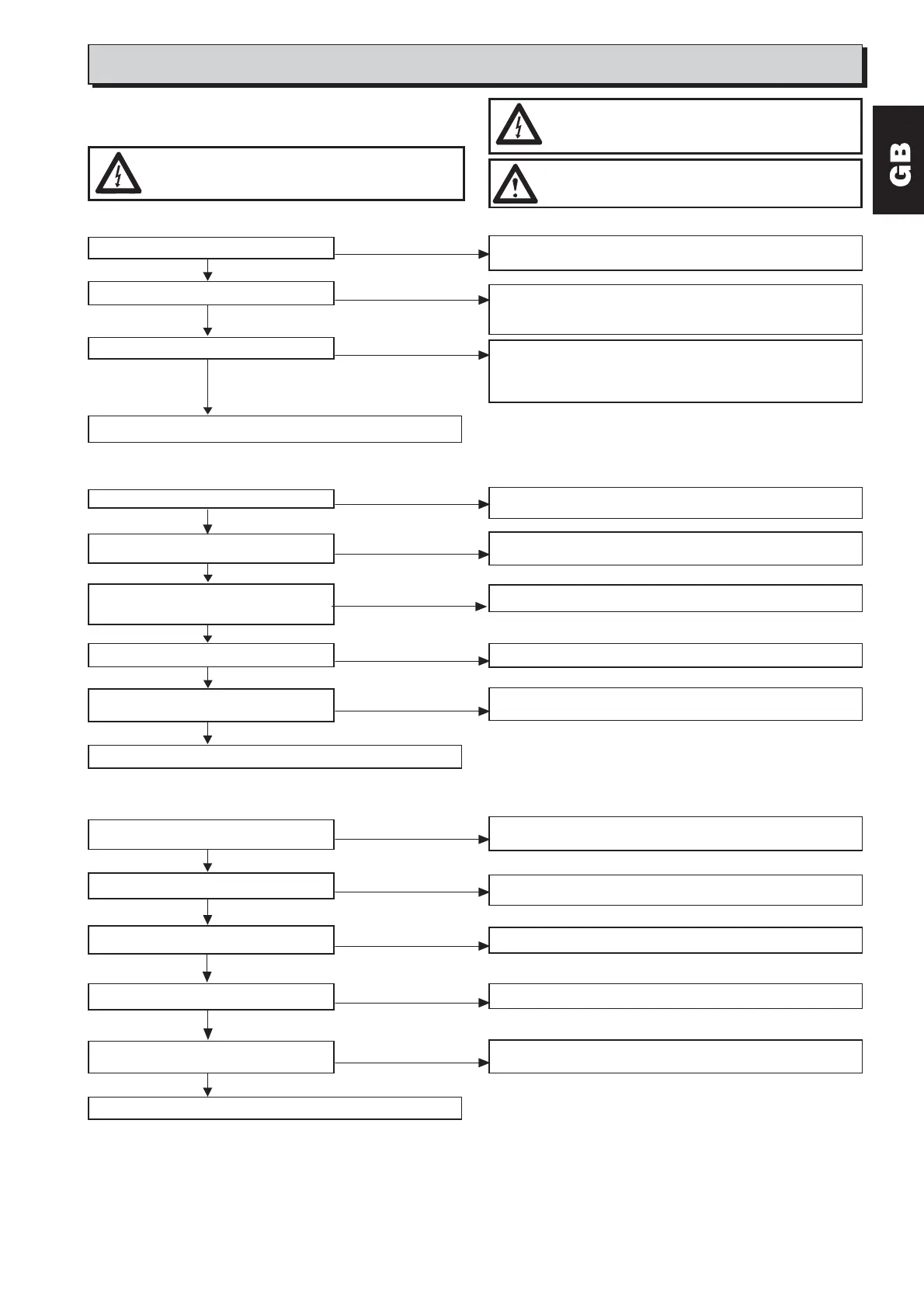
The pump fails to start.
Is a fault signal indicated on the starter? Yes Check that the cooling performs as intended and that
the impeller is not jammed.
No
Can the pump be started manually? Yes Check that:
1. The level control equipment performs satisfactorily.
No 2. The control equipment performs satisfactorily.
3. The temperature sensors performs satisfactorily.
Is the plant de-energized? Yes Check that:
1. The main power supply switch is closed.
No 2. The control power supply is available.
3. All phases in the incoming supply are live.
4. There is no open circuit in the motor cable.
Get in touch with an authorized Pumpex workshop.
The pump stops.
Is the pump overloaded? Yes Check that the density of the pumped liquid is not too
high (dilute the liquid or change to a suitable pump).
No
Isolate the power supply and check that Yes Clean the volute and check that the wear ring,
the impeller is not stiff to turn by hand. if any, has been correctly adjusted
No
Has the overcurrent protection Yes Adjust.
been adjusted too low?
No
Is the overload protection defective? Yes Replace
No
Does the system have full No Check the motor fuses.
voltage on all phases? Consult an electrical contractor.
Yes
Get in touch with an authorized Pumpex workshop.
The pump runs but the flow rate it delivers is too low.
Is the impeller rotating in the right No Transpose to phases. See under
direction? (See ”Operation”) ”Electrical connections”
Yes
Is the volute or impeller clogged? Yes Clean and check that the wear ring, if any,
has been correctly adjusted.
No
Is the impeller or wearring, if any, worn? Yes Replace any worn parts and/or adjust the wear ring.
No
Are the valves or pipes clogged? Yes Remedy the fault.
No
Is the required delivery head too high? Yes Adjust the pump by fitting a different impeller, for instance.
(See the Product sheet) If this is not possible, change over to a suitable pump.
No
Get in touch with an authorized Pumpex workshop.
The manufacturer reserves the right to change the design and specifications.
Fault tracing
The most common faults on a submersible waste water pump are usually in
the electrical installation, control equipment or pipe system. To enable fault
tracing work to be carried out on the electrical equipment, you will need a
universal instrument, a test lamp and a wiring diagram.
CAUTION!
Always check that no one is in the vicinity of the pump
when the power supply is switched on.
CAUTION!
All fault tracing should be carried out with the power
supply isolated. An exception are the checks that cannot
be carried out without the power supply.
CAUTION!
Work on the electrical equipment should be carried out by
authorized personnel. Always follow the local installation
regulations and observe the recommended safety directives.



 To Next Page