QIRF Operation And Maintenance Manual
QIRF Operation Manual May. 01, 2012
85050-301-000 Rev C
4
Comparing with conventional gas detector, gases to be detected are often corrosive and
reactive. With most sensor types, the sensor itself is directly exposed to the gas, often
causing the sensor to drift or die prematurely. The main advantage of IR sensor or
transmitter is that the detector does not directly interact with the gas (or gases) to be
detected. In the QIRF Smart Sensor, the major functional components are protected with
optical parts. In other words, gas molecules interact only with a light beam. The IR
Source and IR Detector can be treated, making them resistant to corrosion, and are
designed such that they are easily removable for maintenance or replacement.
1.2 Key Features
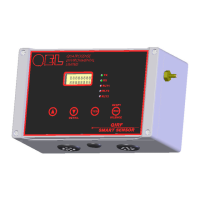
• Infrared Sensing Technology
• Constant Temperature QT Gas Sampling Cell
• Standard RS-485 Output with OptoMux protocol and ModBus protocol
• Standard 4-20mA or 2-10VDC Analog Output
• Diffusion Sampling module or Pump-thru module
• No moving parts in diffusion or pump-thru model
• Water and corrosion resistant PVC enclosure NEMA 4, 4X
• Addressable from 0 to 31
• 4 magnetic sensors as keypad input
• 3 programmable Relays and 3 programmable Buzzers
• 2 x 8 character LCD display c/w backlight
• Operation at 18-30VDC or 15–24VAC
• 3 Relay Status LED, TX Status LED and RX Status LED
• CSA/UL approval (pending)
1.3 Applications
The QIRF is designed to monitor for the loss of refrigerant gas in a variety of
applications:
• Mechanical equipment rooms
• Propellant filling operations
• Solvent cleaning stations
• Cold storage and transport facilities
• Meat packing plants
• Supermarkets and refrigerant storage locations
• Other specialty applications using halocarbons


 To Next Page