36 37
t IX. OPERATING GUIDE
Q. TROUBLESHOOTING GUIDE
FOR POWER SEATING
SYMPTOM Possible Causes How to fix this
Nothing works!
• No batteries in
your wheelchair
• 24V power cable
disconnected
• Fuse is burned
• Control switch
is defective
• Breaker has popped
• Check batteries
• Verify all connections
• Verify and/or replace
battery cables
• Reset the breaker
Actuator is noisy
when going up
or down
• Defective actuator
• Mechanical restraint
• Make sure the seat is
aligned well and doesn’t
interfere with the rear of
the power tilt actuator
when tilting
• Check for and remove
mechanical restraints
Actuator is
going only in one
direction
• Wrong
programming
• Cable connected in
wrong location
• Pinched cables
• Verify electrical assembly
and programming
thoroughly
• If problem persists,
call SUNRISE
technical support for
further instructions
Relays can
be heard, but
actuator does not
operate
• Actuator not
connected to power
module
• Defective actuator
• Defective power
module
• Pinched cables
• Verify electrical
connection assembly and
programming thoroughly
• Verify if cables are
pinched
• If problem persists,
call SUNRISE
technical support for
further instructions
Fuse burns or
breaker pops
repeatedly
• Mechanical restraint
• Short circuit in one
of the cables
• Defective power
module
• Verify mechanical
assembly thoroughly
• If problem persists,
call SUNRISE
technical support for
further instructions
Drive lock-out
switch, tip switch
or reduce drive
switch do not
work properly
• Wrong
programming
• Cable connected in
wrong location
• Drive lock-out
switch is unplugged
or defective
• Reduced drive
switch is unplugged
or defective
• Tip switch is
unplugged or
defective.
• Pinched cables
• Verify proper
mechanical operation of
limit switches.
• Verify electrical assembly
and programming
thoroughly
• Verify if cables are
pinched
• If problem persists,
call SUNRISE
technical support for
further instructions
Charger fuse
burns every time
an attempt is
made to charge
the batteries
• Wrong charger
is used
• Trouble with
the power
interfacing cable
• Make sure you are
using the battery
charger provided with
your wheelchair
• Verify all cables
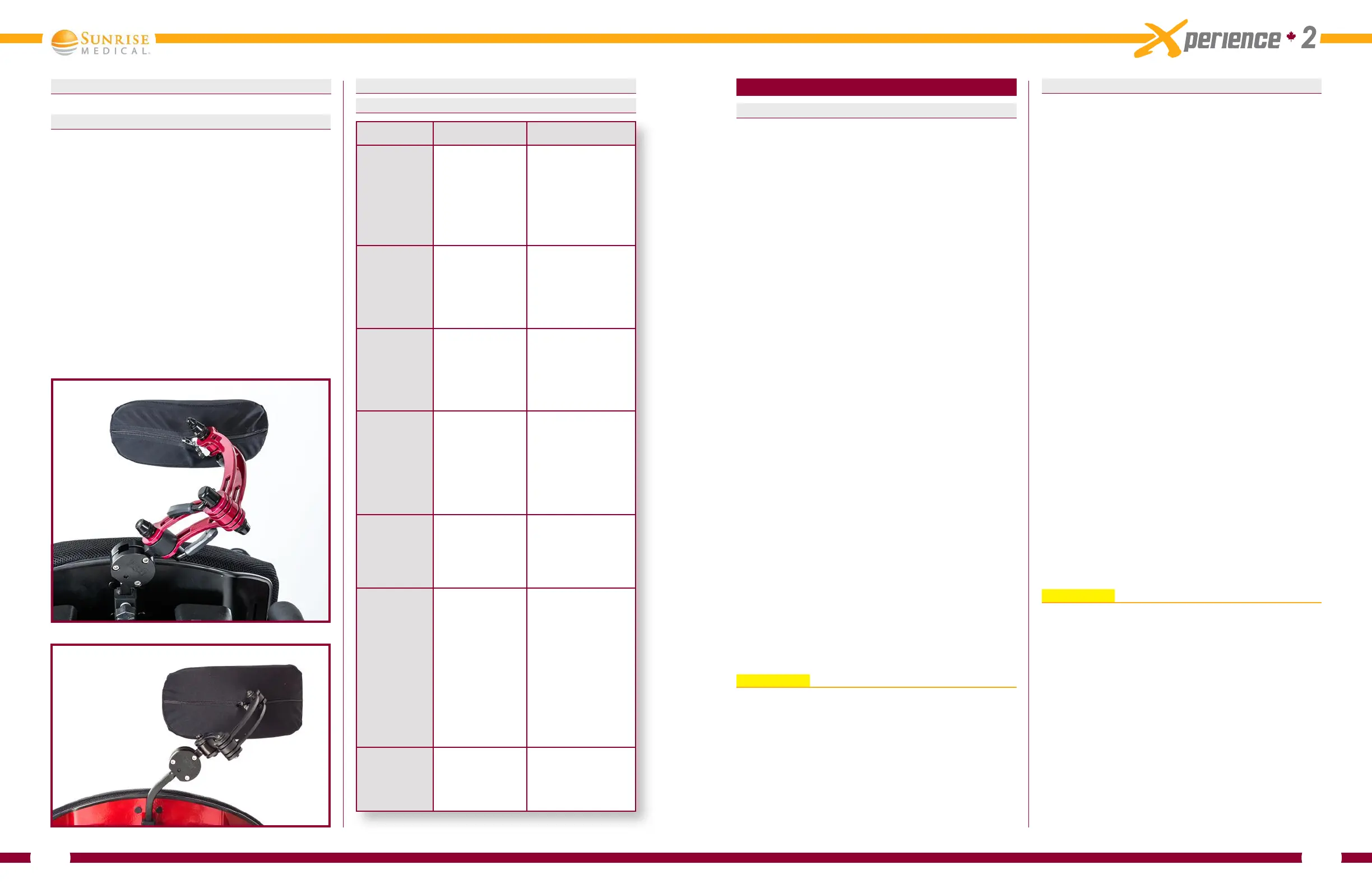
MULTI-AXIS HEADREST
The multi-axis headrest has a pivot ball at the bottom to
allow up to 3” (75 mm) of lateral movement. The kit is
supplied with additional hardware consisting of nuts and
bolts to replace the quick latch system if desired. It also
comes with a second vertical bar that can add another
2” (50 mm) of movement in all directions.
NOTE - When pushing the quick latch back in, it should be hard
and stiff to close down. It should leave a pressure mark on your
palm. If it still moves after that, repeat by tightening the nut, not
the latch. The first time it is tightened, usually the star washer on
the inside will ”break” the paint. The second time, it will be firmly
set into the metal and hold well.
If it is still not tight enough, you can use the replacement
nuts and bolts supplied with every headrest to lock it
into place.
Quick latch u
Pivot ball u
t Straight height
adjustment rod
2” (50 mm)
curved height
adjustment rod u
p
Nuts and bolts
replace quick
release hardware
t Tightening nut
P. ADJUSTMENTS (continued)
X. BATTERIES u
X. BATTERIES
A. INTRODUCTION
1. Notes -
• Batteries supply the power for your wheelchair.
They contain a finite amount of energy and have
limits on how long they can store and supply energy.
• You can charge batteries only a certain number
of times before they will fail and no longer hold
a charge.
• For answers to questions about batteries, consult
your authorized supplier.
2. Use proper batteries:
• Your power wheelchair operates on two 12 volt
deep cycle, AGM- or gel-type batteries.
• They should be Group 24 (or 22NF) size with a
minimum of 50 ampere hour rating. Only deep
cycle sealed case construction batteries should be
used in this device.
• When you buy a replacement, insist on a deep cycle
sealed case type. DO NOT use a car starter battery.
3. Breaking in:
• A battery requires ”breaking-in” for the first
6 to 12 charges. It will not accept a full charge
for this period.
• It is best to limit the length of your trips until you
break the batteries in and you know the range of
your power wheelchair.
4. Discharged batteries:
• NEVER allow a battery to completely discharge.
If you operate your power wheelchair until it has
almost stopped, you will greatly reduce the life of
your batteries.
• NEVER let a battery sit in a discharged condition.
Give unused or stored batteries a full charge once
per month.
• ALWAYS fully charge the batteries. Avoid
”topping off” with frequent charges.
!
WARNING
NEVER connect a life support or auxiliary device to a
power wheelchair battery. The electrical system may fail,
and result in severe injury or death of user.
B. BATTERY CHARGER
A battery charger produces a direct current (DC). When
applied to a discharged battery, this reverses the chemical
reaction that led to its discharge.
1. Charge rate. How fast a battery will charge
depends on:
• Its electrical capacity, state of charge, electrolyte
tem perature, and internal condition.
• The DC output of the charger. (The charge rate will
vary if the alternating current (AC) supply is higher
or lower than 110 volts).
2. Caution — To avoid damage to the charger:
• NEVER place the charger on top of a battery during
charging. (Gases from the battery can damage the
charger and may lead to an explosion or fire).
• NEVER place a battery on top of the charger.
• NEVER expose charger to rain or snow.
• NEVER unplug charger by pulling on the electrical
cord. This will damage the cord.
• NEVER open a charger or attempt to repair it
yourself. Return a defective charger to
your authorized supplier.
• Keep cord out of the way, where it will not be
stepped on, tripped over, or damaged.
3. Caution — To avoid damage to the battery:
• Make sure you use the correct setting for sealed (gel)
bat teries (located on the off-board charger).
• NEVER charge a frozen battery. A fully charged
battery will rarely freeze, but the fluid in a
discharged battery can freeze at 16° Fahrenheit
(minus 9° Centigrade). If you suspect a battery is
frozen, thaw it before charging.
!
WARNING
Lead acid batteries generate explosive gas while charging.
Completely read and follow all warnings on batteries
in this Owner's Manual and any labels applied to the
product. Not doing so, could result in fire, explosion, injury
and/or death.



 To Next Page