Need help?
Do you have a question about the Quincy QP Series and is the answer not in the manual?
Details on electrical installation, NEC/CEC compliance, voltage verification, and grounding.
Safety requirements for mechanical guards, ensuring they are fastened and not removed during operation.
Purpose of pressure relief valves in preventing system failures and the danger of altering settings.
Safety devices required for hoses exceeding 1/2" to prevent whipping in case of failure.
Compliance requirements for air receiver tanks and other pressure vessels per ASME codes.
Essential checks before connecting power to ensure safe and proper compressor startup.
Procedures for reading manual, checking for issues, and starting the compressor for the first time.
Procedures for safely stopping the compressor for maintenance, including lockout/tagout and isolation.
Common causes for low discharge pressure, including restricted inlet, defective valves, and leaks.
Causes for milky lubricant, such as insufficient run time or incorrect lubricant grade.
Causes of excessive vibration, such as incorrect speed, loose components, or inadequate foundation.
Causes of low oil pressure, such as plugged sump strainer, leaks, or low oil level.
Causes of pressure switch malfunction, including moisture buildup, diaphragm rupture, or loose connections.
Reasons for overheating, including clogged intake, inadequate ventilation, or incorrect sizing.
Causes of compressor knocks, like insufficient head clearance, worn bearings, or loose pulleys.
Causes of excessive current draw, like low voltage, wire size, or motor issues.
Troubleshooting steps for when the compressor fails to start, including power, voltage, and switch issues.
Causes of motor stalls, primarily motor overload due to excessive current draw.
 General
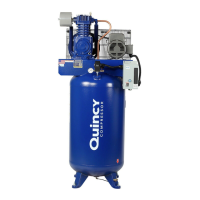
| Brand | Quincy |
|---|---|
| Model | QP Series |
| Category | Compressor |
| Language | English |


 To Next Page