Need help?
Do you have a question about the Quincy QR-25 Series and is the answer not in the manual?
Important safety information and precautions for compressor operation and maintenance.
Defines hazard levels (Danger, Warning, Caution) for safety alerts.
Lists additional safety rules for compressor operation and maintenance.
Specific safety alerts regarding breathing air, oil residue, and battery cables.
Details updates made to the manual since the previous printing.
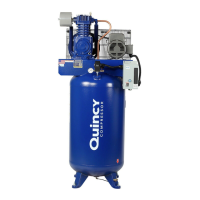
Overview of Quincy Compressor QR-25 Series, types, and capabilities.
Explains single and two-stage compression cycles.
Describes how Quincy compressors are lubricated.
Explains how QR-25 series compressors are cooled.
Discusses the role of dryers and filters in air systems.
Details components like Unloader Towers and Pilot Valves.
Explains different control versions for QR-25 series compressors.
Basic compressor with no added control features.
Start/stop machine with unloader towers and pressure switch.
Variation of Control Version L with check valve.
Version for continuous run applications, often for engine-driven units.
Version with manual shutoff for variable demand.
Technical specifications for QR-25 Series models.
Steps for inspecting and handling compressor equipment upon arrival.
Procedures for handling and reporting shipping damage.
Guidelines for installing the compressor in a suitable environment.
Warnings about operating off-level, toxic atmospheres, and noise.
Details electrical installation requirements and safety.
Explanation and safety advice regarding overload relays.
Crucial guidelines for mounting compressor units safely and effectively.
Importance of quality components and drive pulley considerations.
Diagrams showing wiring for 3 phase magnetic starters.
Diagrams showing wiring for single phase magnetic starters.
Requirements for guards, check valves, shutoff valves, and pressure relief valves.
Details regarding the air intake system.
Requirements for a clean, cool, dry air supply for the compressor.
Guidelines for installing the discharge piping system.
OSHA requirements for safety devices on hoses.
Standards for pressure vessels like receiver tanks.
Warnings about pressure vessels and discussion of condensation issues.
Procedures for manually draining moisture from the air tank.
Warnings and procedures for draining air tanks and inspection intervals.
Essential steps to perform before connecting power.
Warnings about potential restart during service and checklist importance.
Detailed pre-start checks including tools, lubricant, alignment, and piping.
Procedures for starting the compressor and initial operation checks.
How to check and adjust oil pressure.
Monitoring compressor operation for the first few hours.
Daily checks to ensure proper operation and safety.
Procedures for safely stopping the compressor for maintenance.
Importance of developing a routine maintenance schedule.
Sample checklist for daily maintenance tasks.
Lists recommended maintenance procedures by interval (weekly, monthly, etc.).
Information on lubricant types, checks, and changes.
Details on lubricant types, quantities, and viscosity.
Guidelines for proper pulley alignment.
Step-by-step procedures for setting belt tension.
How to adjust the pressure switch settings.
Procedures to reverse the operating direction of the compressor.
Detailed steps for reversing compressor rotation, including oil pump housing.
Procedures for adjusting pilot valve settings.
Probable causes for low discharge pressure and milky lubricant.
Probable causes for excessive vibration and rusty valves/cylinders.
Troubleshooting for belt wear, low oil pressure, and excessive loading.
Causes for defective pressure switches and excessive air pressure.
Troubleshooting for intercooler pressure and other component issues.
Probable causes for compressor overheating and high discharge temperature.
Probable causes for compressor knocking sounds.
Causes for excessive lubricant consumption and excessive current draw.
Probable causes for the compressor failing to start or motor stalling.
Table of correction factors for compressor capacity based on altitude.
Table of average intercooler pressures for QR-25 models.
General legal, contractual, and liability terms for compressor sales.
Manufacturer's warranty terms and compliance with regulations.
 General
| Brand | Quincy |
|---|---|
| Model | QR-25 Series |
| Category | Compressor |
| Language | English |


 To Next Page