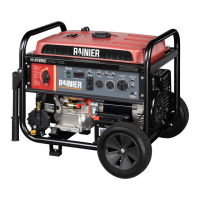
This document describes the Rainier R4400 Open Frame Generator, a portable power solution designed for various applications. The manual provides comprehensive information on its features, operation, maintenance, and safety guidelines to ensure proper and safe use.
Function Description
The Rainier R4400 is an open-frame generator designed to provide portable electrical power. It operates on gasoline and features an electric start for convenience. The generator is capable of producing both running and peak watts, making it suitable for powering a range of tools and appliances. Its primary function is to supply electricity in situations where grid power is unavailable or unreliable, such as during power outages, at construction sites, or for recreational activities. The generator's engine converts fuel into mechanical energy, which then drives an alternator to generate electrical power. It includes various outlets to accommodate different electrical loads and circuit breakers to protect against overloads.
Usage Features
The R4400 generator is designed with user convenience and safety in mind. Before starting, users must ensure the generator is placed on a level, solid surface outdoors in a well-ventilated area, at least 15 feet away from any buildings or combustible materials, to prevent carbon monoxide accumulation and fire hazards. It is crucial to check both engine oil and gasoline levels before operation. The generator requires unleaded gasoline with a maximum of 10% ethanol and an 87 octane rating or higher. Refueling should always be done outdoors with the engine off and cooled to prevent ignition of fuel vapors.
The generator offers two starting methods: electric start and manual recoil start. For electric start, the engine control switch is held in the "START" position until the engine fires up, then released to the "RUN" position. If the engine is cold, the choke lever should be moved to the "ON" position before starting and gradually returned to "OFF" once the engine stabilizes. For manual start, the recoil handle is pulled with a rapid motion after feeling increased resistance. After starting, it's recommended to wait 15 seconds for the engine to stabilize before connecting any electronic devices. All loads should be disconnected from the control panel receptacles before starting to prevent damage to appliances.
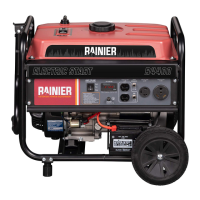
The control panel features a VFT Meter, an LED display that cycles through volts, frequency, and lifetime run hours, allowing users to monitor the generator's performance. It includes 120-Volt, 20-Amp Duplex Outlets (5-20R), a 120-Volt, 30-Amp Twistlock Outlet (L5-30R), and a 120-Volt 30-Amp Outlet (TT-30R) for travel trailers. A main circuit breaker and 20-amp circuit breakers protect the outlets from overcurrent. The generator also has a ground terminal for connecting to earth ground, which may be required by local electrical codes for safety. For portability, the R4400 is equipped with never-flat wheels and a single-piece handle with a rubber grip, allowing for easy movement by pushing or pulling. The fuel cap is designed to close with a clicking sound, ensuring a secure seal. The choke lever is used for cold starts (ON) and warm starts (OFF).
Maintenance Features
Regular maintenance is essential for the longevity and optimal performance of the Rainier R4400 generator. The manual provides a detailed maintenance schedule, differentiating between owner-performed tasks and those requiring an authorized service dealer.
Owner-performed maintenance includes:
- Engine Oil Maintenance: The engine oil level should be checked before every use. The generator requires 4-stroke/cycle engine oil (SAE30, Conventional 10W-30, or 5W-30 depending on temperature). The oil should be changed after the first 20 hours or first month of use, and then every 50 hours or 6 months. To check the oil, the generator must be on a flat surface, the engine stopped and cooled, and the oil fill plug/dipstick removed, wiped clean, reinserted without threading, and then removed again to check the level. Oil should be visible between the H and L lines on the dipstick. Adding oil is done slowly using a funnel until the correct level is reached.
- Cooling Features: These should be checked and cleaned before every use.
- Air Filter Maintenance: The air filter needs to be checked before every use and cleaned every 50 hours or 3 months (more frequently in dusty environments). Cleaning involves turning off and cooling the generator, unlocking the air filter cover, removing the black coarse air filters, and washing the foam elements in a solution of household detergent soap and warm water. The foam elements should be squeezed gently (not twisted or torn) to clean and dry, then coated with clean engine oil before reinstallation.
- Spark Plug Maintenance: The spark plug should be checked and cleaned every 100 hours or 6 months and replaced every 300 hours or year. This involves stopping and cooling the engine, removing the spark plug boot, cleaning the area around the plug, and then removing the plug with a 13/16" socket wrench. The plug should be inspected for cracks, chips, or excessive wear, and the gap checked (0.027-0.032 in. [0.70-0.80 mm]). Only recommended spark plugs should be used.
- Spark Arrestor: This component should be checked and cleaned every 100 hours or 6 months.
Maintenance tasks to be performed by an authorized service dealer include:
- Valve Clearance: Checked and adjusted every 300 hours or year.
- Fuel Filter: Checked and cleaned every 100 hours or 6 months.
- Idle Speed: Checked and adjusted every 300 hours or year.
The manual also provides instructions for storing the generator, which includes draining all gasoline from the fuel tank and carburetor, changing the oil, and placing a small amount of oil into the spark plug opening to protect the cylinder wall from corrosion. Proper disposal of used oil and cleaning solutions is emphasized to protect the environment. Troubleshooting tips are also provided for common issues like the engine not starting, running erratically, or stopping suddenly.


 To Next Page

 General