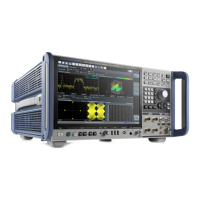
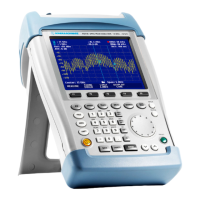
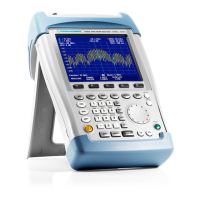
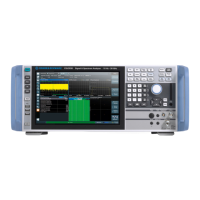
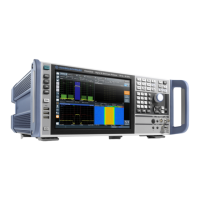
The R&S®FSWP-B1 is a Multi-Standard Radio Analyzer designed for multi-standard radio analysis, offering comprehensive functionality for various analysis tasks and signal types. It operates with firmware version 3.00 or higher and is an integral part of the R&S FSWP-B1 options (1322.9997.08, 1322.9997.26, 1322.9997.50).
Function Description:
The R&S FSWP-B1 operates in a dedicated Multi-Standard Radio Analyzer (MSRA) mode, which allows for the analysis of the same I/Q data across multiple applications and radio standards. This unique capability enables the detection and analysis of correlated effects due to multiple standards, providing a holistic view of complex radio signals.
Key features include:
- Multi-Application Analysis: The device can analyze the same I/Q data in more than one application simultaneously, such as WCDMA, I/Q analysis, or basic spectrum analysis. This is particularly useful for identifying unwanted correlations between different signal components using various transmission standards.
- Correlated Effects Analysis: It allows for the analysis of correlated effects arising from multiple standards, which is crucial for troubleshooting and optimizing multi-standard radio systems. For instance, an irregularity in a GSM burst can be examined in detail using the 3G FDD BTS (WCDMA) secondary application to analyze dependencies like changes in EVM values.
- Centralized Data Acquisition: Data acquisition settings are configured once for all applications through the MSRA primary channel, simplifying the setup process. The MSRA primary is the only channel that captures data and controls global configuration settings for all secondary applications.
- Comprehensive Result Displays: An overview of all results is presented on a single screen, alongside large displays of individual results. The MSRA View provides an overview of all active channels, with the MSRA Primary displaying the data acquisition channel and secondary applications shown in individual windows.
- Common Analysis Line: A common analysis line (time marker) is available across all applications, allowing users to easily analyze results at a specific time point across different measurements and determine correlations like cross-talk.
- Time and Frequency Domain Measurements: The device performs measurements in both the frequency and time domains on I/Q data, including channel power measurements, ACLR, SEM, statistical evaluations, EVM, and modulation accuracy.
- Sequencer Functionality: Upon switching to MSRA mode, the Sequencer is automatically activated in continuous mode, performing data acquisition and evaluating data across active secondary applications sequentially. This ensures continuous monitoring and analysis.
Important Technical Specifications:
- Input Source: Default is "Radio Frequency" via the RF Input connector. Optional sources include external mixers, power sensors, and active modular probes.
- RF Input Protection: Equipped with an overload protection mechanism that activates if power at the input mixer exceeds specified limits, preventing hardware damage.
- Input Coupling: Supports both AC and DC coupling for RF input. AC coupling is default to prevent DC voltage damage, while DC coupling is available for specific measurement requirements.
- Impedance: Reference impedance can be set to 50 Ω or 75 Ω. User-defined impedances from 50 Ohm to 100 MOhm are available for certain applications.
- Direct Path: Enables or disables the use of a direct signal path for small frequencies to avoid LO feedthrough, with an "Auto" mode for automatic selection.
- High Pass Filter: An optional internal high-pass filter for RF input signals from 1 GHz to 3 GHz can be activated to remove harmonics.
- YIG-Preselector: An optional internal YIG-preselector ensures image frequency rejection, active for frequencies greater than 8 GHz.
- Preamplifier: Optional internal preamplifier hardware offers 15 dB or 30 dB amplification for low output power signals, depending on the FSWP model.
- Frequency Range: Center frequency can be defined in Hertz, with a step size that can be coupled to the center frequency or manually set. Frequency offset can range from -1 THz to 1 THz.
- Trigger Sources: Supports various trigger sources including Free Run, External Trigger 1/2 (TTL signal), IF Power, RF Power, and I/Q Power. Trigger level, drop-out time, offset, hysteresis, and slope can be configured.
- Data Acquisition: Configurable sample rate, analysis bandwidth, maximum bandwidth (up to 320 MHz with options), measurement time, and record length.
- Resolution Bandwidth (RBW): Can be set automatically or manually, with a maximum of 1 MHz. Correlated with sample rate and record length.
- FFT Parameters: Advanced FFT mode allows configuration of transformation algorithm (Single, Averaging), FFT length (up to 524288 points), window function (Blackman-Harris, Flattop, Gauss, Rectangular, 5-Term), window overlap, and window length.
- I/Q Data Formats: Supports ASCII, REAL (16-bit/32-bit/64-bit IEEE 754 floating-point), IQBlock, and IQPair formats for data transmission.
- Maximum Record Length: Depends on the sample rate, e.g., 440 Msamples for 100 Hz to 200 MHz, and 220 Msamples for 200 MHz to 600 MHz (without bandwidth extension options). With B320 option, up to 470 Msamples * sample rate / 1GHz for 200 MHz to 468 MHz.
Usage Features:
- Intuitive Interface: The device features a touchscreen interface, allowing for easy navigation and configuration of settings. Alternative methods using keys or an on-screen keyboard are also available.
- SmartGrid Mode: Evaluation modes for MSRA applications are displayed in the selection bar in SmartGrid mode, facilitating quick access to various analysis tools.
- Overview Dialog Box: A central "Overview" dialog box provides quick access to main settings for input, amplitude, frequency, trigger, data acquisition, output, analysis, and display configuration.
- Channel Management: Users can create new measurement channels, duplicate existing ones, rename, delete, and select channels, enabling flexible measurement setups.
- Remote Control: Comprehensive SCPI commands are available for remote control, allowing for automated configuration and measurement execution in a remote environment. Programming examples are provided for testing purposes.
- Data Export/Import: Captured I/Q data from the MSRA primary can be exported for further analysis in external applications or imported if in the correct format.
- Automatic Settings: Functions like "Auto All," "Auto Frequency," and "Auto Level" automatically adjust settings for optimal measurement performance, including reference level, attenuation, and preamplifier settings.
- Analysis Line: A common time marker (analysis line) can be positioned in any MSRA secondary application or the MSRA primary, and is then adjusted in all other secondary applications, aiding in correlated analysis.
Maintenance Features:
- Documentation: A comprehensive set of documentation is available, including a Getting Started manual, User Manuals (main and application-specific), Service Manual (for registered users), Instrument Security Procedures, Data Sheets, Brochures, Release Notes, Open Source Acknowledgment (OSA), Application Notes, and White Papers.
- Firmware Updates: Release notes describe firmware installation and new features, improvements, and known issues.
- Troubleshooting: Error messages are displayed in the status bar for contradictions between configured capture and analysis settings, aiding in troubleshooting. Hints and tips for optimizing and troubleshooting measurements are also provided.
- Preset Channel: A "Preset Channel" button restores all measurement settings in the current channel to their default values, simplifying recovery from misconfigurations.
- Status Registers: Standard status registers (STATus:OPERation register) provide information on current activities, calibration status, sweep progress, measurement status, trigger waiting state, and hardcopy in progress, which can be queried remotely for monitoring and diagnostics.

 Need help?
 General

 To Next Page