EasyManua.ls Logo

Ravensburger LEVEL 8 - User Manual

Ravensburger LEVEL 8
2 pages
Print Icon
To Next Page IconTo Next Page
Loading...
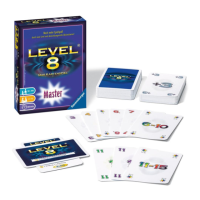
Game Contents
99 playing cards, including 90 numbered cards (1-15 in 6 colors), 6 wild cards,
and 3 “Skip!” cards
6 level cards
6 level indicators
Please note: Before the first game, cut all level indicators on the two dotted lines
as marked.
Game Idea
Over several rounds, players try to collect and display eight levels of card
combinations before their opponents.
Whoever completes LEVEL 8 first, wins the game.
Game Setup
Every player receives a level card and a level indicator, and slides the
level card in the indicator so that the first level (= “2 runs of three”)
is showing (see picture on the left).
Choose a player to be the dealer. The dealer shuffles the
99 playing cards and deals 10 cards face down to each player. The
remaining cards are placed – face down – to form a draw pile in
the middle of the table.
The dealer flips over the top card
of the draw pile and places it
beside the draw pile, facing the
dealer, forming the first card of
the dealer’s own discard pile.
In subsequent turns, the other
players will form their own
discard piles in the same manner,
always facing in their direction
(see picture on the right).
Game Play
The player to the left of the dealer starts, and the game continues in clockwise
direction. Each playes turn is as follows:
1.) Pick one card (required). Either take the top card of the (face down) draw pile
or take a card from any (face up) discard pile.
2.) Display your level (not required). Place all cards necessary to complete your
current level in your display area, face up and visible to everyone.
The 1
st
level: place 2 runs of three.
Note: You are not allowed to place cards forming an incomplete level (e.g. only
1 run of three). In addition, you are not allowed to add more parts than required to
complete the level (e.g. adding a 3
rd
run to the 1
st
level).
As soon as you have placed your first level, you may add additional cards from
your hand to any combination displayed on the table (your own level and/or any
of your opponents’ levels), and you may continue to play cards on these displayed
levels until the end of the round.
Your goal is to be the first player to get rid of all the cards in your hand, in order to
receive the end of round bonus (see end of a round, below).
Examples:
There is a run of three (4, 5, 6): The player may add a 7 (and then a 8 etc.)
and/or a 3 (and then a 2 etc.).
• There are 4 pairs (2-2, 3-3, 6-6, 6-6): The player may add any 2, 3 and/or 6.
There is a run of four (8, 9, 10, 11) and two pairs (3-3, 9-9): The player may add a 7
(and then a 6 etc.), a 12 (and then a 13 etc.), and/or any 3 and 9.
1.) First, take a card
from the draw pile or
any discard pile
(required!)
2.) Then, place a
complete level!
(not required!)
Deal 10 cards
per player
Whoever completes
all 8 levels first, wins!
The card game for 2-6 players 8 and up
Editor: Stefan Brück
Illustrations: Arthur Wagner • Design: Buck Design, DE Ravensburger
GB
USA

Question and Answer IconNeed help?

Do you have a question about the Ravensburger LEVEL 8 and is the answer not in the manual?

Summary

Game Contents

Game Idea

Game Setup

Game Play

The Combinations

End of a Round

The Wilds

Explains the use and properties of Wild cards in the game.

The Skip! Cards

Explains the function and use of "Skip!" cards in gameplay.

Game End

Overview

This document describes the card game "LEVEL 8," designed for 2-6 players aged 8 and up. The game's primary function is to provide an engaging card-playing experience where players compete to complete eight levels of specific card combinations.

Game Contents and Specifications:

The game includes 99 playing cards. These are categorized as:

  • 90 Numbered Cards: Ranging from 1 to 15, distributed across 6 different colors. These form the core of the combinations players must achieve.
  • 6 Wild Cards: These cards are versatile and can substitute for any number or color, with the exception of "Skip!" cards. Their use adds strategic flexibility to gameplay.
  • 3 "Skip!" Cards: These special action cards allow players to skip an opponent's turn, introducing an element of direct player interaction and disruption.
  • 6 Level Cards: These cards track each player's progress through the eight levels of the game.
  • 6 Level Indicators: These are used in conjunction with the level cards to visually represent a player's current level. Before the first game, these indicators need to be cut along their dotted lines.

Function Description:

The core function of LEVEL 8 is to challenge players to be the first to complete eight distinct card combination "levels." Each level requires a specific set of cards, such as "2 runs of three," "a run of 6 cards + a pair," or "3 of a kind + 5 cards = color." Players progress through these levels by collecting and displaying the required card sets.

Usage Features:

Game Setup:

  1. Level Tracking: Each player receives a level card and a level indicator. The level card is inserted into the indicator to show the starting level ("2 runs of three").
  2. Dealing: A chosen dealer shuffles all 99 playing cards and deals 10 cards face down to each player.
  3. Draw Pile: The remaining cards form a face-down draw pile in the center of the table.
  4. Discard Piles: The dealer flips the top card of the draw pile to start their own face-up discard pile. In subsequent turns, other players will form their own discard piles, always facing in their direction.

Game Play (Player's Turn):

Each player's turn consists of three main actions, performed in sequence:

  1. Pick One Card (Required): A player must either take the top card from the face-down draw pile or take a card from any face-up discard pile (including their own or an opponent's).
  2. Display Your Level (Not Required): If a player has the cards to complete their current level, they may place these cards face up in their display area, visible to all.
    • Incomplete Levels: Players cannot place cards that form an incomplete level (e.g., only one run of three when two are required).
    • Excess Cards: Players cannot add more cards than required to complete a level (e.g., adding a third run to a level that only requires two).
    • Adding to Existing Combinations: Once a player has displayed their first level, they can add additional cards from their hand to any combination already displayed on the table, whether it's their own or an opponent's. This allows for continuous card play throughout the round.
    • Goal: The immediate goal within a round is to be the first player to get rid of all cards in their hand to earn an end-of-round bonus.

Card Combinations:

The game features various types of card combinations:

  • Runs: Several cards with increasing numbers in any color (e.g., 4-5-6 or 8-9-10-11). It's important to note that 15 and 1 do not connect to form a continuous run.
  • Pairs, Triples, etc.: Several cards with the same number (e.g., 4-4-4 or 11-11-11-11).
  • X Cards of One Color: Any cards (numbers) that are all of the same color (e.g., 7-2-11-15 or 12-13-4-8-1).

Special Cards:

  • Wild Cards (6x): A wild card can substitute for any number or color, except for a "Skip!" card. Multiple wilds can be used per level. When a wild is played, the player must clearly state what number or color it represents. Wilds placed on the table cannot be replaced later by the correct number or color card.
  • "Skip!" Cards (3x): As their third action (instead of discarding a card), a player can place a "Skip!" card in front of an opponent who does not already have one. The "skipped" player's next turn is limited to discarding the "Skip!" card face up at the bottom of their draw pile. If a "Skip!" card is played as the last card of a hand (at the end of a round), its function is ignored.

End of a Round:

A round concludes immediately when any player discards their last card.

  • Bonus for Ending the Round: The player who ends the round (discards their last card) slides their level card up two levels as a bonus.
  • Bonus for Displayed Levels: All other players who have displayed their current level slide their level card up one level.
  • No Bonus: Players who have not displayed a level receive no bonus.
  • New Round Setup: The player to the left of the previous dealer becomes the new dealer. All cards (from the table and players' hands) are collected, shuffled, and 10 cards are dealt to each player. The player to the left of the new dealer takes the first turn of the new round.

Game End:

The game ends in one of two ways:

  1. Level 8 Completion: The player who places their 8th level immediately wins the game, regardless of any remaining cards in their hand.
  2. Level 7 Completion + Round End: A player can also win by placing their 7th level and then ending the round. In this scenario, the level indicator will display "Victory" when slid up two levels.

Maintenance Features:

  • Card Care: The game involves playing cards, so standard card care practices apply: keep them clean, avoid bending or tearing, and store them in a dry place.
  • Level Indicators: The initial cutting of the level indicators is a one-time setup task.
  • Shuffling: Regular shuffling of the cards is required between rounds to ensure fair play.

The game is published by Ravensburger Spieleverlag, with illustrations by Arthur Wagner and design by Buck Design, DE Ravensburger.

Ravensburger LEVEL 8 Specifications

General IconGeneral
BrandRavensburger
ModelLEVEL 8
CategoryGame
LanguageEnglish