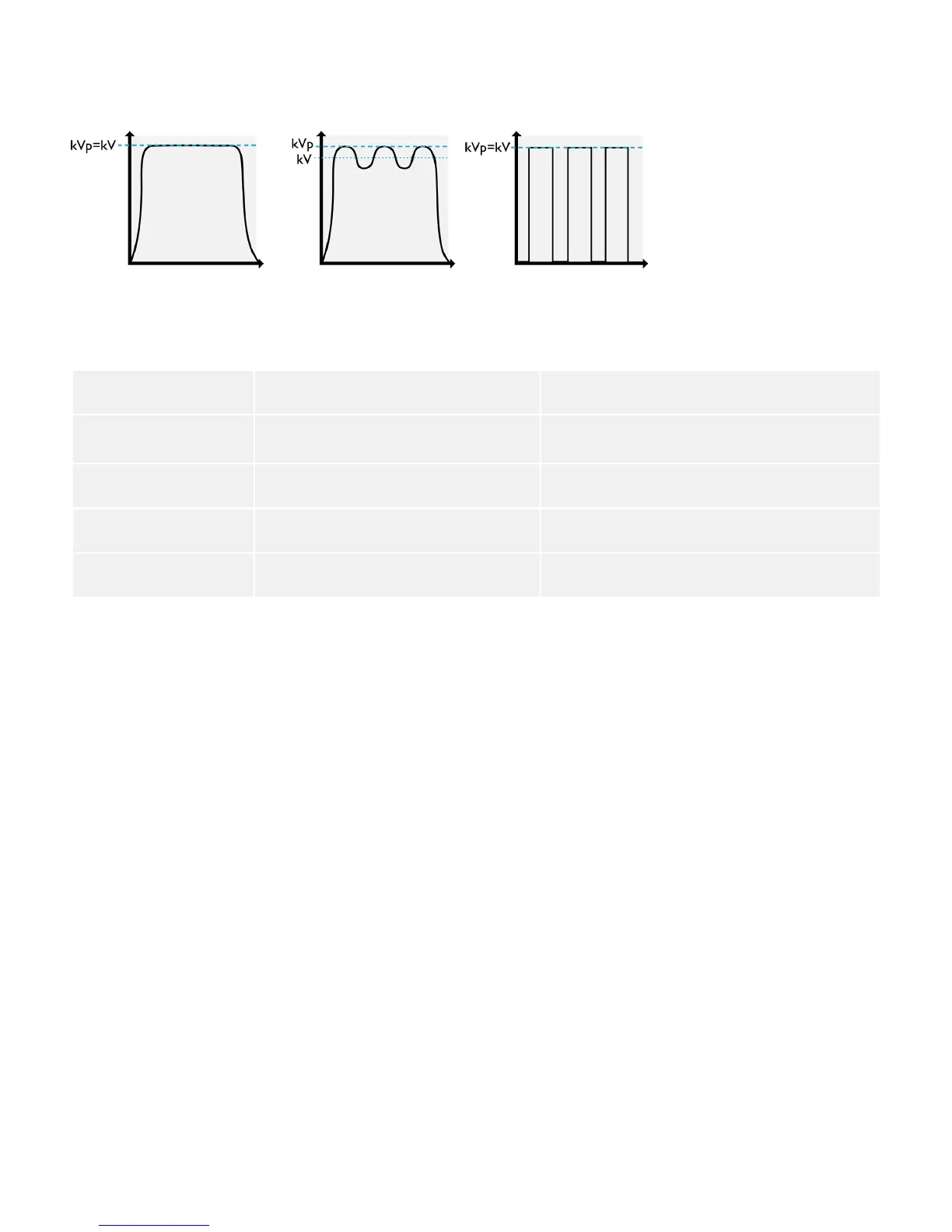
Figure 4. kV and kVp
Table: Active compensation on kV measurements
SENSOR FILTRATION kV/KVp
R/F low Max. 15 mm Al kV
R/F high RAD Max. 15 mm Al kVp (when signal level is high enough)
DENT low Max. 1 mm Cu or equivalent kV
DENT high Max. 1 mm Cu or equivalent kVp (when signal level is high enough)
Use a kVp delay on machines with a slow rising output. 150 ms on dental single phase machines and 1000 ms
on a fluoroscopy machine is recommended.
kV is available for R/F, MAM, RAD and DENT detectors.
TIME
The RaySafe Solo measures time from the start trig (may be adjusted with the Trig level setting) until the signal
falls below 25 % of the peak (50 or 75 % if adjusted with the Trig level setting). At low dose rates (about 1 %
of the max dose rate for the active sensor), the 25 % end level is changed to a low level (about the lowest
measurable dose rate for the active sensor).
If the radiation has a pulsed characteristic, the time is measured until the last pulse ends. The dead time
interval between pulses must, however, be less than the Calc. Delay time (0.5, 2, 4, 6 or 7 s). The R/F low
or DENT low sensor has an electrical bandwidth of 0.1 kHz (slower rising and falling slopes), causing the
displayed exposure time to be a few milliseconds longer than for the R/F high or DENT high sensor, which has a
bandwidth of 2.5kHz.
29
RaySafe Solo User Manual – Measurement definitions


 To Next Page