12
● Amperage
Standard rule of thumb is the thicker the material the more amperage required.
On thick material, set the machine to full output and vary your travel speed. On thinner material, you need to turn down the amper-
age and change to a lower-amperage tip to maintain a narrow kerf. The kerf is the width of the cut material that is removed during
cutting.
● Speed
Amperage and speed are critical to producing a good quality cut. The faster you move (especially on aluminium), the cleaner your
cut will be. To determine if you're going too fast or too slow, visually follow the arc that is coming from the bottom of the cut. The
arc should exit the material at a slight angle away from the direction of travel. If it's going straight down, that means you're going
too slow, and you'll have an unnecessary buildup of dross or slag. If you go too fast, it will start spraying back onto the surface of
the material without cutting all the way through. Because the arc trails at an angle, at the end of a cut, slow your cutting speed and
angle the torch in to cut through the last bit of metal.
● Direction
It is easier to pull the torch towards you than push it. The plasma stream swirls as it exits the tip, biting one side and nishing off
on the other leaving a bevelled edge and a straight edge. The bevel cut effect is more noticeable on thicker material and needs to
taken into consideration before starting your cut as you want the straight side of the cut to be on the nished piece you keep.
● Torch tip height & position
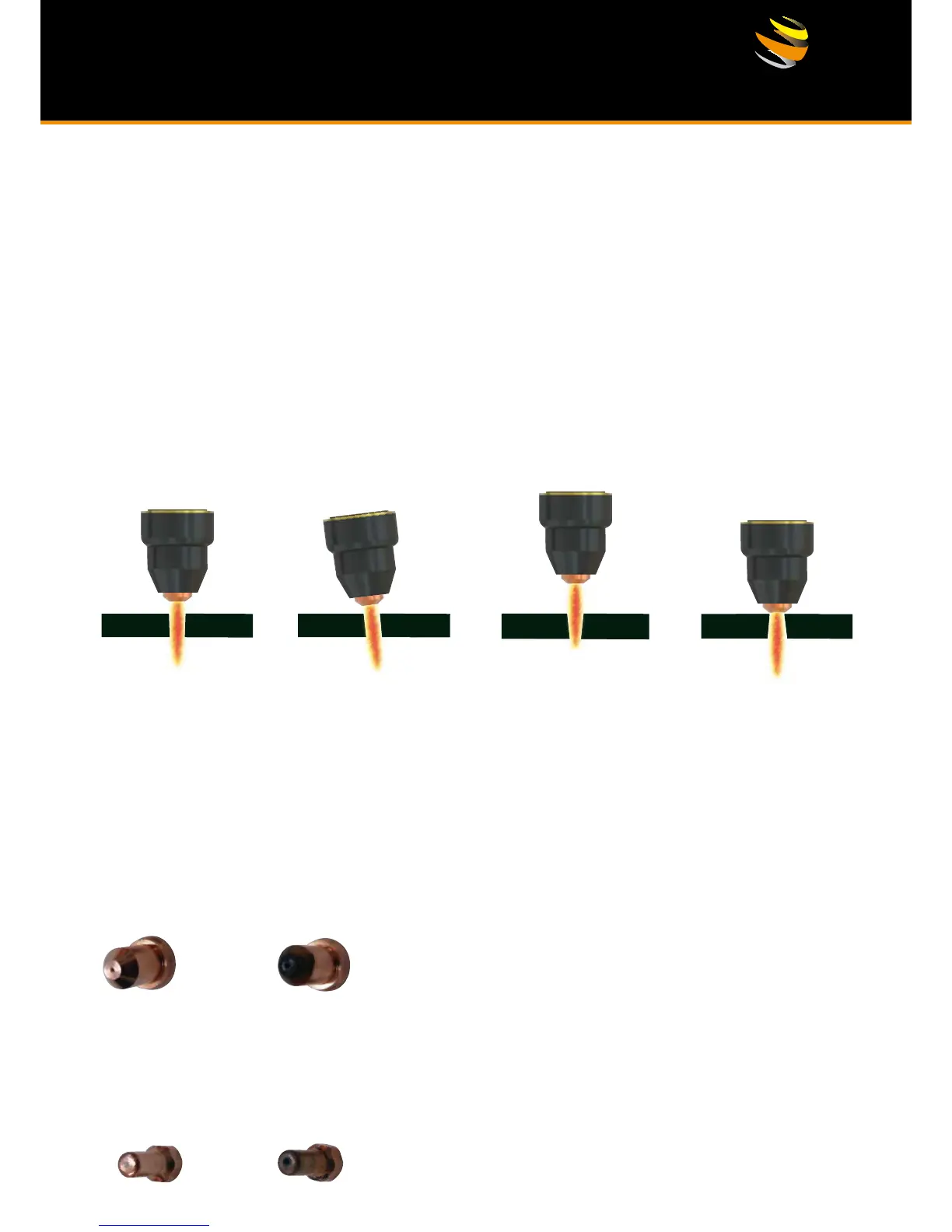
The distance and postion of the plasma torch cutting tip has an affect on the quality of the cut and the extent of the bevel of the cut.
The easiest way to reduce bevel is by cutting at the proper speed and height for the material and amperage that is being cut.
Correct torch height and
square to the material.
Minimum bevel & equal bevel
Longest consumable life
Torch angled to the material.
Unequal bevel, one side may
be excessively beveled.
Torch height too high.
Excessive bevel, plasma
stream may not cut all the
way through the material
Torch height too low.
Reverse bevel. Tip may
contact the work and short
out or damage the tip.
● Tip size and condition
The tip orices focus the plasma stream to the work piece. It is important to use the correct size tip for the amperage being used,
for example a tip with a 3/64" orice is good for 0-40 amps whereas a 1/16" orice is better for 40-80 amps. The low-amp tip has a
smaller orice which maintains a narrow plasma stream at lower settings for use on thin-gauge material. Using a 25 amp tip at an
60 amp setting will blow out and distort the tip orice and require replacement. Conversely, using an 80-amp tip on the lower
settings will not allow you to focus the plasma stream as well and creates a wide kerf. The condition of the tip orice is critical to
the quality of the cut result, a worn or damaged tip orice will produce a distorted plasma stream resulting in a poor cut quality.
● Electrode condition
A fixed gap is established between the electrode and the inside of the cutting tip. Electrons arc across the gap, ionizing and super
heating the air creating the plasma stream. The electrode contains an insert in the end made of a highly conductive material called
hafnium. This insert erodes with use and develops a pit in the end of the electrode, when the pit becomes too much poor quality
cuts will result and necessitate replacement of the electrode.
New Tip Worn Tip
New Electrode Worn electrode
Operating Procedure & Techniques
for PLASMA Cutting


 To Next Page
 Loading...