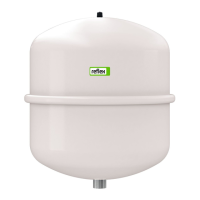
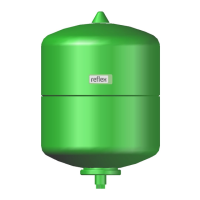
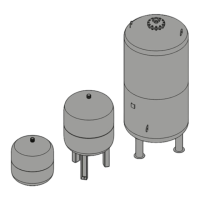
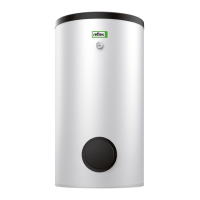
This document describes Reflex diaphragm pressure expansion vessels, which are pressure-retaining devices designed for use in stationary, closed heating, solar, and chilled water systems. These vessels are manufactured by Reflex Winkelmann GmbH, located in Ahlen, Germany.
Function Description
Reflex diaphragm pressure expansion vessels serve to maintain pressure and compensate for volume changes within the system. A flexible diaphragm divides the vessel into a water compartment and a gas compartment. As the system's water volume changes due to temperature fluctuations, the diaphragm flexes, allowing the gas cushion to absorb or release pressure, thereby stabilizing the system pressure. This design ensures efficient operation and protects the system from excessive pressure build-up or drops.
Important Technical Specifications
The vessels are designed according to the Pressure Equipment Directive 2014/68/EU. They are intended for use in systems with non-corrosive, chemically non-aggressive, and non-toxic water. A wear allowance for corrosion is not provided, meaning the vessels are not designed for corrosive media.
Key specifications include:
- Glycol Content: The glycol content in the system water must be maintained between 25% and 50%. When adding additives, manufacturers' instructions regarding permissible dosages, especially concerning corrosion, must be strictly followed.
- Operating Pressure: The pressure must not fall below or exceed the minimum/maximum permissible operating pressure (PS). The pre-charge pressure must not exceed 4 bar during storage and transport.
- Operating Temperature: The minimum/maximum permissible operating temperature (TS) must be observed.
- Safety Valve Activation Pressure (Psv): The activation pressure of the system's safety valve (Psv) must be less than or equal to the permissible operating pressure (PSmax) of the pressure equipment.
- Media Compatibility: Reflex vessels are unsuitable for oil and are not approved for media in fluid group 1 (e.g., toxic media) as per Directive 2014/68/EU. Information on other media can be obtained upon request.
- Oxygen Ingress: The ingress of atmospheric oxygen into the entire system must be reliably minimized to prevent corrosion and maintain system integrity.
Usage Features
The installation and maintenance of these vessels must be performed by qualified and skilled personnel.
- Installation Location: The vessel must be installed in a closed, dry, and frost-free room, protected from flooding. It should be positioned to allow inspection from all sides, including access to the gas filling valve and the shut-off/drain valve on the water side. The type plate must remain visible.
- Piping Connection: Piping must be connected freely, without torque, and isolated from vibrations. For further questions, contact Reflex After Sales & Service.
- Pre-charge Pressure Adjustment: The pre-charge pressure (P0) needs to be set according to the system's static height (H) and other parameters, typically P0 = H(m)/10 + 0.2 bar. For solar systems, additional pressure (PD + ΔPp) must be considered.
- Leakage and Function Test: After installation, a leakage test and a function test are mandatory.
- Safety Warnings: Users must strictly adhere to all safety warnings provided in the manual. These include warnings against severe or fatal injuries (e.g., from hot surfaces, hot water, or steam), health hazards, and material damage or malfunctions. It is crucial not to drill into power or water lines, and the vessel must be free of water during installation.
Maintenance Features
Regular maintenance is essential to ensure the longevity and safe operation of the Reflex expansion vessels.
- Annual Inspection: The system operator must perform an inspection at least once a year. This inspection includes checking the water quality, external inspection of the vessel, and verifying the pre-charge pressure. All applicable national regulations, laws, and standards must be observed.
- Component Replacement: Only original spare parts from the manufacturer should be used for replacements.
- Testing: Pressure equipment is subject to mandatory testing. The operator determines the test intervals based on national regulations, a safety-technical assessment, and the actual operating conditions.
- Disposal: The product must be disposed of correctly according to local waste recycling or disposal regulations and should not be discarded with regular household waste.
The manual also references relevant standards such as VDI 2035 (prevention of damage in hot water heating systems) and DIN EN 12828 (heating systems in buildings). The operation safety ordinance (for Germany) provides additional information.

 Need help?
 General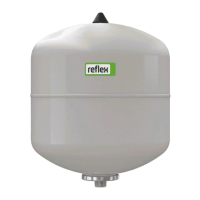

 To Next Page