86
Chapter 4
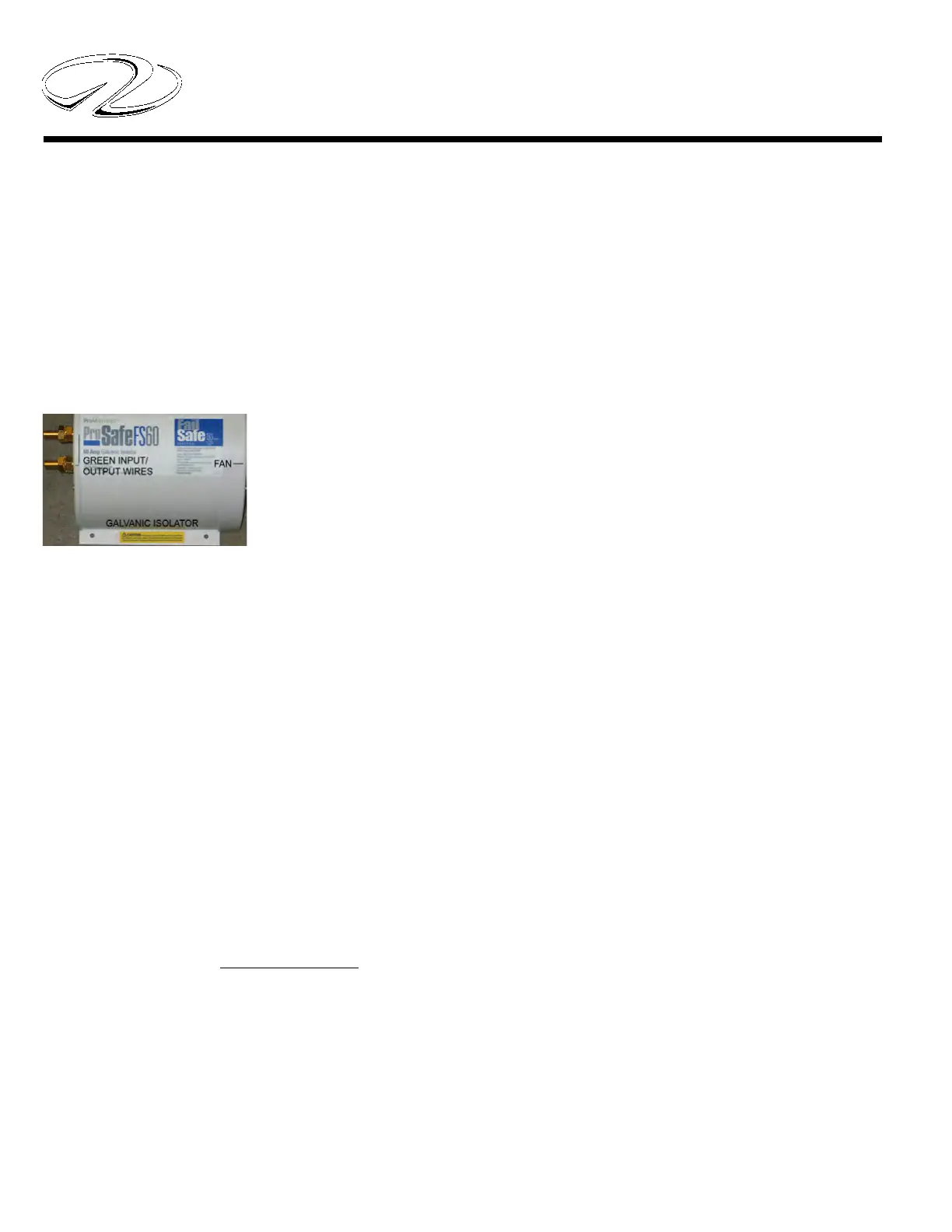
TYPICAL GALVANIC ISOLATOR
As part of the AC boat circuitry the green ground wire
takes a different path from the conductors. It enters via
the boat’s shore power inlet and travels to a galvanic iso-
lator. See the illustration.
A 60 amp (60 hertz) galvanic isolator for domestic use is
connected in series with the AC grounding “green” wire.
Overseas boats use a 30 amp (50 hertz) galvanic isolator.
The purpose of the galvanic isolator is to isolate the
boat’s grounding system
electrically from the dock
and other vessels below
1.4 volts but to maintain
a connection to the shore
green ground at high
voltage potentials. The
low voltage isolation will prevent the vessel’s zinc from
protecting the underwater metal hardware on another
vessel sharing the same AC common green ground wire.
This eliminates the possibility of galvanic interaction
from other boats on the same dock circuit and permits
your anodes to protect your boat. The green ground or
“bonding wire” runs from the boat’s shore power inlet to
a galvanic isolator stud. From the other stud of the gal-
vanic isolator it runs to the AC ground buss located be-
hind the AC main ship’s control panel in the salon. Note
that the stud nuts must be torqued and maintained at 8.8
inch pounds.
Since the galvanic isolator is not polarized either termi-
nal can be used for the inlet or outlet side for the green
grounding wire.
There is a fan located at the right side of the isolator
identied by an array of ventilation holes. If you ever
hear the fan running the isolator has failed. Disconnect
the shore power from the boat and check the system. Call
your closest Regal dealer for more information.
Do not store objects close to the isolator that might in-
hibit air ow to the fan.
Note that the galvanic isolator system is also used in boats
using the 50 amp main breaker (no ELCI). Normally the
galvanic isolator is found in the engine room sometimes
called the bilge or sump.
TYPICAL ISOLATOR WIRING
Warning: It is extremely dangerous to swim or be
in the marina water due to potential AC current that
may be present. Take all necessary precautions as
this may be life threatening.
Caution: This device does not provide a status monitor.
Following a lightning strike this unit may not continue to
provide galvanic isolation protection.
Warning: The fan will operate only when there is a
fault to ground and the isolator is conducting elec-
tricity. If you notice the fan running immediately
disconnect the shore power and contact a qualied
marine electrician to isolate and repair the problem
with the vessel or the shore power connection. Nev-
er cover the fan holes.
Caution: Never test the isolator. Troubleshooting gal-
vanic isolators shall be done by qualied personnel only.


 To Next Page
 Loading...