22
Required Safety Equipment
Personal Flotation Devices:
All personal flotation devices (PFD’s) must be
Coast Guard approved, in good working condi-
tion, and must be the correct size for the wearer.
All PFD’s must be readily accessible. This means
being able to wear them in a reasonable amount
of time in case of an emergency (fire, boat sink-
ing, etc.). They should not be stored or locked
in closed areas. Also, make sure that all cover-
ings are removed such as plastic from any PFD’s.
Throw-able devices such as a ring buoy need to be
available for immediate deployment. A PFD should
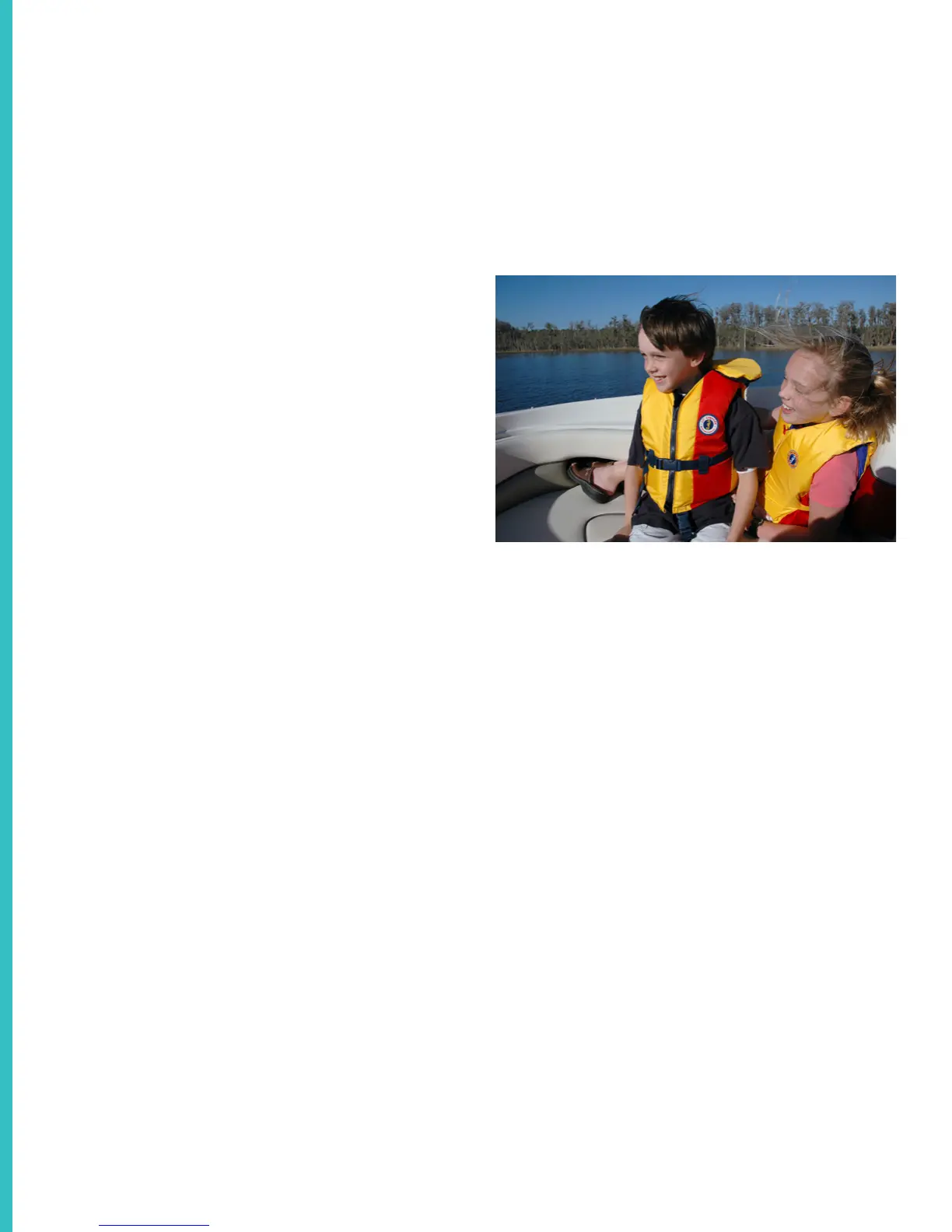
be worn at all times when your boat is operating on
the water. A PFD may save your life, but it must be
worn to do so.
As a minimum U. S. Coast Guard requirement all
recreational boats must carry one type I, II, III, or V
PFD (wearable) for each person aboard. See the
explanation following for each type. For type V to
be counted they must be used according to the la-
bel instructions. In addition, all boats over 16’ must
carry one Type IV (throw-able) PFD.
Some states require that PFD’s be worn by chil-
dren of specific ages at all times. Check with local
and state boating agencies for particular require-
ments in your state before taking children on the
water. Child life jackets are classified by the child’s
weight and should like all life jackets be sized be-
fore being purchased.
Remember PFD’s will not necessarily keep you
from drowning, even though they are designed
to keep a person from sinking. When purchasing
PFD’s make sure it safely fits the person wearing
it. It is a good idea to test PFD’s in a life guarded
shallow pool before venturing on the water.
Refer to the USCG minimum equipment require-
ments at the end of this chapter. It is meant to be
a guide only. Contact state and local agencies for
additional equipment requirements. Remember as
the captain of your vessel you are responsible for
its safe operation.



 To Next Page