18
REMKO series ETF Eco
Continuous unit operation
with external condensate
outlet
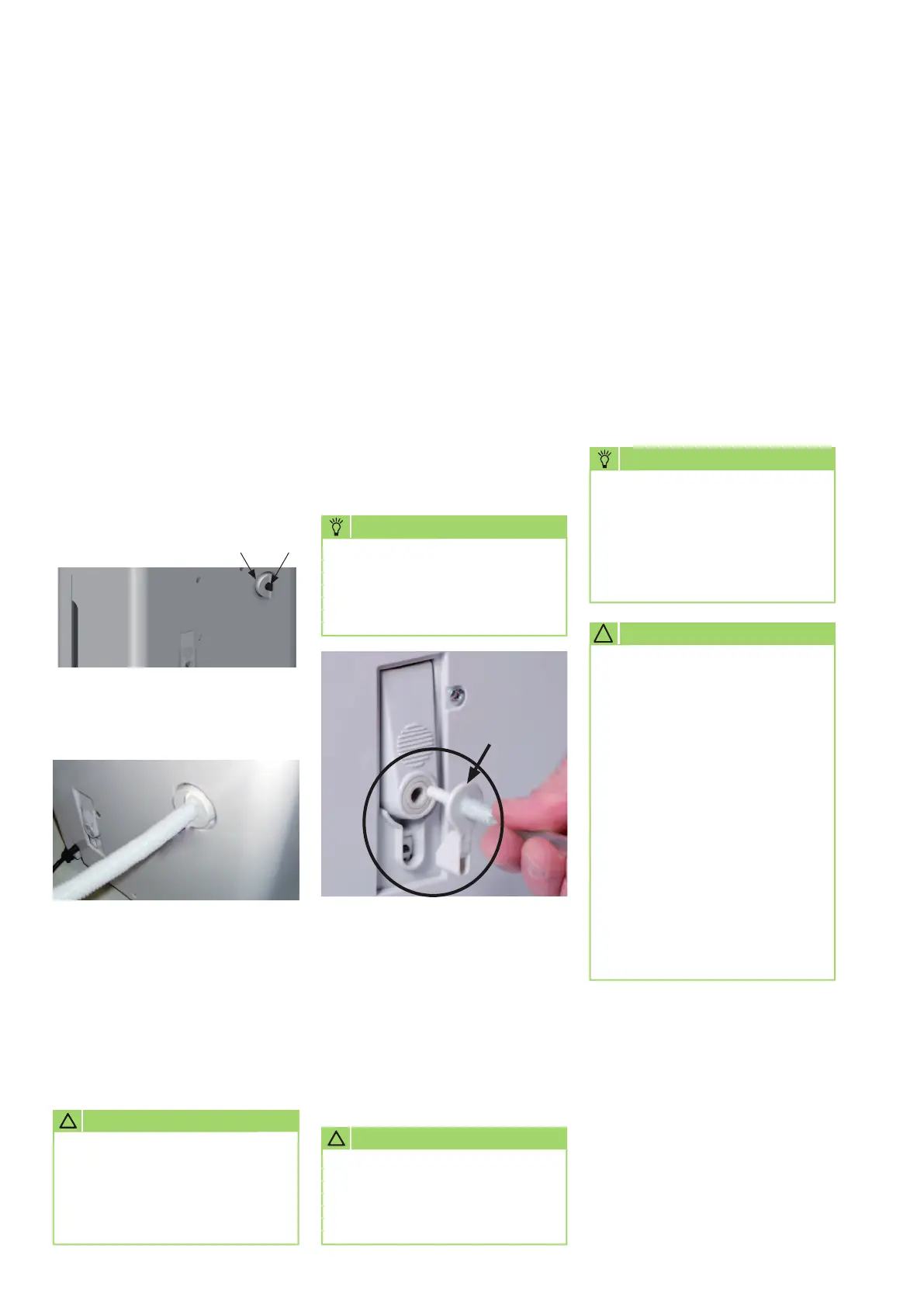
The units are equipped with
a condensate connection nozzle on
the rear.
A special (1m) drainage hose that
is supplied can be connected here.
1. Unscrew the union nut [A] (turn
anticlockwise).
2. Pull the sealing plug [B] out of
the connection nozzle.
3. Push the drainage hose with the
smooth end through the rear of
the union nut [A].
Ensure that the drainage hose
is placed at an incline to the
drain to allow the condensate
to drain without hindrance!
CAUTION
!
After you plug in the adapters
[SA], , the pump is immediately
ready for operation and can convey
water immediately if required.
CAUTION
!
The pump function is only
possible via the connection
adapter [SA] provided.
NOTE
Continuous unit operation via
the internal condensate pump
For applications in locations
without a drain, the devices are
fitted with a condensate pump
especially for this.
You can use this to provide various
condensate drainage options
according to the local conditions.
The patented condensate pump
connectionpanel [KP] is located on
the rear of the units.
Carefully connect the connection
adapter [SA] provided here.
4. Screw the drainage hose onto
the connection nozzle using the
union nut [A].
A B
The hose supplied as standard has
a length of 5 metres. The customer
can extend this to 10 metres if
required.
CAUTION! Do not kink the hose!
A height difference of up to
5 metres can be bridged using the
integrated condensate pump.
In unattended permanent
operating mode, the condensate
should preferably be drained into
a lower-level drain.
If using an external collection
container (pan, bucket, etc.), the
unit must be placed at a correct
height.
SA
KP
Leakage control device
The unit is equipped with a leaka-
ge control device to prevent dama-
ge in the event of refrigerant loss.
If the unit detects a leak, the
compressor is switched off. The
fan continues to operate without
interruption in order to prevent an
accumulation of refrigerant.
HINWEIS
By switching the compres-
sor off and on again, the unit
initially continues to run in
normal operation until the
leakage control device switch-
es the compressor off again.
A lack of refrigerant can cause
damage to the unit. If a lack of
refrigerant is detected (con-
tinuous fan operation when
the compressor is not running),
the unit must be taken out of
operation immediately!
Work on the refrigerant system
and on the electrical equip-
ment must only be conducted
by a specially authorised
specialist!
The leakage control device
must not be viewed as a
replacement for maintenance
work and damage checks!
!
ACHTUNG



 To Next Page