5
Water vapour
condensation
Because the capacity for the
maximum possible volume of
water vapour increases as the air
is heated, the volume of water
vapour contained remains constant
and so relative humidity falls.
In contrast, because the capacity
for the maximum possible volume
of water vapour decreases as the
air is cooled, the volume of water
vapour contained remains constant
and so relative humidity increases.
If the temperature continues to
fall, the capacity for the maximum
possible volume of water vapour
is reduced so much so that it is
ultimately equal to the volume of
water vapour contained in the air.
This temperature is referred to
as the dew point. If the air is
cooled to below the dew point,
the volume of water vapour in
the air will become greater than
the maximum possible volume of
water vapour.
At this point, the water vapour
begins to precipitate.
This condenses to water and
moisture is removed from the air.
Examples of condensation include
steamed-up window panes in
winter, or the moisture on the
outside of a cold drinks bottle.
As the relative humidity of the air
increases, so too does the dew
point, making it easier for the
temperature to fall below it.
Building materials and structures
are capable of absorbing
considerable volumes of water,
such as brick 90-190 l/m³, heavy
concrete 140-190 l/m³ and
limestone 180-270 l/m³.
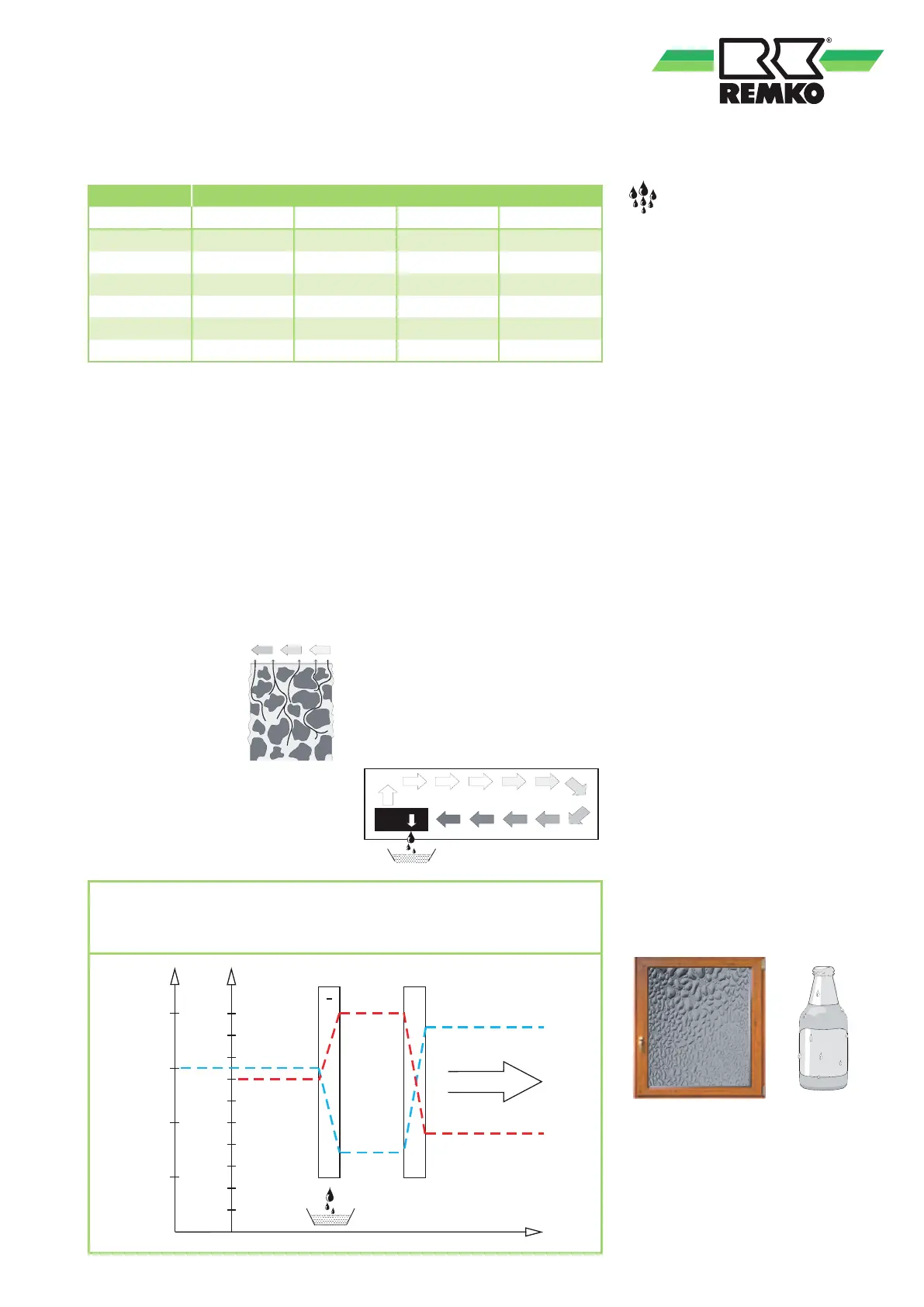
The drying of moist materials such
as masonry is effected as follows:
■
The moisture
moves from
the inside
of the material
to its surface
■
Evaporation occurs
on the surface =
transfer of water vapour to the
ambient air
■
The air containing water vapour
is constantly circulated through
the REMKO air dehumidifier.
The air is dehumidified and,
slightly heated, leaves the unit
in order to re-absorb water
vapour
■
In this way, the moisture
contained in the material is
reduced gradually
The material is dried!
The accumulated condensate is
collected in the unit and drained
off from there.
Drying materials
Verdampfer Kondensator
°C
30
25
20
15
% r.F.
100
90
80
70
60
50
40
30
20
10
+
+
-
Lufttemperatur
Luftfeuchte
Verlauf
Luftrichtung
As it flows through or over the evaporator, the air stream is cooled
to dew point. The water vapour condenses, and is collected in
a condensate trap from where it is drained off.
Temp. Water vapour content in g/m
3
at humidity of
°C 40% 60% 80% 100%
-5 1.3 1.9 2.6 3.3
+10 3.8 5.6 7.5 9.4
+15 5.1 7.7 10.2 12.8
+20 6.9 10.4 13.8 17.3
+25 9.2 13.8 18.4 23.0
+30 12.9 18.2 24.3 30.3
% RH
Evaporator Condenser
Air temperature
Air direction
Humidity
Course



 To Next Page