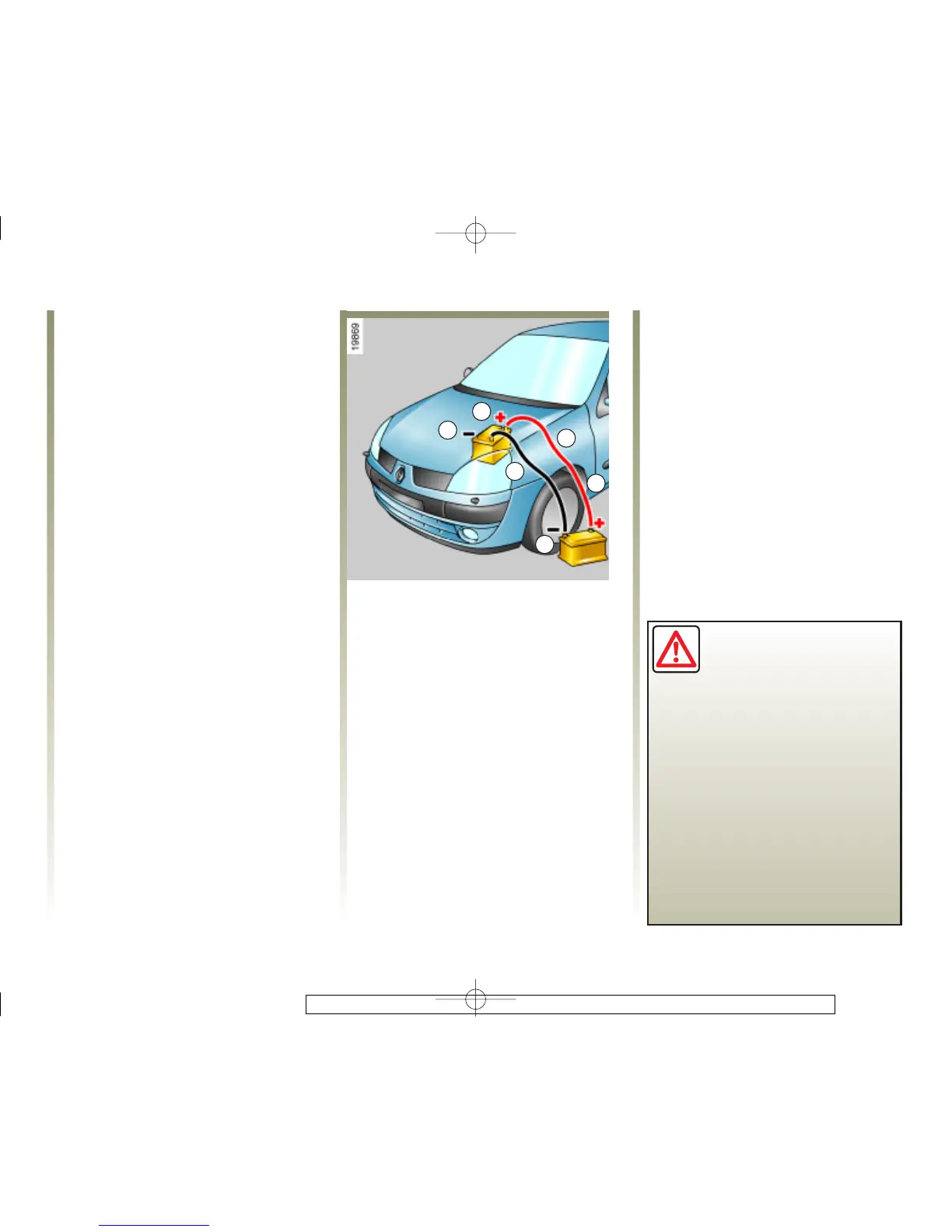
1
4
A
2
B
3
nu683-5_fra_G5.qxd 4/06/03 15:52 Page 5.18
CLIO L65 NU683-5 - Spécial pays de l'Est
C:\Documentum\Checkout\nu683-5_eng_T5.win 4/9/2003 13:25
-page18
5.18
BATTERY: breakdown (continued)
Starting the vehicle using the
battery from another vehicle
When jump-starting your vehicle
from another vehicle’s battery,
proceed as follows:
obtain suitable jump leads (with a
large cross section) from a
RENAULT Dealer or, if you already
have jump leads, ensure that they
are in perfect condition.
The two batteries must have an
identical voltage: 12 volts.
An iced-up battery must be thawed
out before current is supplied to it.
Ensure that there is no risk of
contact between the two vehicles
(risk of short circuiting when the
positive terminals are connected)
and that the discharged battery is
properly connected. Switch off your
vehicle ignition.
Start the engine of the vehicle
supplying the current and run it at
an intermediate engine speed.
Attach one end of the positive cable
(+) A to the (+) terminal 1 of the
discharged battery, the other to the
(+) terminal 2 of the battery
supplying the current.
Attach one end of the negative cable
(–) B to the (–) terminal 3 of the
battery supplying the current and
the other end to the (–) terminal 4 of
the discharged battery.
Check that there is no contact
between cables A and B and that
cable A (+) is not touching any
metal parts on the vehicle
supplying the current.
Start the engine as normal. As soon
as it starts, disconnect cables A and
B in reverse order (4-3-2-1).
Handle the battery with
care as it contains
sulphuric acid which
must not come into
contact with the eyes or skin. If it
should, wash the affected area
with plenty of cold water.
Keep all naked flames, red-hot
objects and sparks away from the
battery as there is a risk of
explosion.
Take care when working in the
engine compartment as the
engine cooling fan may start up
at any moment.






 To Next Page