EasyManua.ls Logo

Rheem Raypak RPSF16 - User Manual

Rheem Raypak RPSF16
16 pages
Print Icon
To Next Page IconTo Next Page
Loading...
E󰀨ective: 01-15-20
Replaces: 12-10-19
P/N 241829 Rev 3
INSTALLATION
AND OPERATION
MANUAL
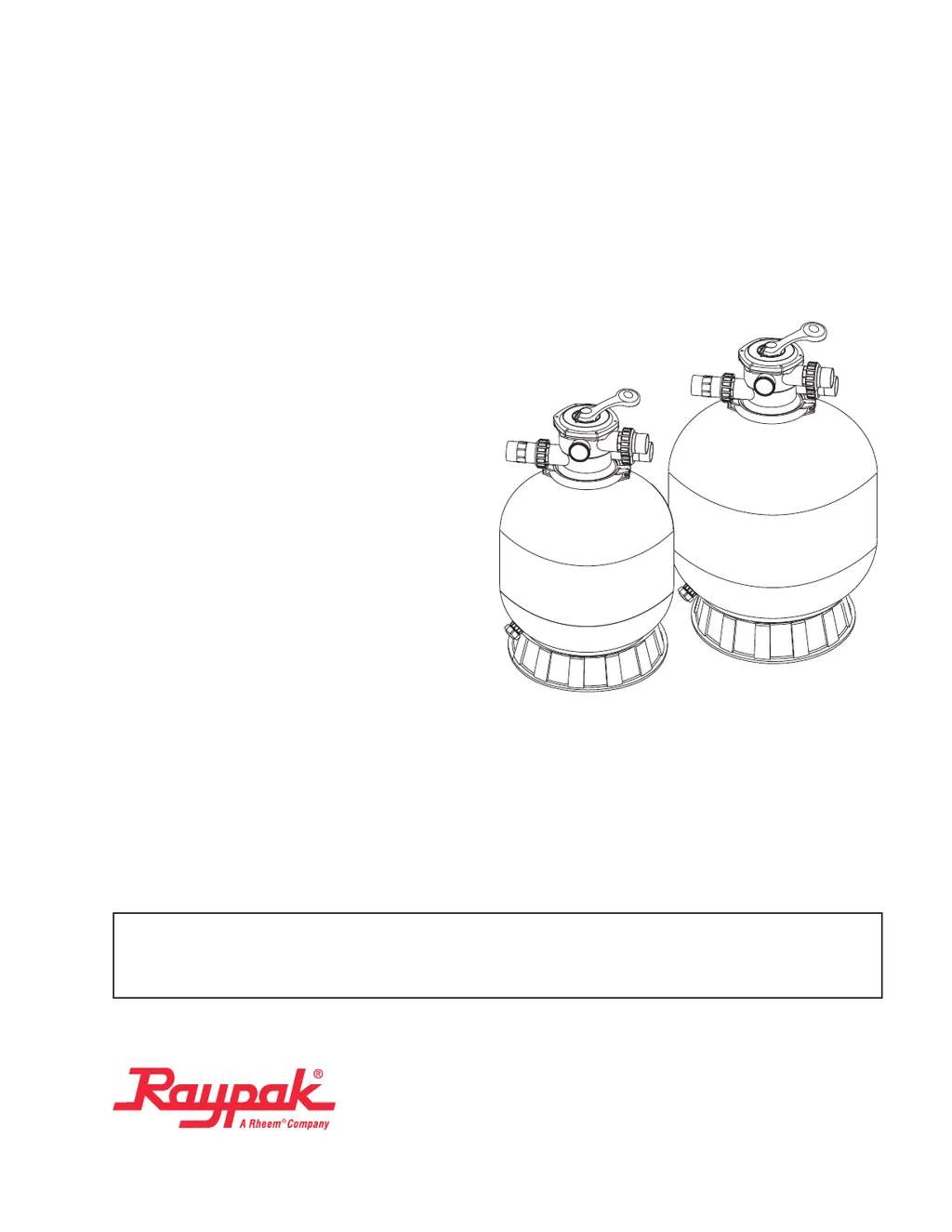
Models
RPSF14, RPSF16,
RPSF18, RPSF21,
RPSF25, RPSF28
IMPORTANT SAFETY INSTRUCTIONS. READ AND FOLLOW ALL
INSTRUCTION. SAVE THESE INSTRUCTIONS.
NOTE: The instructions in this manual are for the use of qualied individuals specially trained and experienced
in the installation and maintenance of this type of equipment and related system components. Installation and
service personnel are required by some states to be licensed. Persons not qualied shall not attempt to install,
service, or maintain this equipment.
This manual should be maintained in legible condition and kept adjacent to the sand lter or in a safe place for
future use.
SAND FILTER
CONTROLLED COPY approved for factory use on 4/16/2020. RAYPAK PROPRIETARY AND CONFIDENTIAL INFORMATION . Approval signatures on file in Engineering.

Questions and Answers

  • V
    Virginia WyattAug 12, 2025
    Why is my Rheem Raypak RPSF16 Water Filtration Systems pool water cloudy?
    • P
      Paul BarkerAug 12, 2025
      Cloudy pool water with Rheem Water Filtration Systems often arises from a dirty sand bed needing backwashing. Other causes include incorrect sand needing replacement, algae buildup from poor water chemistry which requires adjusting the chlorine level, or calcified sand, which requires pH balance adjustment. Heavy swimmer usage may also contribute, necessitating more frequent backwashing. Ensure that the flow rate on the pump is correct for the filter and pool size. Also, verify that the backwashing cycle is sufficiently long, and the backwash line isn't too small, restricting water flow.
  • J
    Jacqueline DanielsAug 15, 2025
    How to prevent sand entering pool with Rheem Water Filtration Systems?
    • M
      Mr. Alan SmithAug 15, 2025
      If sand is entering your pool when using Rheem Water Filtration Systems, several factors could be responsible. The sand size might be too small, allowing it to pass through the laterals; in this case, you should change the sand. Alternatively, the pump's flow rate may be too high, pushing sand through the laterals; try adjusting the flow rate. A calcified sand bed, resulting from poor water chemistry, can also cause this issue; adjust the chemistry to balance the pH. Other potential causes include a broken lateral (repair it), a loose center-pipe (re-tighten it), too much sand in the tank (reduce the sand level), a multiport valve not correctly positioned in the filter (remove and reattach correctly), or too much air in the filter (purge the air).
  • B
    beckjoshuaAug 20, 2025
    Why is there high pressure in my Rheem Raypak RPSF16 Water Filtration Systems filter?
    • C
      Chad MejiaAug 20, 2025
      High pressure in Rheem Water Filtration Systems typically means that the filter requires backwashing. Another cause could be a calcified sand bed due to poor water chemistry, which means you should adjust the chemistry to balance the pH. Finally, return lines that are too small for the pump flow rate can cause high pressure; increase the pipe size in this case.
  • L
    Linda GarrettAug 23, 2025
    What to do if Rheem Raypak RPSF16 Water Filtration Systems sand is coming out of waste line?
    • A
      Alyssa RandallAug 25, 2025
      If you observe sand coming out of the waste line in Rheem Water Filtration Systems, it's likely that the pump's flow rate is too high. This can lift the sand too high during backwash. Adjust the flow rate, and if needed, change the pump.
  • M
    meredithgrantAug 27, 2025
    Why is my Rheem Raypak RPSF16 multiport control valve leaking?
    • L
      Lori EverettAug 27, 2025
      A multiport control valve leak in Rheem Water Filtration Systems can occur if the handle is not properly located in the selected setting; re-assemble it correctly. Damaged O-rings on the valve to tank, valve cover, or pressure gauge can also cause leaks; replace the damaged O-ring.
  • M
    Mackenzie HayesAug 30, 2025
    Why is there low pressure in my Rheem Raypak RPSF16 filter?
    • K
      Kayla AdamsAug 30, 2025
      Low pressure in Rheem Water Filtration Systems can occur if the multiport control valve is incorrectly set; re-assemble it correctly. The pump flow rate might also be too slow; check the speed and control valves. An air leak in the pump suction can also cause low pressure; check the seals and tighten as needed.
  • M
    Mr. David WiseSep 3, 2025
    Why is my Rheem Raypak RPSF16 Water Filtration Systems filter leaking water?
    • D
      David ObrienSep 3, 2025
      If your Rheem Water Filtration Systems filter is leaking water, the tank may be cracked, requiring replacement. Alternatively, the drain plug might not be tight; re-tighten it. A damaged O-ring on the valve to tank could also be the cause, so replace it if necessary.
  • C
    Carlos MurraySep 7, 2025
    What causes abnormal loss of pool water with Rheem Raypak RPSF16 Water Filtration Systems?
    • P
      Patricia ArcherSep 7, 2025
      Abnormal loss of pool water in Rheem Water Filtration Systems can be due to a leak inside the control valve; re-tighten or replace it as needed. Another cause can be a leak from the pool or PVC piping; inspect, repair, or replace the affected components.

Summary

Sand Filter Installation and Operation Manual

Important Safety Instructions

Essential safety guidelines to follow before installation and operation.

Warnings and Safety Precautions

General Operational Safety

Key safety instructions for installation, operation, and maintenance to avoid severe injury or damage.

Electrical and System Safety

Emphasizes electrical shock hazards, proper grounding, and system pressure management.

Installation Procedures

Sand Media Installation

Step-by-step guide for correctly pouring filter sand into the tank.

Filter Control Valve Assembly

Instructions for assembling the filter's control valve onto the tank.

Operation and Maintenance

Initial Startup Procedure

Steps to follow for the initial operation of the sand filter after installation.

Filter Cleaning and Backwashing

Details on how to clean the filter and perform the backwash cycle.

Winterizing the System

Troubleshooting Common Issues

Warranty Information

Overview

This document is an installation and operation manual for Raypak sand filters, specifically models RPSF14, RPSF16, RPSF18, RPSF21, RPSF25, and RPSF28. It provides comprehensive information for qualified individuals on the proper installation, operation, and maintenance of these swimming pool filters.

Function Description

The Raypak sand filter is designed to extract suspended particles (dirt) from pool water, thereby keeping the water clear. It utilizes a special filter sand to trap and collect these particles as water flows through the unit. The filtering action occurs as water enters through a valve on the top of the filter, passes evenly through the sand bed, and then flows out through the bottom side, up through the standpipe, and back into the pool via a valve on the top.

The filter operates under pressure, and its primary function is to maintain water clarity. It does not adjust pH levels or bacterial counts, which are handled by other specialized pool chemistry equipment.

Important Technical Specifications

The manual provides a table of dimensions and sand media requirements for each model:

Model Height in. (mm) A Diameter in. (mm) B Valve Port Size Inch Silica Height in. (mm) C Silica 16/30* Weight lb. (kg)
RPSF14 28.6 (726) 13.8 (350) 1.5" 6.3 (160) 44 (20)
RPSF16 29.8 (757) 15.7 (400) 1.5" 6.9 (175) 77 (35)
RPSF18 32.0 (814) 17.7 (449) 1.5" 8.3 (210) 99 (45)
RPSF21 33.3 (845) 20.7 (527) 1.5" 9.3 (235) 209 (85)
RPSF25 37.4 (950) 24.7 (627) 1.5" 11.8 (300) 319 (145)
RPSF28 40.2 (1020) 27.7 (703) 1.5" 13.0 (330) 462 (210)

*Note: Suggested silica weight with differences in filter media size for reference only.

The filter operates under high pressure, and specific warnings are provided regarding pressure release during servicing. The system uses a 6-way multiport valve (1-1/2") for various functions.

Usage Features

The sand filter is designed for use in swimming pool applications. Its operation involves several modes controlled by a multiport valve:

  • FILTER: This is the standard operational position where water flows from the pool, is distributed across the top of the sand bed, filtered, and returned to the pool. This position can also be used for manual vacuuming and cleaning.
  • BACKWASH: Used to clean the sand bed when the pressure gauge indicates 8-10 PSI above the clean filter's operation. Water flow is reversed, lifting the sand bed and flushing debris out through the waste pipe. The sight glass helps monitor water clarity during backwash.
  • RINSE: Used after backwashing to settle the sand bed and carry any remaining loose dirt through the waste line. This prevents debris from returning to the pool. Rinsing continues until clear water is seen through the sight glass, typically for about half the duration of a backwash cycle.
  • WASTE: Allows excess water from the pool to be pumped directly to the waste pipe, bypassing the filter. Useful for high water levels or vacuuming heavy debris.
  • RECIRCULATE: Bypasses the filter and circulates water directly back to the pool. Useful for circulating chemicals without filtering or if a leak develops in the filter, allowing continued water circulation while leaks are located.
  • CLOSED: Prevents water flow through the tank, useful for maintenance on the filtration system.

The manual emphasizes the importance of turning off the pump before changing valve positions to prevent equipment damage and injury.

Maintenance Features

Regular maintenance is crucial for the sand filter's optimal performance and longevity. The manual outlines several key maintenance aspects:

  • Cleaning (Backwash and Rinse): A regular schedule for backwashing and rinsing is essential. The frequency and duration depend on pool size, usage, and environmental conditions. The filter needs cleaning when the pressure gauge reading is 8-10 PSI higher than the initial "clean" pressure.
  • Chemical Cleaning: The manual mentions chemical cleaning as a method to address issues like calcified sand beds due to poor water chemistry.
  • Winterizing: Instructions are provided for winterizing the system, which involves draining the filter tank and removing the drain cap to prevent water damage from freezing.
  • Troubleshooting: A detailed troubleshooting table helps identify and resolve common issues such as sand entering the pool, cloudy pool water, filter leaks, multiport control valve leaks, abnormal water loss, high or low pressure, and air leaks. Solutions range from adjusting flow rates and chemistry to replacing damaged parts.
  • Parts Replacement: The manual includes an illustrated parts list with Raypak order numbers for components like the 6-way valve, union and pressure gauge, locking clamp, lateral assemblies, and water drain. This facilitates easy identification and ordering of replacement parts.
  • Regular Inspections: The manual recommends checking all gaskets and pressure gauges, inspecting for leaks, and ensuring the multiport valve is correctly positioned.
  • Professional Service: For complex issues or to ensure proper maintenance, consulting a qualified pool professional is highly recommended.

The manual also includes important safety warnings, emphasizing the need for qualified individuals to perform installation and service, the dangers of high-pressure release, electrical shock hazards, and the importance of maintaining clear pool water to prevent drowning. It also provides guidelines from the U.S. Consumer Product Safety Commission regarding spa water temperatures and usage.


Rheem Raypak RPSF16 Specifications

General IconGeneral
BrandRheem
ModelRaypak RPSF16
CategoryWater Filtration Systems
LanguageEnglish

Related product manuals