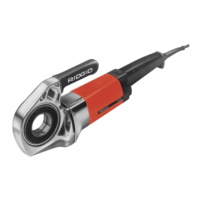
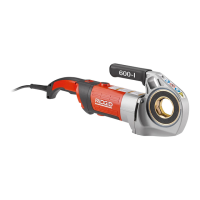
600 Hand Tube Bender Instruction Sheet
1
EN
600 Hand Tube Bender Instruction Sheet
WARNING
Read these instructions and the warnings and instructions for all
equipment being used before using to reduce the
risk of serious personal injury.
• Alwaysusesafetyglassestoreducetheriskof
eyeinjury.
• Donotusehandleextensions(such as a piece
ofpipe).Handleextensionscansliporcomeoff
andincreasetheriskofseriousinjury.
The EC declaration of conformity (890-011-320.10) will accompany this
manual as a separate booklet when required.
If you have any question concerning this RIDGID® product:
– Contact your local RIDGID distributor.
– Visit www.RIDGID.com or www.RIDGID.eu to nd your local
RIDGID contact point.
– Contact RIDGID Technical Services Department at
rtctechservices@ em erson.com, or in the U.S. and Canada call
(800) 519-3456.
The RIDGID® 600 series lever benders are designed to easily bend materi-
als such as copper, steel, stainless steel and other hard metal tube to a
maximum of 180°. Built-in rollers and a heavy-duty handle design com-
bine to produce high quality bends with greatly reduced eort when
compared to conventional benders.
Figure1–600SeriesBender
CarriageHandle
Carriage
Tube
Latch
Form
FormHandle
NOTICE
Selection of appropriate materials and installation, joining
and forming methods is the responsibility of the system designer and/
or installer. Selection of improper materials and methods could cause
system failure.
Stainless steel and other corrosion resistant materials can be contami-
nated during installation, joining and forming. This contamination could
cause corrosion and premature failure. Careful evaluation of materials
and methods for the specic service conditions, including chemical and
temperature, should be completed before any installation is attempted.
Inspection/Maintenance
The bender should be inspected before each use for wear or damage
that could aect safe use. Clean as needed to aid inspection and to pre-
vent handles and controls from slipping from your grip during use. Make
sure the bender is complete and properly assembled. If any problems are
found, do not use until the problems are corrected. Lubricate all moving
parts/joints as needed with a light lubricating oil, and wipe any excess oil
from the bender.
Operation
The 600 Series Lever Benders can be used either hand held or with the
bender mounted in a vise. Vise mounting is especially useful when bend-
ing hard or thick walled materials.
Spring Back
All tubing will exhibit spring back after a bend is completed. Softer tub-
ing, such as copper, will have less spring back than harder tubing, such
as stainless steel. Experience will help you predict the amount of spring
back. Depending on tubing material and hardness, expect to overbend
approximately 1° to 3° to compensate for spring back.
General Operating Instruction
1. Grasp bender by the Form Handle or mount the bender in vise (Figure
2).
Figure2–ViseMountingPoint
Figure3
GripIn
Vise
2. Move Carriage Handle and Tube Latch away from Form.
3. Position tubing in Form groove and secure tubing in Form with Latch
(Figure 3).
4. Lower Carriage Handle until the “0” Line on the Carriage aligns with
the 0° designation on the Form (Figure 4).
5. Rotate the Carriage Handle around the Form until the “0” Line on the
Carriage aligns with the desired degree of bend on the Form (Figure
5).
0 Line
Figure4
Figure5
0 Line
Measured Bends Relative to Other Features
(Tube ends, Bends, etc.)
For 90° Bends:
• Mark the tube at the desired distance (X) from the feature (end of tube,
bend, etc.). The center of the leg of the bend will be this distance from
the feature.
• Place the tube in the bender as described in Steps 1-5 above.
• If the feature is to the LEFT of the mark (see Figure 6 – Before), align the
mark on the tube with the “L” line on the Carriage.
• If the feature is to the RIGHT of the mark (see Figure 8 – Before), align
the mark on the tube with the “R” line on the Carriage.
L Line
MarkOn
Tube
Figure6–Before
Figure7–After
L Line
MarkOn
Tube
X
X


 To Next Page
 Need help?
 General