Need help?
Do you have a question about the Rinnai R75LSI and is the answer not in the manual?
Explains hazard symbols like DANGER, WARNING, and CAUTION.
Covers essential safety behaviors, handling water-damaged units, and proper grounding.
Details inherent safety mechanisms such as overheat shutdown and flame failure protection.
Overview of how the direct vent tankless water heater functions and its ignition system.
Describes the functions and features available on different Rinnai temperature controller models.
Details dimensions and features of the MC-91 and MCC-91 temperature controllers.
Outlines the MC-502RC wireless controller, its features, and installation notes.
Describes the BC-100V controller, its functions, and water resistance.
Details the MC-100V controller's functions, including clock and sound volume.
Critical safety information regarding severe burn risks from hot water.
Step-by-step guide on using the controller to set the desired water temperature.
Explains how to set temperature using dip switches when no controller is installed.
Lists the available temperature settings for different Rinnai water heater models.
Provides recommended temperature settings for kitchen, shower, and bath applications.
Instructions for adjusting the voice prompt volume on the MC-100V controller.
Instructions for adjusting the voice prompt volume on the BC-100V controller.
Introduces the bath fill feature and its temperature settings.
Guides users on setting the specific water volume for the bath fill function.
Important advice to avoid overfilling the bath during the fill process.
Detailed steps for operating the bath fill function to fill a tub.
How to enable or disable audible key press beeps on specific controllers.
Instructions for setting the clock function on the MC-100V controller.
Comprehensive cleaning instructions for internal and external components.
Maintenance guidelines for the vent system and unit motors.
Procedures for handling scale buildup, including error code LC.
Guidance on how to visually inspect the burner flame for proper operation.
A table listing error codes, their meanings, and suggested remedies.
Continues the table of error codes, fault descriptions, and troubleshooting steps.
Addresses common problems like lack of hot water and temporary cold water.
Explains why hot water might be delayed and fan operation after shutdown.
How to access and view error codes, water flow, and outlet temperature.
Lists acceptable levels for various water quality parameters.
Detailed steps to flush the heat exchanger using vinegar or citric acid.
Requirements for installers, including licensing, training, and local codes.
Essential general instructions, safety warnings, and code compliance.
Specifies minimum clearances to combustibles and non-combustibles for safe installation.
Instructions for securely mounting the water heater unit to the wall.
Details the necessary power outlet type and grounding for the unit.
Critical guidelines for gas supply line installation, unions, and testing.
Explains how to size gas pipes and provides tables for natural gas and propane.
Rules for connecting water lines, potable water use, and debris purging.
Requirements and installation advice for pressure relief valves.
Details electrical heating elements, intermittent firing, and optional drain valves.
Illustrates the piping setup for automatic drain solenoids for freeze protection.
Advises on heat tracing and proper placement of water pipes and fittings.
A diagram showing the recommended pipe connections for a basic installation.
Lists essential Rinnai components, including optional kits, for basic piping.
Depicts the piping arrangement for residential and commercial circulation systems.
Guidance on selecting and controlling pumps for optimal circulation loop performance.
Information on how optional circulation piping affects the product warranty.
Illustrates an optional piping layout for circulation systems, including storage tanks.
Rules for direct venting, specifying materials, connections, and support.
Instructions on managing condensate formation and preventing damage to the heat exchanger.
How to determine maximum vent length based on elbow count and dip switch settings.
Lists tested vent products and their manufacturers for Rinnai appliances.
Provides contact details for various vent system manufacturers.
Detailed table of required clearances for vent terminals in Canadian and US installations.
Advises on avoiding specific locations for vent terminals, such as near dryer vents.
Guidelines for horizontal vent termination when a condensate collector is not used.
Guidelines for horizontal vent termination when using a condensate collector.
Instructions for vertical vent termination, always requiring a condensate collector.
Details on assembling and connecting the air intake system for R98LSi models.
Table showing vent clearances to combustibles for R98LSi models.
Illustration of horizontal termination requirements for air intake and exhaust.
Diagram illustrating horizontal termination with concentric venting for R98LSi.
Illustration of vertical termination requirements for R98LSi models.
Explains how to set dip switches for optimal performance at different altitudes.
Information on EZConnect™ and MSA pack accessories for linking units.
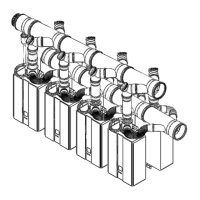
Rules and recommendations for installing and operating multiple water heaters together.
Recommendations for controller placement and discussion of possible configurations.
Details on controller wiring, cable gauge, and maximum cable lengths.
Step-by-step guide for physically mounting the temperature controller to the wall.
Critical safety warnings and checks before turning on the appliance.
Detailed sequence for starting up and operating the water heater.
Instructions for safely shutting off the gas supply to the appliance.
Graph illustrating pressure loss in relation to water flow rate.
Graph showing water flow rates based on temperature rise.
Rules and considerations when using the heater for both water and space heating.
Guidance on choosing appropriate pumps and sizing them for space heating systems.
Caution against using iron radiators or components in space heating applications.
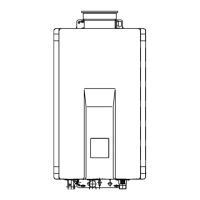
Specifications for the width, depth, and height of these Rinnai models.
Specifications for the width, depth, and height of R98LSi models.
A visual representation of the unit's electrical components and their interconnections.
Fields for recording purchase and installation details for warranty purposes.
Details the duration and scope of the limited warranty for various components.
Explains Rinnai's responsibilities for repair or replacement of defective products.
Procedures for getting service, including contacting providers and proof of purchase.
Lists items and conditions not covered by the warranty, and limitations on implied warranties.
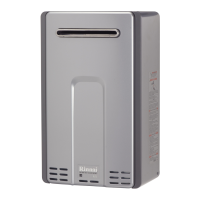
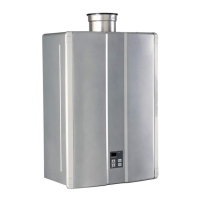
A brief summary of Rinnai's tankless water heater product line.
A brief summary of Rinnai's direct vent furnace product line.
A brief summary of Rinnai's direct-vent fireplace product.
A brief summary of Rinnai's hydronic air handler product.
 General
| Energy Factor | 0.82 |
|---|---|
| GPM at 45°F Rise | 7.5 GPM |
| GPM at 70°F Rise | 4.8 GPM |
| Category | Tankless |
| Fuel Type | Natural Gas |
| Temperature Range | 98°F - 140°F |
| Ignition Type | Electronic |
| Warranty | 12 years heat exchanger, 5 years parts |


 To Next Page