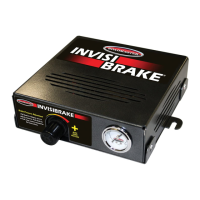
If increased/decreased braking pressure is desired,
follow the steps below. Read this section completely
before changing the brake pressure.
For vehicles with full-time
(‘active’) power braking systems…
IMPORTANT — Some late model vehicles have ‘ac-
tive’ braking systems, which will activate even when
the ignition is off.
If your towed vehicle has full-time (‘active’) power
brakes, the brake pressure setting must be lower than
the factory setting.
This step is included in the installation instructions.
If InvisiBrake was professionally installed, make cer-
tain that the installer has lowered the brake pressure
setting.
CAUTION
A full-time or “active” power brake system ap-
plies full power brakes even when the ignition is
turned off. For this reason, we recommend setting
the initial InvisiBrake pressure at 20 psi. This step
is included in the installation instructions.
NOTE TO CONSUMER: If this InvisiBrake system
is to be professionally installed, make certain that the
installer begins with an initial pressure of no more than
20 psi. An initial pressure higher than 20 psi will cause
the brakes to lock during each brake application and
will flat spot the vehicle’s tires. The following vehicles
have active power brake systems as of this writing*
• Ford C-Max
• Ford Escape hybrid
• Hummer H3
• Lexus GX 470
• Mazda Tribute hybrid
• Mercury Mariner hybrid
• Toyota Tacoma
*The above vehicles are among those that have ac-
tive power brake systems. If you are unsure about your
particular vehicle application, check with the vehicle
manufacturer.
The degree to which the brake pressure setting will
affect the motorhome will vary, depending on the size
and weight of the motorhome in comparison to the size
and weight of the towed vehicle —
• Brake pressure set too high — a sharp pull at the
motorhome may indicate that the brake pressure is set
too high — in this case, you may choose to lower the
setting until the towed vehicle brakes with less force.
See “If necessary, change the brake pressure setting.”
If necessary,
change the brake pressure setting
1. Pull the break away pin (Figure 2). The pressure
gauge on the controller (see page one) will display the
current braking pressure.
CAUTION
Reinsert the brake away pin within five minutes,
or premature compressor failure may result.
2. Pull out on the brake pressure adjustment knob
(see page one) to unlock it. Turn the knob clockwise
to increase the braking pressure or counterclockwise
to decrease the braking pressure.
3. Adjust the pressure by no more than 10 psi.
4. Push the brake pressure adjustment knob in to lock
it in place. Reinsert the break away pin.
5. Test drive the motorhome and towed vehicle for a
short distance, making six to eight stops. If necessary,
adjust again until you are satisfied with the brake pres-
sure setting.
Every time you adjust the brake pressure, you
must test drive the motorhome and towed vehicle.
After repetitive braking, check for excessive heat
near the center of the towed vehicle’s wheels — this
indicates that the brakes are overheating and that
the brake pressure is set too high.
You must lower the braking pressure and retest
until the brakes are not excessively hot.
Failure to follow these instructions may cause
brake failure, resulting in property damage, per-
sonal injury or even death.
4
How to change the brake pressure
It is possible to lower the brake pressure set-
ting to the point that it negates the benefit of the
supplemental braking system and break away. In- suf-
ficient brake pressure will lengthen stopping distance.
• Brake pressure set too low — if the combination of
vehicles takes longer to stop than the motorhome alone,
you may choose to raise the setting. See “If necessary,
change the brake pressure setting” (below).
If brake pressure is set too high, InvisiBrake will ap-
ply excessive force to the towed vehicle’s brake pedal,
which will cause tire and brake system damage, as well
as other consequential, non-warrantydamage.


 To Next Page
 Loading...