Operating Manual
RO-Control NAVY Series
No.8721
No.8722
No.8723
No.8724
Page
7
Programming is carried out in four steps.
Activate programming mode
→
Determine parameters to be changed
→
adjust the selected parameter
→
Exit programming mode
04. Programming the controller
Step 1: Activate programming mode
1. Switch on the transmitter and put the throttle stick into full throttle position, then connect
the drive battery.
2. Turn on the controller and wait 2 seconds, a signal sounds (beep, beep).
3. After another 5 seconds, a tone sequence sounds, indicating that the programming
mode is active.
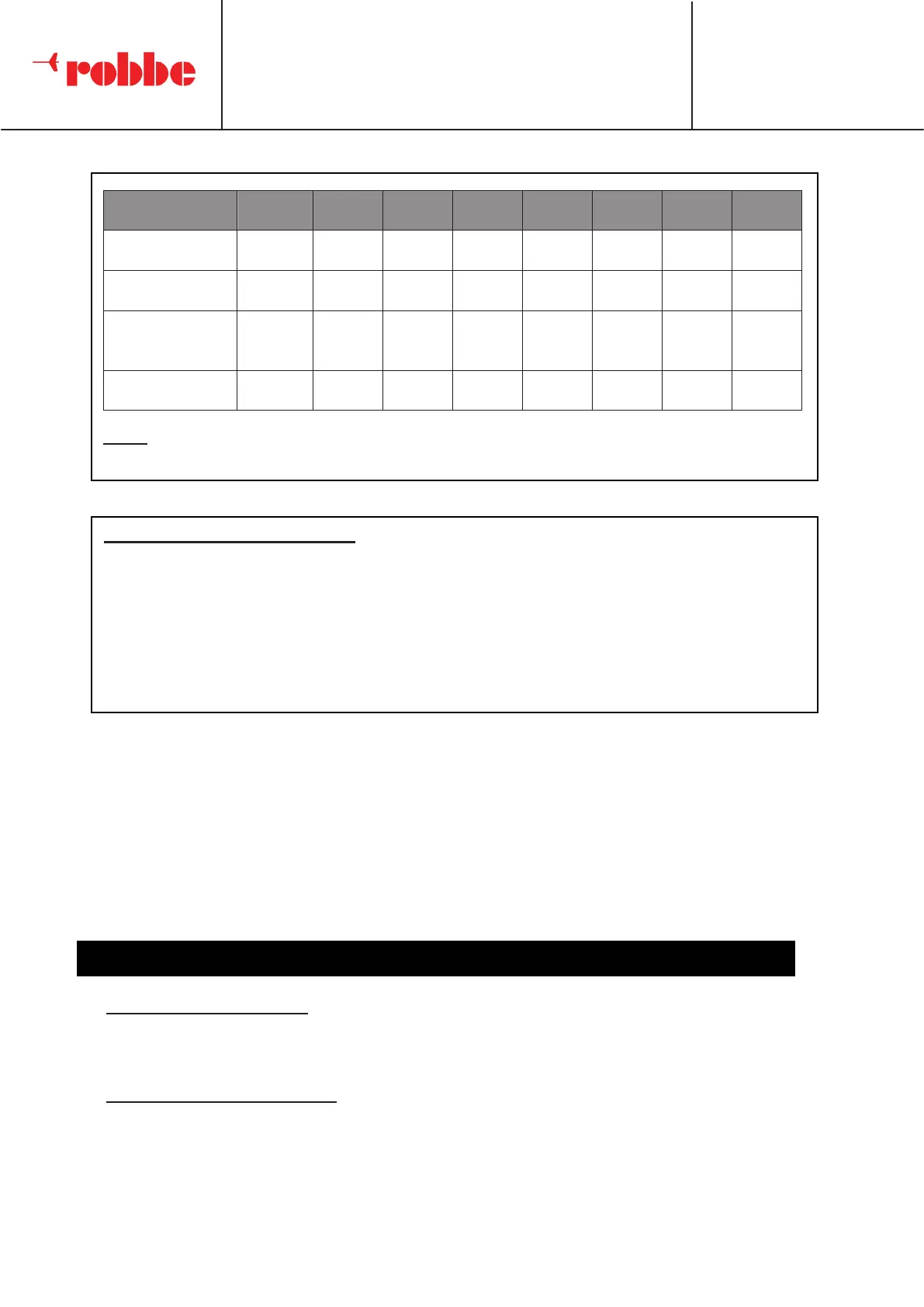
Step 2 Determine parameters to be changed
After activating the programming mode, 4 different tones sound in succession, which can be
assigned to the individual parameters according to the following arrangement. To select a
parameter, the throttle stick must be moved to the lower position within 3 seconds after
sounding. A special tone indicates that the selected parameter is active and can be changed.
1. Beep-
2.
Beep-, Beep-
3. Beep-, Beep-, Beep-
4. Beep-, Beep-, Beep-, Beep-
(Run
ning mode)
Number of LiPo cells
Low-voltage protection
Overtemperature protection
One short note
Two short notes
Three short notes
Four short notes
Step 3 Change the value of the selected parameter
After determining the parameter, different tones sound cyclically in succession, which can be
assigned to the individual values of a parameter according to the following table. To activate
a certain value, bring the throttle stick into full throttle position within 2 seconds. A special
tone sequence will then sound confirming the selection and indicating that the value has been
saved. If you want to stop programming prematurely, move the throttle lever to the lower
"engine off" position within 2 seconds. This allows you to exit the programming mode
immediately and quickly.
If you want to continue, please wait, you will automatically return to step 2 where you can set
another programmable parameter that you can change according to the same procedure.
Operating Manual
RO-Control NAVY Serie
No.8721
No.8722
No.8723
No.8724
Page
8
It is possible to comfortably configure these controllers with an optional programming card. The
programming card has three LEDs to display the programming steps and the parameters. It is very
easy to use. With the 30 A controller, the connection cable to the receiver (gas channel) must be
connected to the programming card. The other controllers have a separate programming port for
connecting the programming card.
1. Undervoltage protection: If the voltage level of the battery is below the set limit for a period of
1 second, the motor is switched off. The red LED then flashes rapidly. After the throttle stick has
been brought into the "engine off" position, the engine starts again, with half the power output.
2. Overtemperature protection: If the temperature of the controller exceeds the preset value, the
motor is switched off for safety reasons. The green LED then flashes quickly. After the throttle
stick has been brought into the "engine off" position, the engine starts again, with half the power
output. As soon as the controller has cooled down to below 80°C, the full power can be called
up again.
B B B B B B B B B
B
B---- B---- B B---- B
B
B---- B
B B
Running
Mode
forward
backward
LiPo Cells
autom.
2S 3S 4S 5S 6S
Undervoltage
cut-off
deact.
2,8 V
per
Cell
3,0 V
per
Cell
3,2 V
per
Cell
3,4 V
per
Cell
Timing
0
O
3,75
O
7,5
O
11,25
O
15
O
18,75
O
22,5
O
26,75
O
Note: A long note B----- corresponds to five short notes B, B, B, B, B, B
Example: B----B stands for the sixth value of the parameter (5 + 1)
Step 4 Exit programming mode
Two methods are available for terminating the programming mode.
1. At step 3, after changing the value and the sound of the special sequence of tones, the
throttle can be moved to the "engine off" position. The programming mode is then exited
within 2 seconds.
2. The drive battery can be disconnected in order to leave the programming mode.
05. Integrated protection functions
Programming the ESC with a Programming Card


 To Next Page
 Loading...