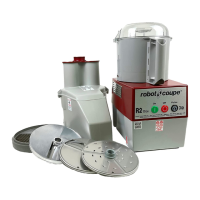
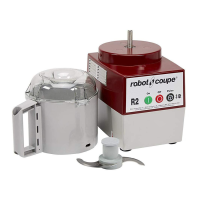
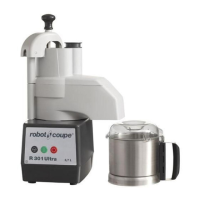
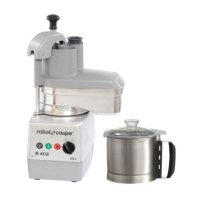
R2N and R2N Ultra
Operation Manual
12
IV. CLEANING/PREVENTIVE
MAINTENANCE
(1) CLEANING: Proper cleaning of the machine is
one of the most important preventive maintenance
measures the user can employ. The high acid con-
tent of food can cause harm to the electrical parts
contained within the housing. Although a seal iso-
lates these elements from the outside, food juices
will tend to seep. If food juices are allowed to collect
on the machine over periods of use, erosion of the
seal can occur. It is recommended that the machine
be cleaned after each operational use.
Correct cleaning procedures are required to assure
that damage is not inflicted in the cleaning process.
The motor base assembly contains the motor and
electrical components.
DO NOT IMMERSE THE MOTOR BASE
ASSEMBLY IN WATER!
CLEANING INSTRUCTIONS
ATTACHMENTS: Remove and disassemble all at-
tachments before cleaning. The bowl and continu-
ous feed attachments should be cleaned per the fol-
lowing instructions or as required by local health de-
partment regulations.
The bowl, blade, lid, continuous feed attachment,
continuous feed lead, pushers, and plates are dish-
washer safe. All of the attachments listed above can
be washed in a dish machine or three tank system
pot sink. Pre-rinse the attachments before washing
to remove any bulk food on the parts. A stiff bristle
brush or power sprayer faucet attachment is effec-
tive in knocking the food out of the crevices as a pre-
rinse procedure. The washer should have an indus-
try standard wash, rinse, and sanitization cycle. Al-
low the parts to air dry after sanitizing and before re-
assembly.
NOTE: The high temperatures of dish
machines will tend to shorten the life of
the plastic and rubber parts. Hand wash-
ing using a three pot sink will provide for
the longest life of these parts.
Inspect the area around the handle and bowl-switch-
rod to ensure they are clean. Use a brush on these
areas if necessary.
Cleaning the Blade Assembly
There is a removable cap attached to the top of the
S-blade assembly. This cap should be removed when
cleaning the blade assembly.
CAUTION: THE BLADES ARE SHARP.
WEAR CUT-RESISTANT GLOVES WHEN
HANDLING THE BLADE.
The blade cap may be removed by carefully pulling
the cap up away from the blade. It may be helpful to
pull slightly to the side. The cap is held in place by
small plastic clips molded into the cap which snap
into the body of the blade assembly. If the cap is
difficult to remove, you can use a small diameter rod
or screwdriver inserted through the bottom side of
the blade assembly to knock out the cap using a quick
sharp impact. Again, use caution when handling the
blade.
Cleaning: Clean the blade according to local Health
Department regulations. It may be necessary to pre
wash the blade with a power head sprayer followed
by the use of a small round brush to remove any re-
maining residue. Typical cleaning instructions may
include the following:
Dishwasher: Clean the blade assembly in a com-
mercial dish machine by removing the blade cap and
placing it flat on a wash tray or in a small parts holder,
it could otherwise be washed out of the rack. The
dish machine should have a standard wash, rinse,
and sanitizing cycle.
Pot Sink: The blade may also be cleaned using the 3
sink method of wash, rinse, and sanitize. Remove
the blade cap, and wash each item separately. The
sanitization sink should include a minimum of 200
PPM chlorine solution or other approved sanitizing
agent. The use of a small brush will assist in remov-
ing food particles from around the blade and inside
the hub. Allow the parts to air dry laying flat on a
drying tray.
Autoclave: The blade assembly will withstand clean-
ing in an autoclave system with temperatures less
than 210 degrees C. However, it will reduce the life
of the blade as compared to other sanitizing meth-
ods.



 To Next Page
 Loading...