
 Need help?
Do you have a question about the Roland BOLT-60 and is the answer not in the manual?
Details the amplifier's warm overdrive effects, two-channel operation, effects loop, and built-in reverb.
Illustrates and lists connection points for tape recorders, effects devices, foot switches, headphones, and guitars.
Explains channel indicators, volume controls (Volume 1, 2, Master), EQ controls (Bass, Middle, Treble), and Reverb control.
Details the Effect Loop Switch, Power/Standby switches, Input Jacks, and various Output Jacks including Send, Return, and Headphone.
Describes the PRE OUT, MAIN IN, LINE OUT, and SPEAKER jacks on the rear panel for external connections.
Provides step-by-step instructions for powering on the amplifier and setting up for Normal and Overdrive sounds.
Offers specific examples for achieving different tones, including clean, distorted, sustained, and bright sounds.
Explains the PRE EQ, POST EQ, and POST VOL settings for the effect loop and how they influence sound.
Provides crucial safety advice regarding heat, electrical interference, speaker strain, cleaning, and fuse replacement.
Lists common conditions, their causes, and suggested measures for resolving problems with power, sound, and effects.
Details power output, channels, inputs, controls, switches, output jacks, power consumption, dimensions, and weight.
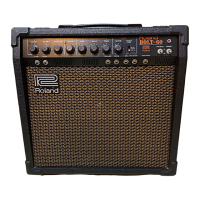
The Roland BOLT-60 is a guitar amplifier designed to produce a warm overdrive effect, leveraging a combination of a low-noise FET and RCA vacuum tubes. This hybrid design aims to deliver the characteristic warmth and richness associated with tube amplifiers while maintaining a low noise floor. The amplifier offers a two-channel operation, allowing users to switch between a "NORMAL" channel for clean tones and an "OVERDRIVE" channel for distorted sounds. This channel switching can be conveniently controlled via a footswitch, making it suitable for live performance where quick transitions between sounds are essential.
One of the key features of the BOLT-60 is its versatile external effects loop. This loop allows musicians to integrate their preferred external effects devices into the amplifier's signal path, offering flexibility in sound shaping. The amplifier also includes a built-in reverberation unit, providing an additional layer of spatial effect to the sound without the need for external equipment. For ease of use during performance, most of the amplifier's jacks are located on the front panel, ensuring quick and accessible connections.
The front panel controls are logically laid out, starting with the channel indicators that show whether the NORMAL or OVERDRIVE channel is active. For the OVERDRIVE channel, there are separate VOLUME 1, VOLUME 2, and MASTER VOLUME controls, which allow for nuanced shaping of the overdrive sound. VOLUME 1 and VOLUME 2 contribute to the amount of gain and saturation, while the MASTER VOLUME controls the overall output level of the overdrive channel. The NORMAL channel has its own VOLUME control to adjust its output level independently.
Tone shaping is handled by a three-band equalizer, featuring BASS, MIDDLE, and TREBLE controls. These controls allow users to adjust the frequency response of their sound. When all three controls are set to "0," the frequency response is flat, providing a neutral starting point. The REVERB control on the front panel adjusts the amount of reverberation added to the sound, giving users control over the spaciousness of their tone.
The amplifier also includes an EFFECT LOOP switch, which determines where the external effects loop is positioned within the amplifier's circuit. This allows users to experiment with different placements of their effects for varied sonic results. The POWER switch and an accompanying pilot lamp are present, indicating the amplifier's power status. It's important to note that the vacuum tubes require approximately 20 seconds for warmup before sound can be produced. The STANDBY switch, when turned OFF while the power switch is ON, feeds power to the vacuum tube heater elements, placing the amplifier in a standby condition after 20 seconds. Sound will be produced immediately once the STANDBY switch is turned ON, which is useful for preserving tube life during short breaks.
Input options include INPUT Jacks for both high and low gain guitars. The LO input is recommended for guitars that produce particularly high-level output signals, helping to prevent signal clipping. Additional jacks on the front panel include an OVERDRIVE Foot Switch Jack for ON/OFF control of the overdrive effect, and a REVERB Foot Switch Jack for ON/OFF control of the reverberation effect. A SEND Jack is provided for connecting to an external effects device's input, and a RETURN Jack for connecting to its output. Finally, a HEADPHONE Jack is included, which disables the speaker when in use, allowing for silent practice.
On the rear panel, the amplifier offers further connectivity. A PRE OUT Jack provides an internal preamp stage output, useful for connecting to a separate external power amplifier. The MAIN IN Jack serves as an input to the internal power amplifier, allowing an effects device or a foot volume pedal to be connected between the PRE OUT and MAIN IN jacks for adding effects or controlling sound volume. A LINE OUT Jack provides an output for connecting to external line-level devices such as tape recorders or mixers. Lastly, a SPEAKER Jack is available for connecting to a larger external speaker cabinet.
For operation, users should first ensure the POWER and STANDBY switches are off, then plug in the AC cord and turn on the power. After approximately 20 seconds, the STANDBY switch can be turned on. To achieve a normal sound, VOLUME 1 should be set to NORMAL, and the volume adjusted with the NORMAL CHANNEL knob. For a distortion-free normal sound, VOLUME 1 should be turned all the way to the left, and the volume adjusted with the NORMAL CHANNEL knob.
To achieve an overdrive sound, VOLUME 1 should be turned to the right, and VOLUME 2 and MASTER VOLUME adjusted to an appropriate level. For a heavy sustain effect, both VOLUME 1 and 2 should be set to "10," with the volume level adjusted using the MASTER VOLUME. A powerful overdrive sound can be achieved by setting VOLUME 1 and MASTER VOLUME to "10," and adjusting the volume level with VOLUME 2. For a bright sound with soft distortions, VOLUME 2 can be set to about "7," MASTER VOLUME to about "5," and the volume level adjusted with VOLUME 1, making adjustments with VOLUME 1 and MASTER VOLUME for a balanced effect.
Maintenance and care are important for the BOLT-60. Due to the heat radiated by the vacuum tubes, a chassis has been installed on the outside. Users should avoid placing their hand behind the amplifier for approximately 15 minutes after the power has been turned on or off. It is advisable to keep the amplifier away from interferences that induce high levels of noise, such as fluorescent lamps and neon lights. Changing the position of the guitar may help reduce noise. When unplugging cords, always decrease the volume to "0" to prevent strain on the speaker and potential damage. When connecting the amplifier to an instrument, always plug in the instrument first, then the amplifier. When unplugging, reverse the order. The amplifier should not be exposed to great shock or moved while operating. It should also be kept away from dusty or high humidity environments. Cleaning the amplifier should be done by wiping it with a neutral detergent, avoiding solvents like paint thinner. For fuse replacement, only the ones provided by the company should be used.
 General
| Type | Guitar Amplifier |
|---|---|
| Power Output | 60W |
| Reverb | Yes |
| Effects | Overdrive, Reverb |
| Inputs | 1 x 1/4" (instrument) |
| Outputs | 1 x 1/4" (line out) |
| Footswitch | Yes (for channel switching) |
| Speaker | 12" |



 To Next Page