This document is an owner's manual and assembly instructions for a Rollplay 6V MINI Cooper S ride-on vehicle. It provides comprehensive guidance for assembling, operating, and maintaining the vehicle, emphasizing safety and proper usage.
Function Description
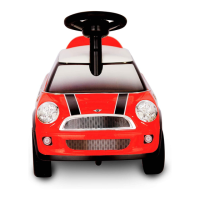
The Rollplay 6V MINI Cooper S is a battery-powered ride-on toy designed for children aged 3 years and up. It allows a single rider to operate the vehicle using a foot pedal for acceleration and a steering wheel for direction. The vehicle is equipped with a 6-volt battery and a 6-volt motor, enabling it to move forward and in reverse. The steering wheel includes buttons for horn and engine sounds, enhancing the play experience. The vehicle is designed for use in safe, secure environments with adult supervision, not on roadways or near hazardous areas.
Usage Features
The manual outlines several key usage features and instructions for operating the MINI Cooper S:
- First Use and Battery Charging: Before initial use, the battery must be charged for a full 24 hours (and no more than 30 hours). Subsequent charges should be 8-12 hours, but no more than 30 hours, after each use. The battery should also be charged at least once a month, even if the vehicle is not in use, to prevent it from being left in a discharged condition. Only an adult should handle the battery and charger. The charging process involves connecting the red battery connector to the red battery charger connector and plugging it into a 120V AC outlet. It is not always necessary to remove the battery for charging, but instructions are provided for removal if the outlet is not accessible.
- Power On/Off: The vehicle is turned on by setting the power switch to "I" and turned off by setting it to "O."
- Forward and Reverse: A shifter allows the rider to select between forward and reverse motion. Pushing the shifter forward engages forward movement, while pulling it backward engages reverse.
- Acceleration and Braking: The vehicle is propelled by pressing down on a foot pedal. Releasing the foot pedal brings the vehicle to a stop.
- Steering Wheel Functions: The steering wheel is an assembly that needs to be attached to the steering rod. It requires two AA batteries to power its sound features. Pressing the left and right buttons on the steering wheel activates horn and engine sounds. If the sounds become distorted or slow, the batteries should be replaced.
- Assembly: The manual provides detailed, step-by-step instructions for assembling various components of the vehicle. This includes:
- Front Wheels: Involves sliding a large washer, the front wheel, a wheel cover, a small washer, and a snap pin onto the front axle, then covering with a hub cap. This process is repeated for both front wheels.
- Rear Wheels (Left and Right): Similar to the front wheels, but with specific attention to the orientation of the gear teeth on the rear wheels, which must face inward to engage with the gearbox. A helpful tip is included for realigning the rear axle if both wheels are difficult to fit.
- Steering Wheel: Requires removing a screw and nut, inserting the steering wheel onto the steering rod, aligning screw holes, and fastening the nut.
- Speedometer/Windshield: The speedometer aligns with a slot on the dashboard and clicks into place. The windshield aligns with two side slots between the dashboard and body, then is pushed lightly at each end and in the middle until it clicks.
- Spoiler/Mirrors: The rear spoiler clips into slots on the back of the car body. The wing mirrors clip into slots on the chassis, with a note to differentiate between left and right mirrors.
- Seat: The seat is positioned over the battery compartment, slid onto guides, and locked in place with a thumb screw. It's important to ensure the red battery connector is attached to the red engine connector before attaching the seat.
- Safety Guidelines: The manual emphasizes strict adherence to safety rules. Riders must be at least 3 years old and weigh no more than 35 kg (77 lbs). Adult assembly is required, and small parts should be kept away from children. A fitted helmet complying with CPSC Standard CFR 1203 must always be worn. Only one rider is allowed, and the vehicle should not be overloaded or pulled by other devices. Body parts, hair, and clothing must be kept away from moving parts. Shoes must always be worn. The vehicle should never be used on roadways, near cars, on steep inclines, steps, swimming pools, or other bodies of water. Operation should be on relatively level ground, avoiding dangerous weather, loose dirt, mud, sand, fine gravel, or flammable vapors. Direct adult supervision is mandatory, and children should never be left unattended in the vehicle. The manual also includes warnings about battery safety, including the risks associated with lead-acid chemicals and tampering with the electric circuit system.
Maintenance Features
The manual provides instructions for maintaining the vehicle to ensure its longevity and safe operation:
- Regular Inspection: All vehicle parts, including the charger, cord, plug, and related components, should be regularly inspected for good working condition and any damage.
- Damaged Parts: Any damaged parts must be removed immediately, and Customer Service should be contacted for replacements. The vehicle should not be operated if damaged.
- Cleaning: The vehicle should be cleaned carefully with a damp cloth and mild soap. Water should not get into or near electrical parts, and the vehicle should not be washed with a hose.
- Storage: The vehicle should be stored indoors or covered with a tarp, away from stoves, heaters, or other heat sources. When storing for extended periods, the battery connector should be disconnected from the engine connector.
- Battery Care: Beyond regular charging, the battery should never be left in a discharged condition. If the charger heats slightly, it is normal, but if it rises above 71°C / 160°F, it should be disconnected, and Customer Service should be called. The charger must be kept away from water or excessive moisture. Only the specified charger should be used, and non-rechargeable batteries should not be recharged. Using any other battery will void the warranty. Damaged batteries should be removed immediately and disposed of responsibly. Supply terminals should not be short-circuited.
- Thermal Fuse: The vehicle is equipped with a thermal fuse to protect the electric circuit. If the vehicle cuts out, turning it off and on will reset the fuse.
- Troubleshooting Guide: A comprehensive troubleshooting guide is included to help diagnose and resolve common issues such as the vehicle not moving, running for a short time, running slowly, intermittent operation, lights not working, motor working but wheels not turning, battery not charging, and sound functions not working. This guide helps users identify potential causes (e.g., low voltage, loose connections, damaged parts, old battery) and provides corresponding solutions (e.g., recharging, tightening connections, contacting Customer Service, replacing batteries).
The manual also includes FCC information regarding compliance and interference, as well as details on service, repairs, and warranty information, emphasizing that the product should not be returned to the store but rather to contact Rollplay Customer Service for assistance. Proof of purchase is required for warranty claims and replacement parts.



 To Next Page

 General