Need help?
Do you have a question about the Rolls MS112 and is the answer not in the manual?
Highlights XLR jacks, selectable momentary/latching modes, status indicator, and mounting provisions.
Explains the device's ability to mute or switch microphone/XLR signals between outputs.
Details input/output connectors, physical dimensions, and chassis construction.
Describes connecting XLR cables and signal routing via the A/B outputs based on switch state.
Details the 9-15 VDC power input and the function of the status LED indicator.
Explains the switches for momentary/latching operation and ground lift for the A output.
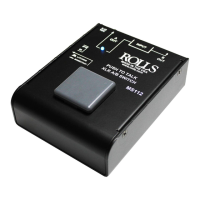
The Rolls MS112 is a "Push to Talk" XLR A-B switch designed to control the routing of an XLR signal, typically from a microphone, between two different XLR outputs (A and B). This device is handcrafted in Salt Lake City, UT, and is built with a thick powder-coated steel chassis, ensuring durability.
The primary function of the MS112 is to momentarily mute or "talk" a microphone or XLR signal by switching it between two XLR outputs. When the switch is pressed and held, the signal is sent to output A. Releasing the switch routes the signal back to output B. This functionality is particularly useful in situations where a user needs to temporarily mute their microphone to prevent distracting noises like sneezes or coughs from being transmitted. It also serves as a convenient tool for controlling when a microphone is active for announcements or paging, or for switching between two different destinations for an audio signal. The device can be configured for either "momentary" or "latching" operation via an internal switch, which is accessible from the side of the unit. In momentary mode, when powered on and the switch is not pressed, the signal is sent to output B.
To operate the MS112, connect your balanced XLR microphone or signal source to the female input jack. Then, connect the male XLR output jacks (A and B) to your desired destinations (e.g., mixer, amplifier). Power the unit using the provided Rolls PS27s power adapter. Configure the internal switch for either momentary or latching operation based on your needs. When in momentary mode, pressing and holding the switch sends the signal to output A; releasing it sends the signal to output B. The status LED will illuminate when output A is active. The ground-lift switch can be engaged if ground loop noise is present on output A.

 To Next Page
 General