48 Undo the two air suction pipe retaining
bolts
49 Undo the two bolts securing the fuel pipe
retaining clips adjacent to the air suction
valve.
50 Relieve the fuel system pressure as
described in Part D, Section 5.
51 Undo the two banjo union bolts securing
the fuel pipes to the front fuel rail. Release the
pipes and collect the copper washers. Cover
the open unions after disconnection then
move the pipes away.
52 Undo the vacuum pipe cluster support
bracket bolt and move the pipes slightly for
access to the air suction valve.
53 Undo the three bolts and withdraw the air
suction valve from the manifold. Recover the
gasket.
54 Refitting is a reversal of removal. Clean
the mating faces prior to refitting and use a
new gasket.
Air suction valve pipe (V6 engines) -
renewal
55 Remove the throttle body and the
electronic idle control valve as described in
Part D, Section 12.
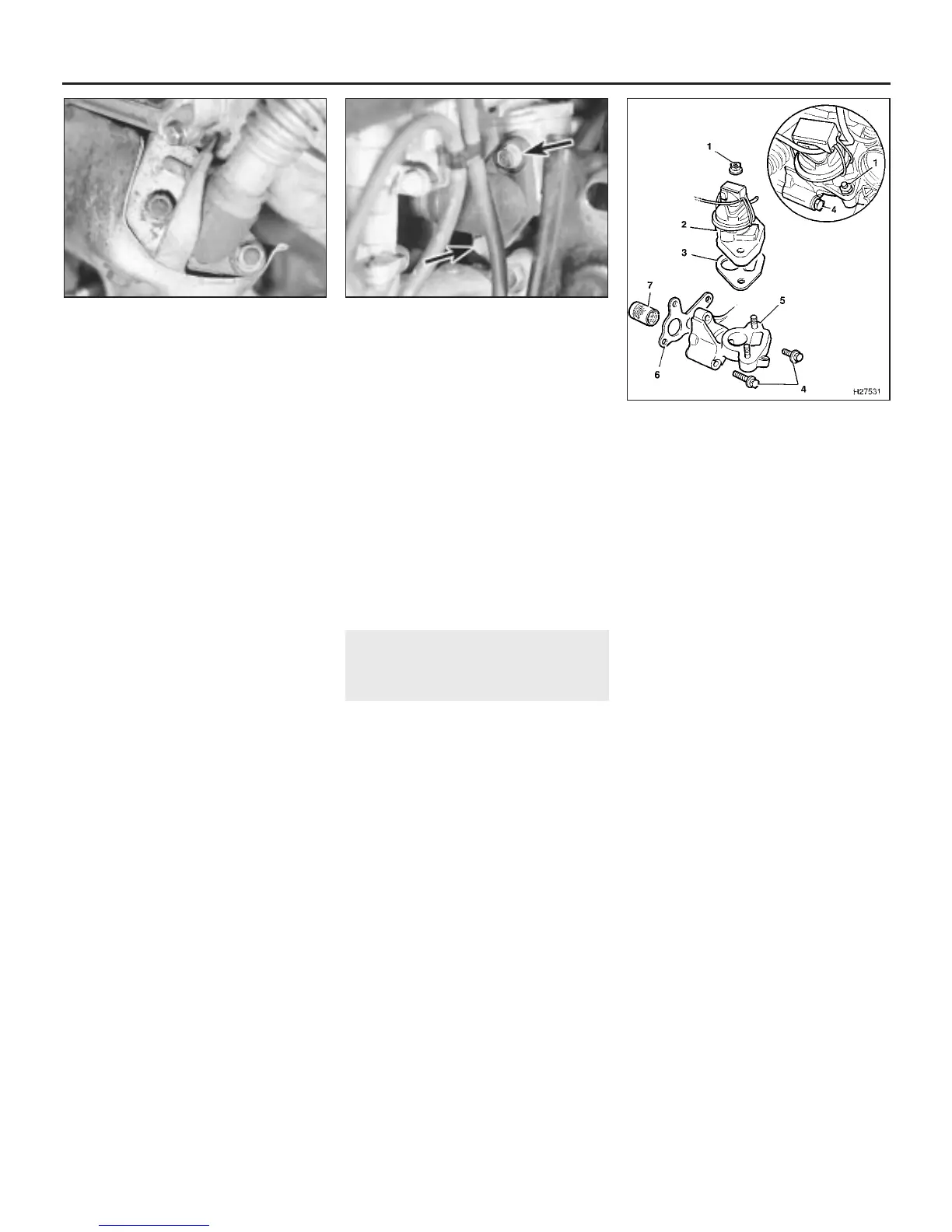
56 Undo the two nuts from the suction valve
pipe front flange and release the heat shield
(see illustration).
57 Undo the two bolts at the suction valve
pipe rear flange (see illustration).
58 Disconnect the lead from the thermal
transmitter and release the lead from its clip.
59 Release the air suction pipe flanges and
remove the pipe from the engine. Recover the
two flange gaskets.
60 Refitting is a reversal of removal. Clean
the valve flange and manifold mating faces
prior to refitting and use a new gasket.
EGR valve and filter (V6 engines) -
renewal
61 Remove the air intake trunking and air
cleaner assembly as described in Part D,
Section 2.
62 Disconnect the EGR valve multiplug and
release the multiplug from its bracket.
63 Disconnect the vacuum hose at the valve.
64 Undo the two nuts and remove the EGR
valve from the filter housing (see illustration).
Recover the flange gasket.
65 Undo the two filter housing retaining bolts
and remove the housing from the cylinder
head. Recover the flange gasket and remove
the filter from the housing.
66 Clean the valve core and body using
compressed air and a small screwdriver. Take
care not to actuate the valve while holding it.
67 Refitting is a reversal of removal. Fit a new
filter during reassembly and use new gaskets
at the mating faces.
3 Catalytic converter - general
information and precautions
1 The catalytic converter is a reliable and
simple device, which needs no maintenance
in itself, but there are some facts of which an
owner should be aware if the converter is to
function properly for its full service life.
(a) DO NOT use leaded petrol in a vehicle
equipped with a catalytic converter - the
lead will coat the precious metals,
reducing their converting efficiency, and
will eventually destroy the converter.
(b) Always keep the ignition and fuel systems
well-maintained in accordance with the
manufacturer’s schedule (see Chapter 1).
(c) If the engine develops a misfire, do not
drive the vehicle at all (or at least as little
as possible) until the fault is cured.
(d) DO NOT push- or tow-start the vehicle -
this will soak the catalytic converter in
unburned fuel, causing it to overheat
when the engine does start.
(e) DO NOT switch off the ignition at high
engine speeds, ie do not “blip” the
throttle immediately before switching off.
(f) DO NOT use fuel or engine oil additives -
these may contain substances harmful to
the catalytic converter.
(g) DO NOT continue to use the vehicle if the
engine burns oil to the extent of leaving a
visible trail of blue smoke.
(h) Remember that the catalytic converter
operates at very high temperatures. DO
NOT, therefore, park the vehicle in dry
undergrowth, over long grass or piles of
dead leaves, after a long run.
(i) Remember that the catalytic converter is
FRAGILE. Do not strike it with tools
during servicing work.
(j) In some cases, a sulphurous smell (like
that of rotten eggs) may be noticed from
the exhaust. This is common to many
catalytic converter-equipped vehicles.
Once the vehicle has covered a few
thousand miles, the problem should
disappear - in the meantime, try changing
the brand of petrol used.
(k) The catalytic converter used on a well-
maintained and well-driven vehicle should
last for between 50 000 and
100 000 miles. If the converter is no
longer effective, it must be renewed.
2 The catalytic converter is located between
the exhaust system front and intermediate
sections and is removed and refitted in the
same way as the other sections. Always
renew the converter flange seals when the
unit is disturbed in any way, and ensure that
all retaining nuts are securely tightened. Refer
to the relevant earlier Parts of this Chapter, for
details of exhaust system removal and
refitting.
4E•4 Fuel and exhaust systems - Emissions control systems
1 Valve retaining
nuts
2 EGR valve
3 Gasket
4 Filter housing bolts
5 Filter housing
6 Gasket
7 Filter
2.64 EGR valve and filter components
2.57 Undo the two bolts (arrowed) at the
suction valve pipe rear flange
2.56 Undo the two nuts from the suction
valve pipe front flange and release the heat
shield
1380 Rover 800 Series Remake


 To Next Page
 Loading...